Solar-powered emergency radios can provide weather updates and backup power when outlets are unavailable, but solar charging is usually a supplement rather than a fast way to refill a battery. My best overall pick is the Midland ER310PRO for buyers prioritizing weather-radio features, while the Kaito KA500 stands out for its range of power options and the FosPower A1 for a simpler emergency-focused setup. The main tradeoffs are battery capacity versus portability, alert and radio features versus ease of use, and the convenience of rechargeable batteries versus replaceable AAs. Solar panels, hand cranks, and phone-charging ports also vary in how useful they are during an extended outage. Read on for the full comparison and guidance on matching a radio to your emergency plan.

Get backup power and energy gear delivered free with Prime
- Fast, free delivery on millions of items
- Prime Video, Amazon Music and more included
- Member-only deals all year
Key Takeaways
- The Midland ER310PRO is the clearest overall fit for shoppers who put weather-radio capability ahead of extra playback features.
- The Kaito KA500 has a power-source advantage with solar, hand-crank, and AC-adapter options, though its broader feature set may take longer to learn.
- Several radios advertise 12,000mAh batteries, but capacity alone does not show how long the radio runs or how much phone charging is practical.
- The PRUNUS J-135’s AA option sets it apart for buyers who want to carry replaceable batteries instead of relying only on a built-in rechargeable pack.
- Bluetooth and speaker features are not the same as emergency readiness; weather alerts, reliable power planning, and simple controls matter more when conditions are stressful.
| 12000mAh NOAA Emergency Weather Radio with Hand Crank and Solar Charging | 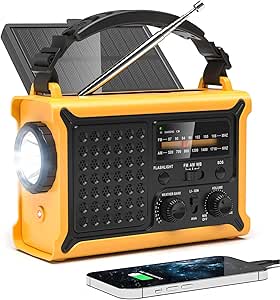 | Best for Flexible Backup Power | Battery capacity: 12000mAh | Radio bands: AM, FM, and 7 NOAA weather channels | Power options: USB-C, solar panel, hand crank, or 3 AAA batteries | VIEW LATEST PRICE | See Our Full Breakdown |
| PRUNUS J-150 Portable AM/FM/SW Radio with Bluetooth, Solar Charging, and USB/TF Playback |  | Best for Shortwave Listening | Radio bands: AM, FM, and shortwave | Frequency ranges: AM: 530–1710 kHz; FM: 88–108 MHz; shortwave: 5.9–18.0 MHz | Power sources: USB, built-in rechargeable battery, solar, or 2 D batteries | VIEW LATEST PRICE | See Our Full Breakdown |
| PRUNUS J-135 AM/FM Portable Bluetooth Radio with Solar and AA Battery Power |  | Best Compact Everyday Radio | Battery capacity: 1800mAh | Power sources: USB-C, solar panel, or 4 AA batteries | Radio bands: FM, AM, and shortwave | VIEW LATEST PRICE | See Our Full Breakdown |
| OnLyee Emergency Weather Radio with 12000mAh Battery, Solar Panel, and Hand Crank |  | Best for Rough Weather | Battery capacity: 12000mAh | Radio bands: NOAA weather, AM, and FM | Power sources: Solar, hand crank, USB-C, built-in battery, or AAA backup | VIEW LATEST PRICE | See Our Full Breakdown |
| Portable AM/FM/SW Radio with Bluetooth, Solar Charging, and 8W Speaker |  | Best for Louder Shared Listening | Radio bands: AM, FM, and shortwave | Frequency ranges: FM: 88–108 MHz; AM: 530–1710 kHz; SW: 8.0–16.0 MHz | Speaker output: 8W | VIEW LATEST PRICE | See Our Full Breakdown |
| Supersonic SC-1180BT SolarWave Portable Emergency Radio with Bluetooth, AM/FM/SW, Solar and USB-C Charging, LED Flashlight, and MicroSD/USB Playback |  | Best for Shortwave and Personal Audio | Radio bands: AM, FM, SW1–SW4 | Charging: Solar and USB-C rechargeable | Connectivity: Bluetooth | VIEW LATEST PRICE | See Our Full Breakdown |
| Supersonic SC-1078ERN Guardian Multi-Powered Emergency Radio |  | Best for Backup-Power Flexibility | Radio bands: AM (520–1710 kHz), FM (87.5–108 MHz), NOAA (162.400–162.550 MHz) | Battery capacity: 4000mAh | Power sources: Rechargeable battery, solar, hand crank, USB Type-C, or 3 AAA batteries (not included) | VIEW LATEST PRICE | See Our Full Breakdown |
| Midland ER310PRO Portable Emergency Weather Radio with Bluetooth |  | Best for Phone Backup Power | Radio bands: AM, FM, and weather | Power bank capacity: 10,000mAh | Power sources: Solar panel, hand crank, and lithium-ion battery | VIEW LATEST PRICE | See Our Full Breakdown |
| Kaito KA500 Voyager Solar/Crank Emergency Weather Radio with AC Adapter and Storage Case |  | Best for Broad Radio-Band Coverage | Radio bands: AM, FM, shortwave, and NOAA weather alerts | Power source: Solar powered | Connectivity: USB | VIEW LATEST PRICE | See Our Full Breakdown |
| Emergency Radio with Hand Crank & Solar, NOAA Weather Band, AM/FM, 12000mAh |  | Best for Rainy-Weather Preparedness | Battery capacity: 12,000mAh | Radio bands: Seven NOAA weather channels and AM/FM | Power sources: Battery, hand crank, solar, and USB-C | VIEW LATEST PRICE | See Our Full Breakdown |
| FosPower NOAA Emergency Weather Radio A1 with 7400mWh Solar Hand Crank (Orange) |  | Best Compact Pick | Power bank capacity: 7400mWh (2000mAh) at 3.7V | Power sources: Solar, hand crank, four AAA batteries, USB-C | Radio bands: AM, FM, weather band | VIEW LATEST PRICE | See Our Full Breakdown |
| Emerson ER-7054-RD Emergency Solar Radio Lantern |  | Best for Room Lighting | Model: ER-7054-RD | Battery capacity: 5000mAh power bank | Power sources: Solar, hand crank, USB-C, AAA batteries (battery count is inconsistently specified) | VIEW LATEST PRICE | See Our Full Breakdown |
| Raynic Solar Emergency Weather Radio with NOAA Alert, 12000mAh Battery, Hand Crank, AM/FM/SW, Flashlight, and Phone Charger |  | Best for Extended Backup Power | Battery capacity: 12000mAh / 44400mWh | Radio bands: AM, FM, shortwave, NOAA | Charging options: Solar, hand crank, AC adapter, USB-C, DC 5V, AAA batteries | VIEW LATEST PRICE | See Our Full Breakdown |
| Emergency Weather Radio with 12,000mAh Battery and Solar Panel | 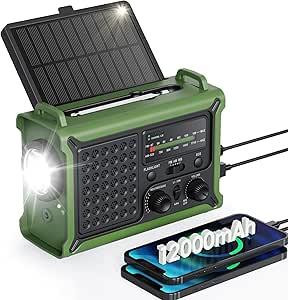 | Best for Wet-Weather Use | Battery capacity: 12000mAh | Solar panel: 8500mm² monocrystalline | Charging methods: Built-in battery, USB-C, solar, hand crank, three AAA batteries | VIEW LATEST PRICE | See Our Full Breakdown |
| solar powered emergency radio | Radio bands | Dimensions | Battery capacity | Power sources |
|---|---|---|---|---|
| 12000mAh NOAA Emergency Weathe | AM, FM, and 7 NOAA weather channels | 4.7 × 2.9 × 6.8 in | 12000mAh | — |
| PRUNUS J-150 Portable AM/FM/SW | AM, FM, and shortwave | — | — | USB, built-in rechargeable battery, solar, or 2 D batteries |
| PRUNUS J-135 AM/FM Portable Bl | FM, AM, and shortwave | 6.3 × 3.9 × 3.4 in | 1800mAh | USB-C, solar panel, or 4 AA batteries |
| OnLyee Emergency Weather Radio | NOAA weather, AM, and FM | — | 12000mAh | Solar, hand crank, USB-C, built-in battery, or AAA backup |
| Portable AM/FM/SW Radio with B | AM, FM, and shortwave | — | — | — |
| Supersonic SC-1180BT SolarWave | AM, FM, SW1–SW4 | 2.17 × 3.94 × 5.9 inches | — | — |
| Supersonic SC-1078ERN Guardian | AM (520–1710 kHz), FM (87.5–108 MHz), NOAA (162.400–162.550 MHz) | 6.02 × 1.85 × 3.03 inches | 4000mAh | Rechargeable battery, solar, hand crank, USB Type-C, or 3 AAA batteries (not included) |
| Midland ER310PRO Portable Emer | AM, FM, and weather | 8.1 × 2.8 × 3.4 inches | — | Solar panel, hand crank, and lithium-ion battery |
| Kaito KA500 Voyager Solar/Cran | AM, FM, shortwave, and NOAA weather alerts | 8.3 × 2.3 × 5.3 inches | — | — |
| Emergency Radio with Hand Cran | Seven NOAA weather channels and AM/FM | — | 12,000mAh | Battery, hand crank, solar, and USB-C |
| FosPower NOAA Emergency Weathe | AM, FM, weather band | 6.2 × 2.1 × 2.9 inches | — | Solar, hand crank, four AAA batteries, USB-C |
| Emerson ER-7054-RD Emergency S | AM, FM, NOAA weather band | 3.6 × 7.5 × 3.6 inches | 5000mAh power bank | Solar, hand crank, USB-C, AAA batteries (battery count is inconsistently specified) |
| Raynic Solar Emergency Weather | AM, FM, shortwave, NOAA | 6.8 × 3.7 × 2.9 inches | 12000mAh / 44400mWh | — |
| Emergency Weather Radio with 1 | AM, FM, seven NOAA bands | — | 12000mAh | — |
More Details on Our Top Picks
12000mAh NOAA Emergency Weather Radio with Hand Crank and Solar Charging
This is the strongest fit for buyers who want an emergency-first radio with several ways to keep it running: USB-C, solar, hand crank, and three AAA batteries. Its 12000mAh battery also gives it more capacity for lighting and emergency phone charging than the PRUNUS J-135’s 1800mAh rechargeable battery. The package adds a 300-lumen flashlight, 250-lumen reading light, and SOS siren, making it more prepared for an outage than either PRUNUS music-focused radio. The tradeoff is that NOAA alerts require the radio to be on and tuned to the weather band, so it is not a set-and-forget alert receiver. Solar and crank charging speeds are unspecified, and the wall adapter is not included. I’d choose it for power flexibility, not for verified rapid recharging.
Pros:- Four power options include USB-C, solar, hand crank, and three AAA batteries.
- 12000mAh battery supports radio use, lighting, and emergency phone charging.
- Combines NOAA, AM, and FM reception with a flashlight, reading light, and SOS siren.
- Compact 4.7 × 2.9 × 6.8-inch body is easier to pack than a larger emergency setup.
Cons:- NOAA alerts require the radio to be on and tuned to the weather band.
- Solar and hand-crank charging speeds are not specified.
- USB-C cable is included, but a wall adapter is not.
Best for: Households that want a high-capacity outage radio with several backup power choices, built-in lighting, and a phone-charging option.
Not ideal for: Buyers who need unattended NOAA alerts or want a specified solar or hand-crank charging rate.
- Battery capacity:12000mAh
- Radio bands:AM, FM, and 7 NOAA weather channels
- Power options:USB-C, solar panel, hand crank, or 3 AAA batteries
- Flashlight:300 lumens; stated range up to 70 m
- Reading light:250 lumens
- SOS siren:115 dB
- Dimensions:4.7 × 2.9 × 6.8 in
Our verdict“Choose this for flexible emergency power and useful lighting, but skip it if you need automatic NOAA alert monitoring.”
PRUNUS J-150 Portable AM/FM/SW Radio with Bluetooth, Solar Charging, and USB/TF Playback
The J-150 is the most listening-oriented choice here: AM, FM, and shortwave reception sit alongside Bluetooth, USB, and TF card playback. That range of audio sources makes it more versatile for everyday listening than the NOAA-focused 12000mAh Emergency Weather Radio, but it is not as complete an outage tool: its 1200mAh battery is far smaller, and the listed features do not include an emergency light or siren. Solar and two D batteries offer backup power choices, though the listing is inconsistent about battery details and says the D batteries are not included. Its faux-wood-grain body and physical tuning knobs suit buyers who prefer straightforward controls. I’d avoid relying on it in wet conditions, since it is not water resistant.
Pros:- Receives AM, FM, and shortwave broadcasts.
- Bluetooth 5.0, USB, and TF card playback provide several ways to play audio.
- Can run from USB, its rechargeable battery, solar charging, or two D batteries.
- Carry handle and physical tuning knobs make it straightforward to move and operate.
Cons:- No NOAA weather band or emergency lighting is listed.
- The 1200mAh battery is much smaller than the 12000mAh batteries in the emergency-radio picks.
- Not water resistant, and the D batteries are not included.
Best for: Listeners who want shortwave alongside AM/FM and appreciate Bluetooth or stored music for everyday use and camping.
Not ideal for: Storm-preparedness buyers seeking NOAA reception, bright emergency lighting, phone charging, or a water-resistant radio.
- Radio bands:AM, FM, and shortwave
- Frequency ranges:AM: 530–1710 kHz; FM: 88–108 MHz; shortwave: 5.9–18.0 MHz
- Power sources:USB, built-in rechargeable battery, solar, or 2 D batteries
- Built-in battery capacity:1200mAh
- Connectivity:Bluetooth 5.0, USB, TF card, and 3.5 mm audio
- Antenna length:13.7 in
- Weight:1.2 lb
- Water resistance:Not water resistant
Our verdict“Pick the J-150 for shortwave and flexible music playback, not as a primary storm-alert or wet-weather emergency radio.”
PRUNUS J-135 AM/FM Portable Bluetooth Radio with Solar and AA Battery Power
The J-135 suits buyers who want a small radio that can double as a music player, with solar, USB-C, and four-AA power providing more backup flexibility than a rechargeable-only portable. Bluetooth 6.0 and USB or TF playback make it more useful for personal listening than the emergency-focused 12000mAh radio, while its built-in flashlight adds a basic outage function. Still, this is a lighter-duty emergency choice: its 1800mAh battery is modest beside that model’s 12000mAh capacity, and no NOAA band or phone-charging feature is listed. The analog display also means tuning and settings are less precise to read than on a digital display. I’d treat the solar panel as one backup option, not a substitute for charged batteries or USB-C power.
Pros:- Three power choices: USB-C rechargeable battery, solar panel, and four AA batteries.
- AM, FM, and shortwave reception adds listening options beyond standard FM.
- Bluetooth 6.0 and USB or TF playback support personal music.
- Compact 16.8-ounce design includes a built-in flashlight.
Cons:- No NOAA weather band or phone-charging function is listed.
- The 1800mAh battery has far less capacity than the 12000mAh emergency-radio options.
- Analog display makes station and setting information less precise to read.
- Four AA batteries are not included, and the small speaker may not suit group listening.
Best for: Campers and casual listeners who want a compact AM/FM/shortwave radio with stored music, Bluetooth, and a simple flashlight.
Not ideal for: People preparing for severe or extended outages who need NOAA weather reception, a large battery, or phone charging.
- Battery capacity:1800mAh
- Power sources:USB-C, solar panel, or 4 AA batteries
- Radio bands:FM, AM, and shortwave
- Frequency ranges:FM: 87–108 MHz; AM: 510–1730 kHz; SW: 7.8–16.2 MHz
- Connectivity:Bluetooth 6.0, USB-C, AUX, TF card, and USB drive
- Supported media formats:MP3, WAV, APE, and FLAC
- Dimensions:6.3 × 3.9 × 3.4 in
- Weight:16.8 oz
Our verdict“Choose the J-135 for compact everyday listening with backup power, but choose a NOAA-equipped high-capacity radio for serious outage planning.”
OnLyee Emergency Weather Radio with 12000mAh Battery, Solar Panel, and Hand Crank
The OnLyee makes the strongest case for outdoor exposure among these five because its IPX6 water resistance is paired with NOAA, AM, and FM reception, a 12000mAh battery, and solar, hand-crank, and USB-C power. Compared with the similarly high-capacity 12000mAh NOAA Emergency Weather Radio, its listed water resistance gives it a clearer role for wet campsites or storm preparations. It also adds a 5W flashlight and foldable reading lamp, while the stated 120dB SOS alarm is louder than that radio’s 115dB siren. Those features come with a 1.6-pound weight and familiar limits: hand cranking can be tiring, solar output varies with conditions, and no charging rate is supplied. AAA backup batteries may also need to be bought separately.
Pros:- IPX6 water resistance adds protection for wet outdoor conditions.
- 12000mAh battery and solar, hand-crank, USB-C, and AAA backup power options.
- NOAA weather, AM, and FM reception.
- 5W flashlight, foldable reading lamp, and stated 120dB SOS alarm.
Cons:- At 1.6 pounds, it is heavier than the compact PRUNUS radios.
- Extended hand-crank use can be physically demanding.
- Solar charging can be slow in poor light, and no charging speed is specified.
Best for: Campers and storm-preparedness buyers who need a high-capacity NOAA radio with stated water resistance and multiple power options.
Not ideal for: Ultralight packers or anyone expecting hand-crank or solar charging to quickly refill the battery.
- Battery capacity:12000mAh
- Radio bands:NOAA weather, AM, and FM
- Power sources:Solar, hand crank, USB-C, built-in battery, or AAA backup
- Water resistance:IPX6
- Solar panel area:8500 mm²
- Flashlight power:5W
- SOS alarm volume:120dB
- Dimensions and weight:6.81 × 2.91 × 4.76 in; 1.6 lb
Our verdict“Choose the OnLyee for a weather-resistant, high-capacity emergency setup, provided its weight and uncertain backup-charging speed suit your plans.”
Portable AM/FM/SW Radio with Bluetooth, Solar Charging, and 8W Speaker
The standout here is its 8W front-facing speaker, which gives it a stronger case for shared listening than the PRUNUS J-150’s stereo-focused portable design. AM, FM, and shortwave reception plus Bluetooth and USB/TF playback make it a flexible radio and music player, while USB-C, solar charging, and a removable 1200mAh rechargeable battery offer basic backup power. But the title’s solar feature does not make this an emergency-weather specialist: NOAA reception, emergency lighting, and a hand crank are not listed. Its battery capacity is also far below the 12000mAh models, so I would not choose it for phone charging or extended outages. Battery details conflict between the removable rechargeable battery and a mention of one included C battery; buyers should verify what is supplied.
Pros:- 8W front-facing speaker is suited to louder shared listening.
- AM, FM, and shortwave reception, plus Bluetooth and USB/TF MP3 playback.
- USB-C charging and a built-in solar panel provide two charging options.
- Removable rechargeable battery can be replaced or charged separately if compatible.
Cons:- No NOAA weather band, hand crank, or emergency lighting is listed.
- The 1200mAh rechargeable battery is small compared with the 12000mAh emergency-radio picks.
- Battery information is inconsistent, including a separate mention of one C battery.
- Solar charging performance and charging time are not specified.
Best for: Listeners who want a portable AM/FM/shortwave set for shared audio, Bluetooth streaming, and stored music, with solar as a supplementary power option.
Not ideal for: Emergency-preparedness buyers who need NOAA alerts, a hand crank, lighting, or a large battery for extended outages.
- Radio bands:AM, FM, and shortwave
- Frequency ranges:FM: 88–108 MHz; AM: 530–1710 kHz; SW: 8.0–16.0 MHz
- Speaker output:8W
- Battery:Removable 1200mAh rechargeable battery; product details also mention 1 C battery
- Charging:USB-C DC 5V and built-in solar panel
- Connectivity:Bluetooth, USB flash drive, and TF card
- Controls:Analog tuning knob and band selector
- Antenna:Telescopic
Our verdict“Pick this for louder general listening with solar as a backup, not as your primary NOAA emergency radio.”
Supersonic SC-1180BT SolarWave Portable Emergency Radio with Bluetooth, AM/FM/SW, Solar and USB-C Charging, LED Flashlight, and MicroSD/USB Playback
The SC-1180BT is the most audio-flexible pick here: it combines AM/FM with four shortwave bands, Bluetooth, and MicroSD/USB playback. That range suits listeners who want entertainment and more broadcast options from one compact radio, while its solar and USB-C charging give two ways to replenish power. Compared with the Supersonic SC-1078ERN, it favors shortwave and playback features over NOAA weather reception, a hand crank, and a dedicated SOS signal. The 360° antenna and flashlight add practical outdoor utility, but the product details do not state battery capacity or runtime, making it harder to estimate how long it will run between charges. I’d choose it for listening versatility, not as my first choice for weather alerts or a clearly documented backup-power plan.
Pros:- Receives AM, FM, and four shortwave bands.
- Combines solar charging with USB-C charging.
- Bluetooth and MicroSD/USB playback offer more listening options than the SC-1078ERN.
- Compact body includes a flashlight, USB device charging, and a 360° antenna.
Cons:- No NOAA weather band is listed, unlike the SC-1078ERN and Midland ER310PRO.
- Battery capacity and radio runtime are not specified.
- The listed battery requirement is for one nonstandard battery.
Best for: Listeners who want shortwave reception, Bluetooth or local music playback, and a compact solar-rechargeable radio for general preparedness.
Not ideal for: Buyers prioritizing NOAA weather alerts, hand-crank charging, or a stated battery capacity and runtime.
- Radio bands:AM, FM, SW1–SW4
- Charging:Solar and USB-C rechargeable
- Connectivity:Bluetooth
- Playback:MicroSD and USB
- Emergency lighting:LED flashlight
- Antenna:360° antenna
- Audio interface:3.5 mm
- Dimensions:2.17 × 3.94 × 5.9 inches
Our verdict“Choose the SC-1180BT if shortwave and flexible audio playback matter more to you than NOAA alerts, hand-crank charging, or clearly stated runtime.”
Supersonic SC-1078ERN Guardian Multi-Powered Emergency Radio
When keeping a radio powered matters more than adding music features, the SC-1078ERN has a persuasive mix of five power options: its 4000mAh rechargeable battery, solar, hand crank, USB-C, and three AAA batteries. The hand crank and replaceable-battery option give it fallbacks that the SC-1180BT lacks, while NOAA reception makes it more directly suited to storm updates. Its flashlight, lantern, and SOS alarm also cover more emergency tasks than the Midland ER310PRO’s listed flashlight and siren. The tradeoff is a smaller battery than the Midland’s 10,000mAh power bank, and the compact body may leave the display and controls feeling limited. AAA batteries are not included, so I’d pack them in advance rather than count on finding replacements during an outage.
Pros:- Five listed power options include solar, hand crank, USB-C, rechargeable battery, and AAA batteries.
- Receives AM, FM, and NOAA weather broadcasts.
- Combines a flashlight, lantern, and SOS alarm with flashing light.
- 3.5 mm headphone jack supports private listening.
Cons:- Its 4000mAh battery is smaller than the Midland ER310PRO’s 10,000mAh power bank.
- Three AAA backup batteries are not included.
- Compact dimensions may limit display and control size.
Best for: Households preparing for outages who want NOAA alerts, several charging fallbacks, and both area lighting and an SOS signal.
Not ideal for: Buyers who need a large-capacity phone-charging bank or prefer a roomier display and controls.
- Radio bands:AM (520–1710 kHz), FM (87.5–108 MHz), NOAA (162.400–162.550 MHz)
- Battery capacity:4000mAh
- Power sources:Rechargeable battery, solar, hand crank, USB Type-C, or 3 AAA batteries (not included)
- Display:LED
- Lighting:LED flashlight and lantern
- Emergency signal:SOS alarm with flashing light
- Audio jack:3.5 mm
- Dimensions:6.02 × 1.85 × 3.03 inches
Our verdict“Pick the SC-1078ERN if you want multiple ways to keep a NOAA radio running and value its lantern and SOS features over a larger power bank.”
Midland ER310PRO Portable Emergency Weather Radio with Bluetooth
The Midland ER310PRO earns its place for buyers who want an emergency radio to do meaningful phone-charging duty: its 10,000mAh power bank is the largest capacity stated among these five products. Solar and hand-crank charging provide alternatives when wall power is unavailable, while NOAA weather scanning and alerts keep the focus on storm readiness. Compared with the Supersonic SC-1078ERN, the Midland offers a larger listed power bank and Bluetooth, but the Supersonic adds a lantern and a separate AAA-battery fallback. The Midland’s SOS flashlight beacon and rescue siren support signaling, though its plastic enclosure may be a concern for rough handling. Its listed 200 hours applies to radio use and can vary with other functions, so I wouldn’t treat that figure as a guarantee for charging devices or running the light.
Pros:- 10,000mAh power bank can charge compatible external devices.
- Solar and hand-crank charging provide power alternatives.
- NOAA weather scan and alert support storm monitoring.
- Bluetooth, SOS flashlight beacon, and rescue siren add utility beyond basic radio reception.
Cons:- Plastic enclosure may be less suited to rough handling than a more protective build.
- The 200-hour battery-use figure is listed for radio use and may vary with other functions.
- It lacks the SC-1078ERN’s lantern and AAA-battery fallback.
Best for: Campers and households who want NOAA alerts plus substantial backup capacity for charging a smartphone or tablet.
Not ideal for: Buyers seeking a lantern, replaceable AAA backup, or a radio with a more rugged enclosure.
- Radio bands:AM, FM, and weather
- Power bank capacity:10,000mAh
- Power sources:Solar panel, hand crank, and lithium-ion battery
- Connectivity:Bluetooth
- Flashlight:130-lumen CREE LED
- Display:LCD
- Battery:One lithium-polymer battery included
- Dimensions:8.1 × 2.8 × 3.4 inches
Our verdict“Choose the ER310PRO if phone backup power and NOAA monitoring are your priorities, and you can do without a lantern or replaceable AAA backup.”
Kaito KA500 Voyager Solar/Crank Emergency Weather Radio with AC Adapter and Storage Case
The Kaito KA500 stands out for reception variety: it covers AM, FM, shortwave, and NOAA weather alerts, a combination that makes it more broadcast-focused than the Midland ER310PRO, which adds Bluetooth and a documented 10,000mAh power bank instead. The KA500 is listed as solar powered and comes with an AC adapter, so it can be charged from household power as well as sunlight; its included storage case also makes it easier to keep the radio and accessories together. A 3.5 mm audio interface and USB connection add useful flexibility. The main drawback is missing power detail: neither battery capacity nor runtime is specified, and the description does not clarify the water-resistance level. I’d favor it for someone who values shortwave and NOAA coverage, but not for a buyer who needs a clearly quantified phone-charging reserve.
Pros:- Receives AM, FM, shortwave, and NOAA weather alerts.
- Solar power is complemented by an included AC adapter.
- Includes USB connectivity and a 3.5 mm audio interface.
- Storage case helps keep the radio and accessories together.
Cons:- Battery capacity and runtime are not specified.
- Water resistance is claimed without a listed protection level.
- Unlike the Midland ER310PRO, no power-bank capacity is provided.
Best for: Preparedness-minded listeners who want AM/FM, shortwave, and NOAA alerts in one radio and value an included AC adapter and storage case.
Not ideal for: Buyers who need a stated battery capacity, a defined water-resistance rating, or a documented high-capacity power bank.
- Radio bands:AM, FM, shortwave, and NOAA weather alerts
- Power source:Solar powered
- Connectivity:USB
- Display:LED
- Audio interface:3.5 mm
- Water resistance:Described as water resistant; level not specified
- Included accessories:AC adapter and storage case
- Dimensions:8.3 × 2.3 × 5.3 inches
Our verdict“Choose the KA500 if broad broadcast coverage and included storage accessories matter more than quantified battery life or phone-charging capacity.”
Emergency Radio with Hand Crank & Solar, NOAA Weather Band, AM/FM, 12000mAh
This radio makes the strongest case for outdoor-facing preparedness: it combines IPX6 water resistance with a 12,000mAh battery, solar and hand-crank charging, and USB-C input. Its seven NOAA weather channels, AM/FM reception, 5W flashlight, reading lamp, and 120 dB SOS alarm give it a broader emergency-use brief than the Supersonic SC-1078ERN, whose listed battery is 4000mAh and whose lighting is a flashlight and lantern. The large 8500 mm² solar panel is a useful design detail for sunlight charging, while the battery can also power compatible USB devices. The tradeoff is weight: at 1.6 pounds, it is less appealing for a minimalist day pack than the compact Supersonic. The supplied C-size battery requirement is also worth checking before relying on field replacements.
Pros:- IPX6 water resistance suits rainy outdoor use.
- 12,000mAh battery can power the radio, lights, SOS alarm, and compatible USB devices.
- Solar, hand crank, and USB-C offer multiple charging routes.
- Seven NOAA channels, a reading lamp, 5W flashlight, and 120 dB SOS alarm cover varied emergency needs.
Cons:- At 1.6 pounds, it is heavier than the compact Supersonic SC-1078ERN.
- The listed C-size battery requirement may be harder to replace in the field.
- Its feature-rich setup may be more than needed for buyers seeking a simple radio and flashlight.
Best for: Campers and storm-prepared households who want a water-resistant radio with a large battery, several charging options, and strong signaling features.
Not ideal for: Ultralight hikers or buyers who need a clearly simple, widely available replacement-battery plan.
- Battery capacity:12,000mAh
- Radio bands:Seven NOAA weather channels and AM/FM
- Power sources:Battery, hand crank, solar, and USB-C
- Solar panel area:8500 mm²
- Water resistance:IPX6
- Speaker output:5 watts
- Lighting and alarm:5W LED flashlight, 12 reading-lamp LEDs, and 120 dB SOS alarm
- Dimensions and weight:6.81 × 2.91 × 4.76 inches; 1.6 pounds
Our verdict“Pick this model for wet-weather readiness and a high-capacity emergency kit, but choose a lighter radio if pack weight comes first.”
FosPower NOAA Emergency Weather Radio A1 with 7400mWh Solar Hand Crank (Orange)
The FosPower A1 is the most compact choice in this group, measuring 6.2 × 2.1 × 2.9 inches and weighing 14.8 ounces. Its solar, hand-crank, USB-C, and four-AAA power options give buyers several ways to keep the radio available, while the 7400mWh battery can provide a modest phone top-up. Compared with the larger-capacity Raynic 12000mAh, the FosPower offers less backup power and lacks shortwave reception, but it takes up less room in a go-bag. A 2W speaker, four reading LEDs, and a 1W flashlight cover basic outage use. The main tradeoff is capacity: its 2000mAh-equivalent battery is better for emergency communication than repeated phone charging, and the AAA backup cells must be supplied separately.
Pros:- Compact dimensions and 14.8-ounce weight suit a go-bag.
- Solar, hand-crank, USB-C, and four-AAA power options provide flexibility.
- Built-in 7400mWh power bank can provide an emergency phone charge.
- Separate reading LEDs and a 1W flashlight serve different lighting needs.
Cons:- The 2000mAh-equivalent battery has less capacity than the 12000mAh Raynic and other large-battery options.
- Four AAA backup batteries are not included.
- No shortwave band is listed.
Best for: Buyers who want a small, multi-powered radio for a compact household emergency kit or daypack, with enough stored power for limited phone charging.
Not ideal for: People expecting to recharge a phone several times or wanting broader band coverage; the Raynic offers a much larger listed battery and shortwave reception.
- Power bank capacity:7400mWh (2000mAh) at 3.7V
- Power sources:Solar, hand crank, four AAA batteries, USB-C
- Radio bands:AM, FM, weather band
- Lighting:Four reading LEDs and 1W flashlight
- Speaker output:2W
- Dimensions:6.2 × 2.1 × 2.9 inches
- Weight:14.8 ounces
- Water resistance:Water resistant
Our verdict“Choose the FosPower A1 when compact size and multiple backup power methods matter more than a large phone-charging reserve.”
Emerson ER-7054-RD Emergency Solar Radio Lantern
The Emerson ER-7054-RD earns its place through its lantern-first setup: alongside an AM/FM and NOAA radio, it has a flashlight and a two-level lantern for lighting a room or a focused area. That makes it a more natural fit for a home outage kit than the smaller FosPower A1, whose lighting centers on reading LEDs and a flashlight. Emerson also adds an SOS signal and emergency alarm, plus a 5000mAh power bank for a phone backup. Its solar, hand-crank, USB-C, and AAA options cover the expected power routes, though the AAA details are inconsistent: the description says three AAA cells, while another specification says one AA. Buyers should verify this before relying on disposable batteries. The listed capacity is also modest beside the Raynic’s 12000mAh, and the Emerson is the heaviest of these four.
Pros:- Combines a flashlight with a two-brightness-level lantern.
- Includes an SOS signal and emergency alarm.
- Offers solar, hand-crank, USB-C, and battery power options.
- 5000mAh power bank adds phone-charging capability.
Cons:- Battery information conflicts: the description lists three AAA batteries, while another specification says one AA is required.
- AAA batteries are not included.
- At 15.84 ounces, it is heavier than the FosPower A1 and has less listed battery capacity than the Raynic.
Best for: Households prioritizing a freestanding-style lantern, radio, and alarm in one device for nighttime power outages.
Not ideal for: Buyers seeking a lightweight pack radio or a high-capacity phone-charging bank; the FosPower is smaller and the Raynic lists more than twice the battery capacity.
- Model:ER-7054-RD
- Battery capacity:5000mAh power bank
- Power sources:Solar, hand crank, USB-C, AAA batteries (battery count is inconsistently specified)
- Radio bands:AM, FM, NOAA weather band
- Lighting and alerts:Flashlight, two-level lantern, SOS signal, emergency alarm
- Dimensions:3.6 × 7.5 × 3.6 inches
- Weight:15.84 ounces
- Warranty:1 year parts; 90 days labor
Our verdict“Pick the Emerson when shared-area lighting and an alarm matter more than minimizing weight or maximizing phone-charge capacity.”
Raynic Solar Emergency Weather Radio with NOAA Alert, 12000mAh Battery, Hand Crank, AM/FM/SW, Flashlight, and Phone Charger
The Raynic is the strongest fit here for buyers who put stored power and broadcast range ahead of a simple, small radio. Its 12000mAh battery is substantially larger than the FosPower A1’s 2000mAh-equivalent capacity and the Emerson’s 5000mAh bank, giving it more reserve for charging devices during an outage. It also receives AM, FM, shortwave, and NOAA weather broadcasts, with automatic NOAA alert scanning and a large LCD to make tuning and alerts easier to manage. Six listed charging routes—including solar, hand crank, USB-C, AC adapter, DC 5V, and AAA batteries—add flexibility. The tradeoffs are practical: AAA cells are not included, its IPX3 rating means splash resistance rather than waterproof protection, and at 16 ounces it is heavier than the FosPower.
Pros:- 12000mAh battery offers the largest stated capacity among these four options.
- AM, FM, shortwave, and NOAA bands provide broader reception choices than the FosPower or Emerson.
- Automatic NOAA alert scanning and a large LCD support easier alert monitoring and tuning.
- Six listed charging methods include solar, hand crank, USB-C, AC adapter, DC 5V, and AAA batteries.
Cons:- AAA batteries are not included.
- IPX3 provides splash resistance, not protection against submersion.
- At 16 ounces, it is heavier than the FosPower A1.
Best for: Campers and households wanting a larger phone-charging reserve, shortwave access, and automatic NOAA alert scanning in one portable radio.
Not ideal for: Minimalist packers or anyone needing a radio for wet conditions; the FosPower is lighter, while IPX3 protection does not cover submersion.
- Battery capacity:12000mAh / 44400mWh
- Radio bands:AM, FM, shortwave, NOAA
- Charging options:Solar, hand crank, AC adapter, USB-C, DC 5V, AAA batteries
- Display:Large HD LCD
- Lighting:3W flashlight and 2.5W reading lamp
- Water resistance:IPX3
- Dimensions:6.8 × 3.7 × 2.9 inches
- Weight:16 ounces (listed as 1.2 pounds)
- Connectivity:USB and 3.5mm headphone jack
Our verdict“Choose the Raynic for its larger battery, shortwave band, and alert scanning, provided splash resistance is enough for your setting.”
Emergency Weather Radio with 12,000mAh Battery and Solar Panel
This 12,000mAh emergency radio stands apart from the Raynic through its IPX6 water-resistance rating, a useful advantage for storm kits and outdoor use where heavy splashes are more likely. It pairs AM/FM and seven NOAA bands with five charging methods, including USB-C, solar, hand crank, and three AAA batteries, and adds a 5W adjustable-beam flashlight plus a 12-LED reading lamp. Compared with the Raynic, it has the same listed battery capacity but no shortwave band or stated LCD display, so it is less suited to buyers seeking broader reception or clear on-device tuning information. The product data also does not give dimensions or weight, making pack-fit harder to judge. Its solar panel area is specified, but solar and hand-crank charging still depend on conditions and effort.
Pros:- IPX6 water-resistance rating offers stronger stated protection than the Raynic’s IPX3.
- 12000mAh battery and five charging methods support backup use.
- 5W adjustable-beam flashlight and 12-LED reading lamp provide distinct lighting options.
- Receives AM, FM, and seven NOAA bands and includes an SOS alarm.
Cons:- No shortwave band is listed, unlike the Raynic.
- Dimensions and weight are not provided, so portability is harder to assess.
- AAA cells are needed for that power option, while solar and hand-crank charging rely on sunlight or manual effort.
Best for: Storm-preparedness buyers and outdoor users who value stronger water protection, a large battery, and separate task and area lighting.
Not ideal for: Listeners who want shortwave reception or a documented display and size; the Raynic lists shortwave, an LCD, and physical dimensions.
- Battery capacity:12000mAh
- Solar panel:8500mm² monocrystalline
- Charging methods:Built-in battery, USB-C, solar, hand crank, three AAA batteries
- Radio bands:AM, FM, seven NOAA bands
- Lighting:5W adjustable-beam flashlight and 12-LED reading lamp
- Water resistance:IPX6
- Enclosure material:ABS
- Connectivity:USB
- Color:Army green
Our verdict“Choose this model over the Raynic when IPX6 water resistance and strong lighting matter more than shortwave reception and a specified display.”
How We Picked
I compared the 14 radios by how well their listed features support emergency use: weather-band access and alert functions, the range of charging and battery options, and the usefulness of lights and phone-charging features. I also weighed practical usability, including whether a radio appears geared toward straightforward emergency operation or adds everyday playback features that may appeal to a different buyer. Battery capacity claims were treated as one data point, not a guarantee of runtime or phone-charge performance.
The ranking favors models with a clearer emergency-use case and a useful balance of power options over radios whose appeal centers more on Bluetooth, speaker output, or general listening. Where several products share similar headline features—such as a 12,000mAh battery, solar panel, and hand crank—I distinguish them by their broader feature set and likely buyer fit rather than assuming one is better on capacity alone. Product details and performance can vary, so I recommend checking the manufacturer’s specifications for alert behavior, charging compatibility, and included accessories before choosing.
| solar powered emergency radio | Connectivity | Water resistance |
|---|---|---|
| 12000mAh NOAA Emergency Weathe | — | — |
| PRUNUS J-150 Portable AM/FM/SW | Bluetooth 5.0, USB, TF card, and 3.5 mm audio | Not water resistant |
| PRUNUS J-135 AM/FM Portable Bl | Bluetooth 6.0, USB-C, AUX, TF card, and USB drive | — |
| OnLyee Emergency Weather Radio | — | IPX6 |
| Portable AM/FM/SW Radio with B | Bluetooth, USB flash drive, and TF card | — |
| Supersonic SC-1180BT SolarWave | Bluetooth | — |
| Supersonic SC-1078ERN Guardian | — | — |
| Midland ER310PRO Portable Emer | Bluetooth | — |
| Kaito KA500 Voyager Solar/Cran | USB | Described as water resistant; level not specified |
| Emergency Radio with Hand Cran | — | IPX6 |
| FosPower NOAA Emergency Weathe | — | Water resistant |
| Emerson ER-7054-RD Emergency S | — | — |
| Raynic Solar Emergency Weather | USB and 3.5mm headphone jack | IPX3 |
| Emergency Weather Radio with 1 | USB | IPX6 |
Factors to Consider When Choosing Solar Powered Emergency Radios
A solar panel is only one part of an emergency power plan. I would choose a radio by starting with the conditions it needs to handle, then checking whether its power sources, alert features, and controls suit the people who may need to use it.
Decide What “Emergency Radio” Means for Your Plan
Some buyers need a dedicated way to hear local weather information; others want a general-purpose radio that can also charge a phone or light a room. Those needs point to different feature priorities, so avoid letting Bluetooth or music playback dominate the decision if weather alerts are the main reason for buying. Check whether the radio receives the bands and alert functions you need, rather than relying on a broad “NOAA” label alone. For remote travel, AM/FM/SW reception may be more useful than it is for a home storm kit. A radio with extra functions can be versatile, but more controls can also make it harder to operate quickly. Write down the two or three tasks the radio must handle before comparing models.
Treat Solar as Backup Charging, Not a Power Guarantee
Small built-in panels can help maintain a charge when a radio is left in suitable light, but they should not be treated like a fast, dependable refill method. Panel size, sunlight, placement, and weather all affect the result, and a storm may reduce the very sunlight the panel needs. A common mistake is to buy a solar radio and skip charging it before an outage. Check the manual for solar-charging guidance and make a habit of topping up the unit from a reliable power source when available. For longer disruptions, compare solar with hand-crank, USB, AC-adapter, or replaceable-battery options. A mix of power sources gives more flexibility than relying on one method.
Compare Battery Claims With the Jobs You Expect
A stated capacity such as 12,000mAh can help compare models, but it does not tell you how many hours the radio will play or how much charge a phone will receive. Output, conversion losses, battery condition, volume, lights, and usage patterns affect real results. Phone charging can also drain a radio’s reserve quickly, so treat it as an emergency top-up rather than a substitute for a power bank. Look for runtime details and charging-output specifications where the manufacturer provides them. If the radio will spend most of its time stored, consider how often its battery needs checking or recharging. A smaller battery with a clear maintenance routine may be more useful than a larger one left uncharged.
Choose Power Sources Around Your Likely Outage
Hand cranks can provide power when outlets and sunlight are unavailable, but they require effort and may be better for short bursts than continuous use. Replaceable AA batteries, as offered by the PRUNUS J-135, let buyers carry spares, though those batteries add a separate supply to manage. AC adapters and USB charging are convenient before an outage, while solar can help during prolonged periods outdoors. Think about where the radio will be used: a home kit can favor multiple charging options, while a travel kit may benefit from lower weight and fewer accessories. Avoid assuming that every charging method works equally well or fills the battery at the same speed. Confirm the supported battery types and charging instructions before purchase.
Prioritize Controls and Alerts for the People Using It
During an emergency, a radio that is easy to tune and operate can matter more than one with a long feature list. Check whether controls are clearly labeled and whether the alert function suits your use; a general weather band and an automatic alert are not necessarily the same thing. If several household members may need the radio, choose a layout that does not require someone to remember a complicated sequence. Flashlights and lantern-style lighting can add useful functions, but check whether they compete with radio use for battery power. For a shared emergency kit, clear instructions stored with the device can prevent confusion. Extra features are worth choosing when the intended users will actually use them.
Plan Storage, Maintenance, and Accessories Before You Buy
Emergency radios are most useful when they are charged, accessible, and familiar before a crisis. Choose a storage spot that is easy to reach and allows periodic checks of the battery, cable, crank, and light. A case or AC adapter can make a model easier to store or maintain, while a compact design may fit better in a go-bag. Check whether charging cables, batteries, or other needed accessories are included rather than assuming they come with the radio. Keep a separate power bank or spare batteries if phone charging is part of your plan. A simple maintenance reminder can be more valuable than an additional feature that goes unused.
Frequently Asked Questions
Can a built-in solar panel keep an emergency radio charged during a long outage?
It may help maintain or replenish a charge when the panel receives suitable sunlight, but it is not a dependable replacement for pre-charging or having other power options. Cloud cover, indoor placement, short winter days, and changing weather can all limit solar input. For a long outage, choose a radio with another practical charging method, such as a hand crank, USB, AC adapter, or compatible replaceable batteries. Store it charged and check its condition on a schedule. Treat solar as one layer of backup rather than the whole power plan.
Is a 12,000mAh emergency radio automatically a better choice?
No: a larger capacity figure does not by itself establish longer radio runtime or better phone charging. The radio’s power use, charging output, battery condition, and the way you use its light and speaker all affect performance. Compare manufacturer runtime and output details when available, and think about whether you need phone charging at all. The lineup includes several 12,000mAh models, so that shared figure does little to distinguish them by itself. Give equal attention to alert functions, power-source options, and ease of use.
Should I choose hand-crank charging or replaceable batteries?
That depends on what you can reliably keep available. A hand crank works without stored spare batteries or sunlight, but it takes effort and may suit short emergency use better than frequent, extended listening. Replaceable batteries, as supported by the PRUNUS J-135, are convenient if you keep compatible spares fresh and accessible. Rechargeable options can reduce the need for disposable batteries but still require charging and maintenance. For uncertain conditions, a model that offers more than one usable power source can reduce dependence on any single method.
What should I check before relying on a radio’s NOAA alert feature?
Confirm whether the model receives weather broadcasts, has an alert mode, and supports the alert behavior you expect; those capabilities are not interchangeable. Check the manual for setup steps, including any location or channel selection, and test the radio at home before storing it. Reception depends on local coverage, antenna placement, terrain, and building materials. Keep another way to receive urgent notices if your area has weak radio reception. A listed alert feature is useful only if it is configured and able to receive a signal where you live.
Are Bluetooth and phone-charging features worth prioritizing in an emergency radio?
They can add everyday usefulness, but they should come after dependable reception, clear controls, and a power plan suited to your needs. Bluetooth and media playback may appeal if the radio will also be used at home or on trips. Phone charging can provide a short reserve when outlets are unavailable, but it may consume battery needed for radio listening or lighting. If your main goal is weather updates during outages, favor emergency features over entertainment extras. If you want one device for both regular listening and backup use, those added functions may justify a more feature-heavy model.
Conclusion
For most shoppers, I recommend the Midland ER310PRO as the best overall because its emergency-weather focus makes it a stronger fit for a preparedness kit than radios centered on general playback. The Kaito KA500 is my pick for buyers who want varied power options, while the FosPower A1 makes sense for someone seeking a more focused emergency setup. For a beginner, I would favor a model with controls and charging instructions that are easy to understand, then test it before storing it; the Midland is a sensible starting point if its features match your needs. If replaceable batteries matter most, look at the PRUNUS J-135, and if Bluetooth or speaker features are a priority, compare the PRUNUS J-150 and Supersonic SC-1180BT. Choose based on the power sources and alert functions you will actually rely on, not battery capacity or feature count alone.
Fall Picks

Arlo Essential Wireless Security Camera 2K (3rd Gen) – 3-Cam Kit with Yard Sign
As an affiliate, we earn on qualifying purchases.