The best solar generator kits pair useful battery capacity with panels and charging options suited to the way you plan to use them. My best overall pick is the Jackery Solar Generator 1000 v2 with a 200W panel, a balanced portable setup for everyday backup and trips. For larger loads, the Jackery HomePower 3600 Plus brings a much bigger power reserve, while the MARBERO M823 is a lighter, simpler choice for small devices. The main tradeoffs are capacity versus portability, bundled panel output versus recharge time, and plug-and-play convenience versus the installation demands of larger off-grid systems. Read on for the full breakdown, including which kits fit each kind of buyer.

Get backup power and energy gear delivered free with Prime
- Fast, free delivery on millions of items
- Prime Video, Amazon Music and more included
- Member-only deals all year
Complete the kit


Key Takeaways
- The 1000Wh-class Jackery kits are the middle ground: the 200W-panel bundle favors faster solar input, while the 100W-panel bundle can be easier to pack but may take longer to replenish.
- Small portable kits serve a different job from home-backup units: the MARBERO M823, Jackery Explorer 300, and ZeroKor suit lighter device loads, not extended power for large appliances.
- Capacity alone does not determine backup usefulness: the HomePower 3600 Plus, HomePower 3000, and EcoFlow DELTA models must also be judged by output limits, recharge options, and how much power a household needs at once.
- Bundled portable panels simplify setup but limit expansion choices: buyers seeking a fixed, expandable system may prefer the Renogy or ECO WORTHY kits, while accepting more installation planning.
- The Giosolar wind-and-solar kit is the outlier: it combines generation sources, but its more involved off-grid setup is a poor match for shoppers who want a simple portable power station and foldable panel.
- I ranked kits by how coherently their battery, inverter, included panels, and intended use fit together—not by battery capacity alone.
| Jackery Solar Generator 1000 v2 with 200W Solar Panel |  | Best Mid-Size All-in-One Kit | Battery capacity: 1,070Wh | Battery type: LFP | AC output: 1,500W | VIEW LATEST PRICE | See Our Full Breakdown |
| MARBERO M823 237Wh Portable Power Station with 60W Foldable Solar Panel |  | Best Compact Starter Kit | Battery capacity: 237Wh | Battery type: Lithium-ion | Peak power: 375W | VIEW LATEST PRICE | See Our Full Breakdown |
| Jackery HomePower 3600 Plus Portable Power Station with Two 200W Solar Panels |  | Best for Expandable Home Backup | Battery capacity: 3,584Wh | Battery type: LFP | Output: 3,600W | VIEW LATEST PRICE | See Our Full Breakdown |
| Giosolar 1120W Off-Grid Solar and Wind Power Kit with Batteries and Inverter |  | Best for Fixed Off-Grid Installations | Solar panel configuration: 6 × 120W; 720W total | Wind turbine output: 400W | System voltage: 24V | VIEW LATEST PRICE | See Our Full Breakdown |
| Renogy 400W 12V Premium Monocrystalline Solar Kit with 40A MPPT Charge Controller |  | Best for RV and 12V Battery Builds | Total panel power: 400W | Panel configuration: 4 × 100W | System voltage: 12V | VIEW LATEST PRICE | See Our Full Breakdown |
| Jackery Solar Generator 1000 v2 with 100W Solar Panel |  | Best for Fast Emergency Recharging | Battery capacity: 1,024Wh | Battery chemistry: LiFePO4 | AC output: 1,500W continuous; 3,000W surge | VIEW LATEST PRICE | See Our Full Breakdown |
| EF ECOFLOW DELTA 3 Ultra 3072Wh Portable Power Station with Two 220W Solar Panels |  | Best for High-Power Home Backup | Battery capacity: 3,072Wh | Battery chemistry: LiFePO4 | Continuous output: 3,600W | VIEW LATEST PRICE | See Our Full Breakdown |
| Jackery Explorer 300 Portable Power Station with 40W Solar Panel, 292Wh |  | Best Compact Starter Kit | Battery capacity: 292Wh | Peak surge output: 600W | Battery chemistry: LiFePO4 | VIEW LATEST PRICE | See Our Full Breakdown |
| Jackery Explorer 2000 v2 Portable Power Station with Two 200W Solar Panels |  | Best Mid-Range Capacity Kit | Battery capacity: 2,042Wh | Battery chemistry: LiFePO4 | AC output: 2,200W | VIEW LATEST PRICE | See Our Full Breakdown |
| EcoFlow DELTA 3 Classic Solar Generator with 220W Solar Panel |  | Best 1kWh Solar-First Kit | Battery capacity: 1,024Wh | Battery chemistry: LiFePO4 | AC output: 1,800W continuous; 3,600W surge | VIEW LATEST PRICE | See Our Full Breakdown |
| ECO WORTHY 10 kW Off-Grid Solar Panel Kit with 16 kWh Battery |  | Best for Whole-Home Off-Grid Systems | Inverter continuous output: 10,000 W | Inverter peak output: 20,000 W | Output voltage: 120 V or 120/240 V split-phase | VIEW LATEST PRICE | See Our Full Breakdown |
| BLUETTI Elite 300 Solar Generator Kit with 2x200W Solar Panels |  | Best for RV Owners | Battery capacity: 3,014.4 Wh | Battery type: LiFePO₄ | AC output: 2,400 W continuous; 4,800 W surge | VIEW LATEST PRICE | See Our Full Breakdown |
| Jackery HomePower 3000 Portable Power Station with Two 200W Solar Panels |  | Best for High-Output Portable Backup | Battery capacity: 3,072 Wh | Battery type: LiFePO₄ | AC output: 3,600 W | VIEW LATEST PRICE | See Our Full Breakdown |
| EF ECOFLOW DELTA 3 Max Portable Power Station with 220W Solar Panel, 2,048Wh |  | Best for Fast-Charging Backup | Battery capacity: 2,048 Wh | Battery type: LiFePO₄ | Included solar panel: 220 W bifacial | VIEW LATEST PRICE | See Our Full Breakdown |
| ZeroKor 300W Portable Power Station with 60W Solar Panel |  | Best for Small Devices and Basic Camping | Power station maximum output: 300 W | Solar panel output: 60 W monocrystalline | Solar panel conversion efficiency: 20.5% | VIEW LATEST PRICE | See Our Full Breakdown |
| solar generator kit | Battery capacity |
|---|---|
| Jackery Solar Generator 1000 v | 1,070Wh |
| MARBERO M823 237Wh Portable Po | 237Wh |
| Jackery HomePower 3600 Plus Po | 3,584Wh |
| Giosolar 1120W Off-Grid Solar | — |
| Renogy 400W 12V Premium Monocr | — |
| Jackery Solar Generator 1000 v | 1,024Wh |
| EF ECOFLOW DELTA 3 Ultra 3072W | 3,072Wh |
| Jackery Explorer 300 Portable | 292Wh |
| Jackery Explorer 2000 v2 Porta | 2,042Wh |
| EcoFlow DELTA 3 Classic Solar | 1,024Wh |
| ECO WORTHY 10 kW Off-Grid Sola | — |
| BLUETTI Elite 300 Solar Genera | 3,014.4 Wh |
| Jackery HomePower 3000 Portabl | 3,072 Wh |
| EF ECOFLOW DELTA 3 Max Portabl | 2,048 Wh |
| ZeroKor 300W Portable Power St | — |
More Details on Our Top Picks
Jackery Solar Generator 1000 v2 with 200W Solar Panel
This kit strikes a useful middle ground between small electronics-focused options and home-backup systems. Its 1,070Wh LFP battery and 1,500W AC output can support more than phones and laptops, while the included 200W panel gives buyers a straightforward solar-charging setup. Compared with the MARBERO M823, it offers substantially more capacity and output for appliances, but it is heavier and less suited to a minimal camping loadout. The app-controlled charging adds flexibility, including an optional one-hour emergency mode; that fast mode must be enabled in the app, and the normal stated charge time is about 1.7 hours. I’d choose it for portable backup and longer trips, not for powering a whole home. The station and panel may also ship separately.
Pros:- 1,070Wh LFP battery and 1,500W AC output suit a broader range of devices than small 300W-class kits.
- Includes a 200W solar panel for recharging away from an outlet.
- Three pure sine wave AC outlets plus USB-C, USB-A, and a car port support several device types.
- App-controlled charging modes and a foldable handle add practical flexibility.
Cons:- The one-hour emergency charging mode must be enabled in the app; default charging is listed at about 1.7 hours.
- The 23.8-pound station is less convenient for frequent long-distance carrying than a compact power station.
- The power station and solar panel may ship separately.
Best for: Campers and households seeking a portable kit for device charging, small appliances, and short-duration backup power.
Not ideal for: Buyers who need whole-home capacity or a very light setup; larger expandable systems offer more reserve, while compact kits are easier to carry.
- Battery capacity:1,070Wh
- Battery type:LFP
- AC output:1,500W
- Surge peak:3,000W
- Included solar panel:200W
- AC outlets:3 pure sine wave
- USB-C:2 ports; up to 100W output
- Weight:23.8 pounds
- Warranty:5 years
Our verdict“Choose this kit for a capable, portable mix of solar charging and appliance output, but look to a larger expandable system for extended home backup.”
MARBERO M823 237Wh Portable Power Station with 60W Foldable Solar Panel
The M823 is the most approachable choice here for buyers whose solar kit will mainly keep personal electronics running. Its 237Wh battery, 300W pure sine wave inverter, and included foldable 60W panel make a compact-use package, with USB-C PD and QC3.0 ports for common devices. Compared with the Jackery Solar Generator 1000 v2, it is far less capable for appliances and extended outages, but its smaller capacity also makes more sense for a light camping load or an emergency phone-and-laptop station. The tradeoff is a firm output ceiling: devices above 300W are outside its intended use, and high-draw equipment can drain the battery quickly. I’d treat the solar panel as a way to extend light-duty use, not as a fast refill solution for a heavy power demand.
Pros:- Includes a 60W foldable solar panel for off-grid charging.
- Pure sine wave AC output is suited to compatible sensitive electronics.
- USB-C PD, QC3.0 USB-A, standard USB-A, and DC outputs cover a range of small devices.
- Built-in LED flashlight includes SOS and strobe modes.
Cons:- The 300W rated output excludes many household appliances.
- At 237Wh, it has limited runtime for sustained or high-draw loads.
- The supplied 60W panel is a modest charging source compared with the 200W panel included with the Jackery 1000 v2.
Best for: Solo campers, students, and emergency-kit buyers who need to recharge phones, tablets, and laptops rather than run household appliances.
Not ideal for: Buyers planning to power high-wattage appliances or support several days of backup; its 237Wh capacity and 300W rated output are limiting.
- Battery capacity:237Wh
- Battery type:Lithium-ion
- Peak power:375W
- Included solar panel:60W foldable
- AC outlets:2
- USB ports:2 USB-A QC3.0, 2 USB-A, 1 USB-C PD
- DC output:12–16.8V / 10A
- Solar conversion rate:21.5–23.5%
Our verdict“Pick the M823 for light electronics and compact outdoor use, not for appliance backup or long runtimes.”
Jackery HomePower 3600 Plus Portable Power Station with Two 200W Solar Panels
For buyers who want a solar generator kit that can grow beyond basic outage coverage, this Jackery offers 3,584Wh of LFP storage, 3,600W output, and expansion support up to 21kWh per unit. Its two 200W panels provide a larger solar input setup than the single-panel Jackery 1000 v2, while hybrid AC-and-DC charging is listed at two hours. The design also has wheels and a telescopic handle, useful because the station weighs 77.2 pounds. Compared with the EF ECOFLOW DELTA 3 Ultra, the supplied data here highlights a substantial expansion ceiling and multiple charging methods, but moving it still takes more planning than carrying a mid-size station. This is a home-backup-oriented choice, not a compact camping kit; panels may ship separately, and the listed 4-hour solar recharge time depends on suitable conditions.
Pros:- 3,584Wh capacity and 3,600W output provide substantially more reserve and appliance support than compact kits.
- Expansion support reaches up to 21kWh per unit.
- Hybrid AC-and-DC, AC, solar, and gas-generator charging offer multiple replenishment options.
- Wheels and a telescopic handle help with rolling the 77.2-pound unit.
Cons:- Its 77.2-pound weight makes lifting and frequent relocation difficult.
- Solar panels may arrive separately from the power station.
- The stated four-hour solar recharge time is longer than the listed hybrid AC-and-DC recharge time.
Best for: Homeowners preparing for longer outages who want high output, expandable storage, and several charging routes.
Not ideal for: Campers and buyers who need a lightweight station they can routinely lift or pack into a small vehicle.
- Battery capacity:3,584Wh
- Battery type:LFP
- Output:3,600W
- Parallel output:7,200W
- Included solar panels:Two 200W panels
- Expansion capacity:Up to 21kWh per unit
- Charging options:Hybrid AC+DC, AC, solar, and gas generator
- Weight:77.2 pounds
- Warranty:5 years
Our verdict“Choose this system for expandable outage reserve and high output if you can accommodate its weight and larger home-backup footprint.”
Giosolar 1120W Off-Grid Solar and Wind Power Kit with Batteries and Inverter
Unlike the portable power stations in this roundup, the Giosolar is a component-based setup for a fixed off-grid installation. It combines 720W of listed solar panel output with a 400W wind turbine, two LiFePO4 batteries, charge controllers, and a 3,000W inverter. That mix can make sense where both sunlight and wind are available, while the Jackery HomePower 3600 Plus is a simpler, wheeled option for buyers who want a ready-made portable station. One data point needs scrutiny before purchase: the title calls this a 1120W kit, but the six 120W panels total 720W; the wind turbine’s 400W rating accounts for the difference in the headline, not additional solar capacity. The tower is not listed as included, so installation requires extra planning and equipment. This is the more involved choice, not a grab-and-go kit.
Pros:- Combines solar panels and a wind turbine for two potential generation sources.
- Includes two LiFePO4 batteries with BMS protection and support for parallel connection.
- Package includes charge controllers, a pure sine wave inverter, cables, connectors, and mounting brackets.
- Panel frames are described as corrosion-resistant and rated for high winds and snow loads.
Cons:- The title’s 1120W figure does not match the 720W total solar panel output; it combines that with the turbine’s 400W rating.
- The turbine tower and installation height are not listed as included.
- Battery charging is specified for temperatures from 0 to 45°C.
Best for: Off-grid property owners comfortable planning a fixed solar-and-wind installation and verifying site, mounting, and wiring requirements.
Not ideal for: Buyers seeking a portable, preassembled power station or a simple emergency kit; this system requires installation, and its turbine tower is not listed as included.
- Solar panel configuration:6 × 120W; 720W total
- Wind turbine output:400W
- System voltage:24V
- Batteries:2 × 12.8V 100Ah LiFePO4
- Battery energy:1,280Wh per battery
- Inverter:3,000W pure sine wave, 24V DC to 120V AC
- Solar charge controller:60A
- Wind turbine cut-in speed:2.5m/s
- Included components:Panels, turbine, batteries, controllers, inverter, cables, connectors, and mounting brackets
Our verdict“Choose this kit for a planned, fixed off-grid system where wind can supplement solar, but verify the output breakdown and source the turbine tower before buying.”
Renogy 400W 12V Premium Monocrystalline Solar Kit with 40A MPPT Charge Controller
Renogy’s kit suits buyers assembling a solar charging system around a 12V battery rather than shoppers who want an all-in-one generator. The package pairs four 100W monocrystalline panels with a 40A MPPT controller, Bluetooth monitoring, brackets, and cabling. That parts-based format gives RV and off-grid builders a clear starting point, but it does not include the battery or inverter needed to make a complete generator setup. Compared with the Giosolar solar-and-wind kit, Renogy is narrower in scope: it is solar-only and has no supplied battery or inverter, yet its 12V configuration may be a better fit for buyers who already have compatible components. The listed maximum battery voltage of 32V and maximum panel voltage of 12V deserve careful compatibility checking before installation. I’d shortlist it for a planned 12V system, not as a ready-to-use backup package.
Pros:- Four 100W monocrystalline panels provide 400W of listed panel capacity.
- Includes a 40A MPPT charge controller for the solar charging system.
- Bluetooth module supports phone monitoring.
- Brackets, cables, and an adaptor kit reduce the need to source basic mounting and connection pieces separately.
Cons:- Battery and inverter are not listed among the included components, so it is not a complete power station kit.
- The listed maximum battery voltage is 32V and maximum panel voltage is 12V; buyers should confirm compatibility with their planned setup.
- At 56.4 pounds for the listed kit, it is less convenient to move than a portable power station.
Best for: RV owners and off-grid DIY builders who already have, or plan to choose separately, a compatible 12V battery and inverter.
Not ideal for: Buyers who need a complete solar generator kit with energy storage and AC output included.
- Total panel power:400W
- Panel configuration:4 × 100W
- System voltage:12V
- Charge controller:40A MPPT Rover
- Panel material:Monocrystalline silicon
- Maximum battery voltage:32V
- Maximum panel voltage:12V
- Connector type:MC4
- Panel warranty:5 years for materials and workmanship
Our verdict“Choose Renogy for a component-based 12V solar build if you can supply compatible storage and conversion equipment separately.”
Jackery Solar Generator 1000 v2 with 100W Solar Panel
I’d choose this kit when fast AC recharging and outage protection matter more than maximizing solar input. Its 1,024Wh LiFePO4 battery and 1,500W output cover many everyday essentials, while the 10ms UPS switchover can help keep connected electronics running through a power interruption. Compared with the EcoFlow DELTA 3 Classic, it includes a smaller 100W panel and delivers less AC output, so it is less compelling for faster solar replenishment or heavier loads. Its advantage is the claimed 50-minute emergency AC charge, though that mode must be activated in the app; standard charging takes 1.25 hours. At 23.4 pounds, it is easier to move for trips than the much larger DELTA 3 Ultra, but the modest panel limits how quickly it can recover off-grid.
Pros:- 1,024Wh LiFePO4 battery in a 23.4-pound unit
- Emergency AC charging can reach full capacity in 50 minutes when activated through the app
- 10ms UPS switchover for connected electronics
- Includes a 100W solar panel for off-grid charging
Cons:- The included 100W panel is a modest solar input for a 1,024Wh battery
- Emergency fast-charge mode requires manual activation in the app for each session
- The power station and panel may arrive in separate shipments
Best for: Campers and outage-conscious households who want a relatively portable 1kWh kit with quick AC recharging and UPS support.
Not ideal for: Buyers who expect fast solar recovery or need to run high-draw appliances for extended periods; the included panel is only 100W and capacity is limited to 1,024Wh.
- Battery capacity:1,024Wh
- Battery chemistry:LiFePO4
- AC output:1,500W continuous; 3,000W surge
- Weight:23.4 lbs
- Included solar panel:100W
- Charging time:50 minutes in Emergency Mode; 1.25 hours in Standard Mode
- UPS switchover:10ms
- Ports:2 AC outlets, 2 USB-C, 1 USB-A, 1 DC car port
Our verdict“Choose this Jackery if portability, quick wall charging, and UPS backup matter more than rapid solar charging or a larger power reserve.”
EF ECOFLOW DELTA 3 Ultra 3072Wh Portable Power Station with Two 220W Solar Panels
This is the strongest fit in this group for buyers who need a large reserve and high continuous output, not a lightweight weekend kit. The 3,072Wh battery and 3,600W output can handle a broader mix of household and RV loads than the 1,024Wh Jackery Solar Generator 1000 v2 or EcoFlow DELTA 3 Classic. Two 220W panels give it a more substantial solar setup than either of those smaller kits, although real-world charging depends on sunlight and conditions. It also offers under-10ms backup switching and a stated 25dB operating noise, useful for quiet indoor settings. The tradeoff is its 24.6-inch length and 15.6-inch height, which make it far less convenient to carry. The listed one-hour runtime is not a general-use estimate; buyers should match expected loads to its capacity.
Pros:- 3,072Wh LiFePO4 battery for a larger stored-energy reserve
- 3,600W continuous output and 7,200W surge capacity
- Includes two 220W solar panels
- Under-10ms UPS transfer and stated 25dB operation under load
Cons:- Large dimensions make transport and storage harder than with the Jackery 1000 v2 or DELTA 3 Classic
- Power station and solar panels may arrive in separate packages
- The listed one-hour runtime does not clarify the load behind that estimate
Best for: RV owners and households seeking a high-output backup system with a substantial battery and included solar panels.
Not ideal for: Backpackers, small-car campers, or anyone prioritizing easy lifting and compact storage; this is a large system, not a grab-and-go power station.
- Battery capacity:3,072Wh
- Battery chemistry:LiFePO4
- Continuous output:3,600W
- Surge output:7,200W
- Included solar panels:2 × 220W
- UPS transfer time:Under 10ms
- Noise level:25dB under load
- Dimensions:24.6 × 12.9 × 15.6 inches
- Total power outlets:6
Our verdict“Pick the DELTA 3 Ultra for substantial backup loads and a larger solar kit, but skip it if portability is a priority.”
Jackery Explorer 300 Portable Power Station with 40W Solar Panel, 292Wh
I’d put this kit on the shortlist for small electronics and short outings, not household backup. Its 292Wh capacity, 12.9-pound weight, and 40W panel make it a more portable entry point than the Jackery Solar Generator 1000 v2 or EcoFlow DELTA 3 Classic. The 100W USB-C PD port is a useful detail for compatible devices, and the mix of AC, USB, and car outputs lets several kinds of gear connect. The main compromise is charging pace: the included panel is reported to take about 7.5 hours to reach 80% under the stated conditions, so it is better for topping up during a long sunny stop than restoring power quickly. Its battery chemistry is rated for over 4,000 cycles to 70% capacity, but the small reserve still limits what it can run.
Pros:- Compact 12.9-pound power station for easier transport
- Included 40W solar panel provides an off-grid charging option
- 100W USB-C PD port supports compatible higher-power devices
- LiFePO4 battery rated for over 4,000 cycles to 70% capacity
Cons:- 292Wh capacity is not suited to extended appliance use
- The included 40W panel takes about 7.5 hours to charge the unit to 80% under stated conditions
- The power station and panel may ship separately
Best for: Solo campers, day-trip users, and remote workers who need to charge phones, cameras, laptops, and other modest loads.
Not ideal for: Households seeking outage coverage for appliances or campers who need sustained high-wattage output; 292Wh is a small reserve compared with the larger Jackery and EcoFlow kits.
- Battery capacity:292Wh
- Peak surge output:600W
- Battery chemistry:LiFePO4
- Included solar panel:40W Air Solar Panel
- Weight:12.9 lbs
- Ports:2 AC outlets, 1 100W USB-C PD, 2 USB-A, 1 120W car port
Our verdict“Choose the Explorer 300 for portable charging of small devices, not as a substitute for a larger home-backup kit.”
Jackery Explorer 2000 v2 Portable Power Station with Two 200W Solar Panels
The Explorer 2000 v2 offers a practical middle ground for buyers who need more stored energy than the 1,024Wh Jackery Solar Generator 1000 v2 but do not need the DELTA 3 Ultra’s 3,072Wh capacity and 3,600W output. Its 2,042Wh battery and 2,200W AC output suit longer trips and a wider range of household essentials, while two 200W panels give the kit 400W of rated solar-panel capacity. The 100W USB-C PD port adds a direct charging option for compatible devices. The tradeoffs are meaningful: solar charging is listed at six hours with the included panels, and the provided weight figures conflict—66.8 pounds in the specs versus 39.5 pounds in the description. I’d verify the actual unit weight and handling needs before choosing it for frequent transport.
Pros:- 2,042Wh LiFePO4 battery offers substantially more capacity than the Jackery 1000 v2
- 2,200W AC output and three AC ports support multiple connected devices
- Includes two 200W solar panels
- 100W USB-C PD output supports compatible laptops and devices
Cons:- Listed weight is inconsistent: 66.8 lbs in the specs and 39.5 lbs in the description
- Solar charging is listed at six hours with the included 400W of panels
- The power station and panels may arrive in separate shipments
Best for: Campers and outage planners who want around 2kWh of capacity and a 400W panel setup without stepping up to the DELTA 3 Ultra.
Not ideal for: Buyers who need a clearly documented carry weight, fast solar replenishment, or the higher output of the DELTA 3 Ultra.
- Battery capacity:2,042Wh
- Battery chemistry:LiFePO4
- AC output:2,200W
- AC ports:3
- Included solar panels:2 × 200W
- USB-C PD output:100W
- Solar charging time:6 hours with 400W panels
- Listed weight:66.8 lbs in specs; 39.5 lbs in description
Our verdict“Choose this Jackery for a larger, balanced power reserve than the 1kWh kits, but confirm the weight before planning frequent transport.”
EcoFlow DELTA 3 Classic Solar Generator with 220W Solar Panel
I’d favor the DELTA 3 Classic over the Jackery Solar Generator 1000 v2 when the included panel’s size and stronger AC output matter more than a lighter package. Both have 1,024Wh LiFePO4 batteries, but the EcoFlow supplies 1,800W continuous output and a 220W bifacial panel, compared with the Jackery’s 1,500W output and 100W panel. That gives this kit a better starting point for solar replenishment and heavier compatible appliances, although the stated solar charge time is still 5.8 hours. Its 45-minute AC charge to 80% and under-10ms UPS switching also suit outages where quick recovery and backup continuity matter. The main limitation is runtime: a full-load estimate is about 34 minutes, so this is for managing selected essentials rather than powering heavy loads all day.
Pros:- 1,800W AC output with 3,600W surge capacity exceeds the Jackery 1000 v2’s listed output
- Includes a 220W bifacial solar panel with efficiency up to 25%
- AC charging reaches 80% in 45 minutes
- Under-10ms UPS switch time and LiFePO4 battery chemistry
Cons:- About 34 minutes of runtime is listed at full load, so sustained heavy use quickly drains the battery
- Solar charging is listed at 5.8 hours, subject to available sunlight and conditions
- The generator and panel may ship separately
Best for: Campers and households who want a roughly 1kWh kit with a more capable included solar panel, stronger AC output, and quick wall recharging.
Not ideal for: Buyers seeking long runtimes for high-draw appliances or a lightweight, small-capacity starter kit; its 1,024Wh reserve is limited under heavy loads.
- Battery capacity:1,024Wh
- Battery chemistry:LiFePO4
- AC output:1,800W continuous; 3,600W surge
- Included solar panel:220W bifacial
- Solar panel efficiency:Up to 25%
- AC charging time:0–80% in 45 minutes
- Solar charging time:5.8 hours
- UPS switch time:Under 10ms
Our verdict“Choose the DELTA 3 Classic if you want a 1kWh kit with a larger included panel and stronger output than the Jackery 1000 v2.”
ECO WORTHY 10 kW Off-Grid Solar Panel Kit with 16 kWh Battery
This kit is the lineup’s clearest choice for a permanent, high-output off-grid setup: its 10,000W split-phase inverter can serve 120V and 120/240V loads, while the included battery stores 16.076 kWh. That is a very different proposition from portable kits such as the Jackery HomePower 3000, which are easier to move but provide much less stored energy and output. The tradeoff is that the ECO WORTHY kit pairs its large inverter and battery with just 2,950W of solar panels, so daily replenishment depends heavily on sun, usage, and possible future panel expansion. Pallet delivery and recommended professional installation also make it a substantial project, not a plug-and-play backup box. I’d shortlist it for buyers building around fixed household loads, not casual camping.
Pros:- 10,000W continuous output with 120/240V split-phase support for larger household loads.
- 16.076 kWh LiFePO₄ battery provides substantially more storage than the portable power stations in this roundup.
- Battery monitoring is available through Bluetooth, Wi-Fi, and PC connections.
- Dual MPPT controllers and support for parallel batteries allow room for system expansion.
Cons:- The included 2,950W solar array is modest relative to the inverter and battery capacity.
- Pallet delivery requires an address that can receive truck shipments.
- Professional installation is recommended, adding complexity for buyers who expect a simple setup.
Best for: Property owners planning a professionally installed off-grid system with 120/240V household loads and substantial battery storage.
Not ideal for: Renters, campers, and first-time buyers seeking a portable kit that can be set up without electrical work or truck delivery.
- Inverter continuous output:10,000 W
- Inverter peak output:20,000 W
- Output voltage:120 V or 120/240 V split-phase
- Solar array:5 × 590 W monocrystalline panels; 2,950 W total
- Estimated daily generation:Up to 11.8 kWh under optimal conditions
- Battery:48 V, 314 Ah LiFePO₄; 16.076 kWh
- Battery management system:PACE 200 A
- Maximum battery parallel capacity:15 units, up to 241 kWh
- Shipping:Pallet delivery by truck
Our verdict“Choose this kit for a professionally installed off-grid home system where split-phase output and expandable battery storage matter more than portability.”
BLUETTI Elite 300 Solar Generator Kit with 2x200W Solar Panels
The Elite 300 earns its place as the RV-focused pick because its dedicated TT-30 outlet and 12V/30A DC port are built for common RV connections, rather than requiring the buyer to work around a generic outlet layout. Its 3,014.4Wh LiFePO₄ battery is close in capacity to the Jackery HomePower 3000, but the Jackery lists more AC output at 3,600W; the BLUETTI offers 2,400W continuous and a 4,800W surge. The included pair of 200W panels gives it a renewable charging route, though a full solar recharge is listed at 7–15 hours, making it a slower refill option than its fast AC charging suggests. Its compact-design claim is appealing for RV storage, but the plastic housing and separately shipped panels call for some care with setup and handling.
Pros:- Dedicated TT-30 outlet and 12V/30A DC port suit compatible RV equipment.
- 3,014.4Wh LiFePO₄ battery offers substantial portable storage.
- AC charging is specified to reach 80% in 78 minutes.
- Includes two 200W solar panels for off-grid recharging.
Cons:- Continuous AC output is lower than the Jackery HomePower 3000’s 3,600W rating.
- Solar charging is listed at 7–15 hours, which can mean a long wait for a full recharge.
- Panels ship separately, and the plastic housing may be less suited to rough handling than a metal-cased unit.
Best for: RV owners who want a portable battery with direct TT-30 and 12V/30A connections for compatible appliances and systems.
Not ideal for: Buyers who need more than 2,400W of continuous AC output or want a solar kit that can fully recharge quickly from its included panels.
- Battery capacity:3,014.4 Wh
- Battery type:LiFePO₄
- AC output:2,400 W continuous; 4,800 W surge
- Included solar panels:2 × 200 W
- Solar charging time:7–15 hours
- AC charging time:78 minutes to 80%
- Cycle life:6,000+ cycles
- RV connections:TT-30 outlet and 12V/30A DC port
Our verdict“Pick the Elite 300 if RV-ready ports matter more to you than the higher AC output offered by the Jackery HomePower 3000.”
Jackery HomePower 3000 Portable Power Station with Two 200W Solar Panels
Among the portable kits here, the HomePower 3000 stands out for combining a roughly 3kWh battery with 3,600W of AC output. That extra output gives it more headroom for demanding household essentials than the BLUETTI Elite 300’s 2,400W continuous rating, while its 7,200W surge rating helps with brief startup loads. For home backup, the ≤20ms UPS transfer adds a practical layer of continuity for connected equipment. Its two 200W panels are useful for replenishment, but the listed solar charge reaches only 80% in nine hours, so this is not a rapid solar refill system. At 59.5 lb, it is also less convenient to move than a small camping station; I’d treat it as portable backup rather than grab-and-go power.
Pros:- 3,600W AC output and 7,200W surge rating provide more output headroom than the BLUETTI Elite 300.
- UPS transfer time of 20ms or less supports continuity for connected devices.
- Multiple charging options include AC, hybrid AC/DC, solar, car, and generator charging.
- Includes two 100W USB-C PD ports alongside AC, USB-A, and DC ports.
Cons:- At 59.5 lb, it is a substantial load for frequent carrying.
- The station and solar panels ship separately.
- Two 200W panels are specified to reach 80% charge in nine hours, limiting rapid solar replenishment.
Best for: Households seeking a portable backup station with high AC output, a UPS function, and solar charging for essential devices.
Not ideal for: Campers who prioritize easy carrying or buyers who need a fast, full solar recharge from the included panels.
- Battery capacity:3,072 Wh
- Battery type:LiFePO₄
- AC output:3,600 W
- Surge output:7,200 W
- Included solar panels:2 × 200 W
- UPS transfer time:≤20 ms
- Solar recharge:Up to 80% in 9 hours with two 200 W panels
- Weight:59.5 lb
- Battery cycle life:4,000 cycles to 70% capacity
Our verdict“Choose the HomePower 3000 for portable backup when high AC output and UPS switching matter more than low weight or quick solar charging.”
EF ECOFLOW DELTA 3 Max Portable Power Station with 220W Solar Panel, 2,048Wh
The DELTA 3 Max is a strong fit when quick turnaround matters more than maximum storage: its 2,048Wh battery is smaller than the Jackery HomePower 3000’s 3,072Wh, but its listed AC charging reaches 80% in about 1.13 hours. The included 220W bifacial panel and app control make this a self-contained portable solar kit, while the 10ms transfer time suits buyers who want a fast switch to backup power. Its 2,400W output is capable for many common loads, though X-Boost’s 3,400W figure should not be treated as the same thing as continuous output. With only three listed power outlets and less stored energy than the larger Jackery, it is a less suitable pick for running several high-draw devices for long stretches.
Pros:- Reaches 80% charge in about 1.13 hours using the specified charging method.
- 10ms transfer time supports fast backup switching for connected electronics.
- Includes a 220W bifacial solar panel and app control.
- 2,400W output provides more continuous power than small 300W-class kits such as the ZeroKor.
Cons:- Its 2,048Wh capacity is lower than the Jackery HomePower 3000’s 3,072Wh.
- Only three power outlets are listed in the supplied product data.
- The 3,400W X-Boost figure is not the continuous output rating.
Best for: Campers and homeowners who value rapid AC recharging, app control, and a short transfer time in a mid-capacity solar kit.
Not ideal for: Buyers who need extended runtime for high-power appliances or more than three listed power outlets.
- Battery capacity:2,048 Wh
- Battery type:LiFePO₄
- Included solar panel:220 W bifacial
- Output wattage:2,400 W
- X-Boost output:Up to 3,400 W
- Charging time:0–80% in about 1.13 hours
- Transfer time:10 ms
- Power outlets:3
- Dimensions:19.5 × 9.4 × 12 in
Our verdict“Choose this EcoFlow when fast recharging and a 10ms transfer time matter more than the longer runtime of a larger-capacity station.”
ZeroKor 300W Portable Power Station with 60W Solar Panel
This kit is the smallest-scale choice in this group: its 300W maximum output and included 60W monocrystalline panel are aimed at phones, tablets, and modest laptop charging, not household backup. Compared with the Jackery Explorer 300, which is also a compact-class option in this roundup, the ZeroKor’s clearest distinction is its included 60W panel and its flashlight with reading and SOS modes. The low output ceiling sharply limits what can be connected; the product warns that loads above 300W may damage the unit. Solar charging also depends on keeping the panel’s junction box dry, and the supplied guidance calls for regular charge maintenance rather than long-term storage without attention. I’d choose it for light-duty trips, but skip it if you need to run appliances or build a more substantial solar backup setup.
Pros:- Includes a foldable 60W monocrystalline solar panel.
- Provides AC, DC, standard USB, and quick-charge USB outputs.
- Can recharge from an AC outlet, 12V car outlet, or compatible solar panel.
- Built-in flashlight includes reading and SOS modes.
Cons:- 300W maximum output rules out many appliances, and loads above that limit may damage the unit.
- The solar panel junction box is not waterproof and must be kept dry.
- Product guidance calls for maintaining the battery charge between 60% and 80% and avoiding long periods without charging.
Best for: Occasional campers and day-trip users who need to recharge small electronics and want a basic solar panel included.
Not ideal for: Buyers who need to power appliances above 300W, run several high-draw devices, or leave a battery stored for long periods without maintenance.
- Power station maximum output:300 W
- Solar panel output:60 W monocrystalline
- Solar panel conversion efficiency:20.5%
- AC outlets:2; 300 W maximum
- DC port:9–12.6 V, 10 A maximum
- USB ports:3 × 5 V/3 A maximum, plus quick-charge USB
- Recharge methods:AC outlet, 12V car outlet, or compatible solar panel
- Battery protection:Short-circuit, over-current, over-voltage, overload, and overheating protection
Our verdict“Choose the ZeroKor for small-device charging on short trips, but skip it if your solar kit needs to run appliances or support home backup.”
How We Picked
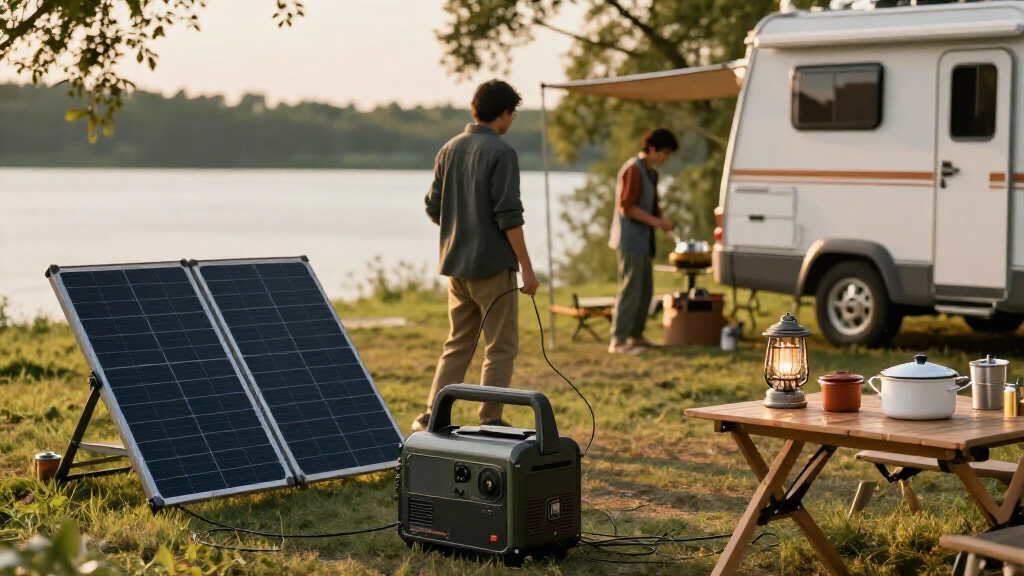
I compared each complete kit as a buyer would receive it: power station or battery, inverter and charge controller where specified, and included solar panels. The main criteria were usable capacity and output for likely loads, the relationship between battery size and panel wattage, charging flexibility, portability, and the setup work required. I also weighed whether the kit’s components make sense together; a large battery paired with modest panel input may be useful for backup, but it will take longer to recharge from sunlight.
The ranking favors clear use-case fit, practical solar replenishment, and manageable setup. Portable power-station bundles rank ahead for general buyers because they combine storage, AC power, and panels in a ready-to-use package. Larger home and off-grid systems can suit heavier or fixed loads, but they rank lower for general use when installation, expansion, or electrical planning adds complexity. Compact kits place well for portability, not for running demanding appliances, and I treat similarly named bundles with different panel sizes as distinct choices.
Factors to Consider When Choosing Solar Generator Kits
Before choosing a kit, match the system to the loads and recharge routine you actually expect. A portable battery with a panel is not automatically a whole-home backup system, and a high-wattage panel does not guarantee fast charging in poor sun. These factors help separate convenient travel bundles from equipment better suited to planned off-grid or household use.
1. Size the battery around both runtime and peak demand
Start with the devices you need to run, then separate their energy use from their starting or peak power demand. Battery capacity gives a rough sense of runtime, but inverter output determines whether a device can run at all. Refrigerators, pumps, and tools may draw more power when starting than during steady operation. Add up the loads you expect to use at the same time, rather than assuming every appliance can run together. Leave a buffer for conversion losses and changing conditions instead of planning to drain the battery to its limit. A small station can be a good match for phones and lights while still being the wrong choice for a refrigerator.
2. Match panel wattage to your recharge window
Panel wattage affects how quickly a kit can collect energy in favorable sunlight, but real output changes with cloud cover, panel angle, shade, and season. Compare the included panel capacity with the battery size and ask whether you can recharge within the time you have available. A larger battery paired with a modest panel may provide more stored power but need longer to refill. Foldable panels make repositioning easier, while fixed panels can suit a permanent installation better. Check the power station’s supported solar input and connector requirements before adding panels; extra panel capacity is of little use if the unit cannot accept it.
3. Decide whether portability or fixed installation matters more
Portable power stations bundle storage and power conversion into a single unit, which can make them easier to move between a home, vehicle, and campsite. Their weight still matters: a high-capacity station may be awkward to carry even when its panels fold for transport. Fixed solar kits can offer a more tailored setup for cabins or off-grid sites, but may call for mounting, wiring, battery placement, and electrical knowledge. Do not treat a kit with a charge controller and separate battery as a plug-and-play alternative without checking what is included. Choose for the place the system will live most of the time, not just for how compact it looks in a listing.
4. Check expansion limits before planning for future loads
Buyers often plan to add panels or batteries later, then discover that the unit’s input limits or design restrict upgrades. Check whether extra batteries are supported, how much solar input the system accepts, and whether additional panels need matching voltage or connectors. Expansion compatibility can matter more than a small capacity difference if your needs may grow. For a fixed off-grid kit, confirm which wiring, mounting hardware, batteries, or inverter components are actually part of the bundle. If future expansion is central to the purchase, favor a documented system path over assumptions based on brand or product family.
5. Choose the right kind of backup power
A portable generator can keep selected devices powered during an outage, but it does not automatically connect to household circuits or cover every room. Decide whether you need portable outlets for a few essentials or a system designed for larger, longer-term loads. Check the output type, available outlets, and any transfer or home integration equipment needed for your intended setup. Solar recharge also depends on having enough clear space and sunlight during the outage. A larger station costs you in weight and storage space, so prioritize the loads that matter most rather than buying capacity without a plan.
6. Count the setup, storage, and maintenance work
Solar generator kits have different upkeep demands: portable batteries generally need sensible storage and periodic charging, while fixed systems add panel mounting, cable routing, and battery-management questions. Consider where the panels will be stored when not in use and whether they can be positioned safely in sun. Review manufacturer guidance for storage temperature, charge levels, and long-term care, especially if the unit will sit between emergencies. Keep connectors clean and protected, and avoid assuming that a bundled panel removes all setup work. A kit you can deploy easily is often more useful than a larger system that stays packed away.
Frequently Asked Questions
Is the 100W or 200W panel bundle a better match for the Jackery Solar Generator 1000 v2?
The 200W-panel bundle is the stronger fit if solar replenishment time matters and you can carry or position the larger panel. The 100W version may suit buyers who put a smaller panel footprint ahead of faster charging, but the same battery can take longer to recharge from sunlight. Check the station’s supported solar input and the conditions where you expect to use it before assuming the panel’s rated output will be continuous. If most charging will happen from an outlet, the smaller panel may be enough for occasional top-ups. Choose based on your charging routine, not the battery name alone.
Can a portable solar generator kit run a refrigerator during an outage?
It may, but the answer depends on the refrigerator’s running and startup demands, the station’s inverter output, and how long the outage lasts. Check the appliance label or manual and compare its requirements with the station’s continuous and surge ratings. Then estimate how much energy the refrigerator uses over a day, allowing for the fact that compressor cycles and ambient temperature affect consumption. Solar panels can extend runtime only when they receive useful sunlight and the station supports their input. For longer outages, a larger battery or a way to recharge from more than one source can matter as much as the panel bundle.
When should I choose a fixed off-grid kit instead of a portable power station bundle?
A fixed kit makes more sense when you have a regular site, space for mounted panels, and loads that justify a planned battery-and-inverter system. It can suit a cabin or other off-grid setting where wiring and component placement are part of the project. A portable power station is usually easier to move and deploy, but may have limits on expansion or sustained output. Compare the full installation scope, including mounting, cables, batteries, and any missing components, rather than comparing panel wattage alone. If you do not want to plan electrical installation, a self-contained station is usually the simpler route.
How much solar panel capacity should I buy with a large battery?
There is no single panel-to-battery ratio that works for every buyer because sunlight, daily energy use, and available charging hours vary. A large battery can store more energy, but a small panel array may take a long time to refill it after heavy use. Estimate the energy you expect to replace in a typical day and compare that with realistic panel output for your location and season. Also verify the station’s maximum solar input, since panels beyond that limit may not deliver their full rated power to the battery. If backup readiness matters, plan around cloudy days rather than ideal midday conditions.
Are compact kits like the MARBERO M823, Explorer 300, or ZeroKor suitable for home backup?
They can provide limited backup for small electronics, lighting, and other modest loads, but their compact format does not make them substitutes for high-capacity home systems. Before buying one for outages, list the devices you need and check both total energy use and peak power requirements. A few low-draw essentials may fit; a refrigerator, heating device, or several appliances may exceed the station’s output or drain its battery quickly. Their smaller size can be an advantage for travel or short interruptions where portability matters more than extended runtime. For broader household backup, compare larger stations or fixed systems instead.
Conclusion
For most buyers seeking a ready-to-use balance of capacity and portability, I’d choose the Jackery Solar Generator 1000 v2 with a 200W panel as the best overall. The Jackery Explorer 300 or MARBERO M823 makes more sense for beginners who need a simple, compact setup for smaller devices, while the ZeroKor 300W is another compact option to compare. For greater stored power, the Jackery HomePower 3600 Plus is my premium pick; buyers should still weigh its size and the needs of their loads. The Renogy 400W kit suits shoppers planning a more tailored solar installation, while the ECO WORTHY 10 kW kit and Giosolar wind-and-solar kit fit more specialized off-grid projects rather than casual portable use. Choose the kit whose panel input, output, and setup match your real routine, not simply the one with the largest headline capacity.