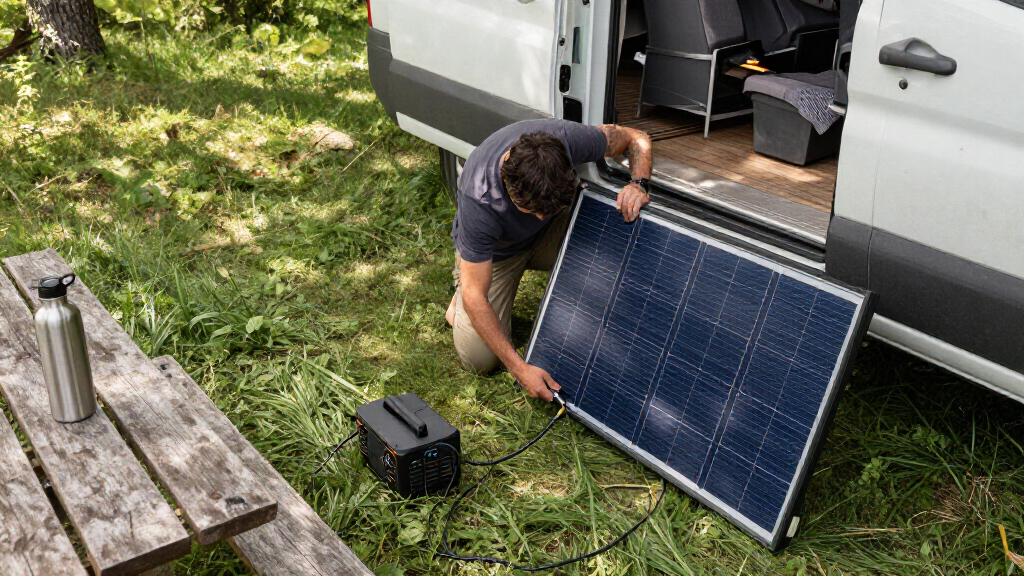
Choosing a portable solar panel for a power station is less about chasing the largest wattage on the label and more about matching the panel to your station, your travel style, and how you plan to set it up. I’d start with the Renogy 200W for its lighter build, adjustable kickstands, and direct USB charging; the SOKIOVOLA 200W stands out for its included multi-connector cable; and the GRECELL 100W is the more manageable choice when carrying weight matters more than fast charging.

Get backup power and energy gear delivered free with Prime
- Fast, free delivery on millions of items
- Prime Video, Amazon Music and more included
- Member-only deals all year
The tradeoff is straightforward: the three 200W panels can offer more potential input, but they are bulkier and their full rated output depends on sunlight and the power station’s input limits. GRECELL gives up rated wattage for a lower carry weight and a smaller setup. I’ve ranked these picks by how well their output, portability, connections, and practical setup suit different power-station owners—not by wattage alone.
Key Takeaways
- Renogy is my most balanced 200W pick: it weighs about 13.89 pounds, has four angle-adjustable kickstands, and can charge USB devices directly, but its 4-in-1 power-station adapter is sold separately.
- SOKIOVOLA includes a 5-in-1 adapter cable and carrying bag, making it a sensible choice for buyers who want broad connector coverage in the package; its 16.3-pound weight still limits hike-friendly use.
- GRECELL is the lightest listed option at 10.3 pounds and folds narrower than the 200W panels, but its 100W rating means slower potential recharging for stations that can accept more input.
- EBL offers 200W potential and a multi-connector cable, but its 17.95-pound weight makes it the least appealing of these four for frequent carrying.
- Before buying any panel, match its voltage, connector, and available solar input to your power station; a panel’s rated watts do not override the station’s input ceiling.
| Renogy 200W Portable Solar Panel with 25% Efficiency |  | Best Overall | Cell type: 16BB N-Type monocrystalline silicon | Stated efficiency: 25% | Maximum voltage: 21.6 V | VIEW LATEST PRICE | See Our Full Breakdown |
| SOKIOVOLA 200W Foldable Portable Solar Panel |  | Best for Included Compatibility | Maximum power: 200 W | Stated conversion efficiency: Up to 25% | Output voltage: 18 V | VIEW LATEST PRICE | See Our Full Breakdown |
| GRECELL 100W Foldable Portable Solar Panel |  | Best Compact and Lightweight | Maximum power: 100 W | Output voltage: 20 V DC | Maximum voltage: 20 V | VIEW LATEST PRICE | See Our Full Breakdown |
| EBL 200W Foldable Portable Solar Panel |  | Best for Multi-Connector 200W Setups | Maximum power: 200 W | Maximum voltage: 35 V DC | Stated conversion efficiency: Up to 23.5% | VIEW LATEST PRICE | See Our Full Breakdown |
| portable solar panels for power station | Weight | Maximum voltage | Folded dimensions | Maximum power |
|---|---|---|---|---|
| Renogy 200W Portable Solar Pan | 13.89 lb | 21.6 V | 23.72 × 22.99 × 1.97 in | — |
| SOKIOVOLA 200W Foldable Portab | 16.3 lb | — | — | 200 W |
| GRECELL 100W Foldable Portable | 10.3 lb | 20 V | Approximately 25.25 × 10.55 × 3 in | 100 W |
| EBL 200W Foldable Portable Sol | 17.95 lb | 35 V DC | 25.31 × 20.87 × 2.17 in | 200 W |
More Details on Our Top Picks
Renogy 200W Portable Solar Panel with 25% Efficiency
I rank the Renogy 200W first because it puts together a useful amount of rated output, a comparatively manageable listed weight, and thoughtful positioning options. At about 13.89 pounds, it is lighter than the SOKIOVOLA and EBL 200W panels in this lineup. That difference matters when moving a panel between a car, campsite, or storage spot, even though this is still a substantial folding panel rather than something I’d choose for a long backpacking trip.
Its four kickstands let me angle the panel toward the sun instead of leaving it flat, which can make setup more adaptable as the sun moves. The USB-C PD 45W and two USB-A ports also give it a role the other listed 200W options do not advertise: it can charge small devices directly while the MC4 output is used for a compatible power station. That flexibility is useful at camp, but I would not confuse those ports with a way to bypass the station’s solar input limits.
The main catch is the 4-in-1 adapter is sold separately. SOKIOVOLA and EBL include multi-connector cables, so either may be a more convenient out-of-box match if their included connectors suit your station. Renogy’s MC4 output is broadly useful, but the buyer still needs to verify connector and electrical compatibility. Its rated 25% cell efficiency is a stated feature, not a guarantee that the panel will deliver 200W in ordinary outdoor conditions.
The listed two-year material and workmanship warranty is longer than the one-year or 12-month coverage stated for EBL and SOKIOVOLA. I give Renogy the top spot for its overall balance, not because it wins every category: GRECELL is lighter, and SOKIOVOLA is more ready to connect from the box. If I want one 200W-class panel for a power station and occasional direct device charging, Renogy is the most rounded option here.
Pros:- 200W rating with 16BB N-Type cells listed at 25% efficiency.
- Four kickstands support adjustable positioning.
- USB-C PD 45W and dual USB-A ports can charge devices directly.
- At about 13.89 pounds, it is lighter than the SOKIOVOLA and EBL 200W options.
Cons:- The 4-in-1 adapter for power-station connections is sold separately.
- The power station must accept the panel’s electrical input and connector setup.
- The folded panel remains bulky for hiking or frequent long-distance carrying.
Best for: Power-station owners who want a 200W-rated folding panel with adjustable positioning, direct USB device ports, and less carry weight than the other listed 200W picks.
Not ideal for: Buyers who need every power-station adapter included, or anyone seeking a genuinely lightweight panel for long hikes.
- Cell type:16BB N-Type monocrystalline silicon
- Stated efficiency:25%
- Maximum voltage:21.6 V
- Amperage capacity:11.3 A
- Weight:13.89 lb
- Folded dimensions:23.72 × 22.99 × 1.97 in
- Outputs:MC4, USB-C PD 45W, dual USB-A
- Warranty:2 years for material and workmanship
Our verdict“I’d choose Renogy as the most balanced 200W option if I value setup flexibility and direct device ports enough to source the adapter separately.”
SOKIOVOLA 200W Foldable Portable Solar Panel
The SOKIOVOLA 200W is my pick for buyers who want a broad connector kit in the box. Its supplied 5-in-1 cable covers XT60, DC5521, DC7909, DC8020, and Anderson connections alongside the panel’s MC4 output. That makes it more immediately adaptable than Renogy, whose 4-in-1 adapter is sold separately. It is still essential to check the power station’s input requirements; a matching plug does not by itself confirm electrical compatibility.
At 200W rated power and up to 25% stated conversion efficiency, SOKIOVOLA sits in the same broad output class as Renogy and EBL. Its ETFE-coated monocrystalline construction, magnetic handle, carrying bag, and four mounting holes add useful options for transport and securing the panel. The folded size of 21 × 23 inches is slightly narrower than the listed Renogy footprint, though the panel is also heavier than Renogy at 16.3 pounds.
That weight puts the product’s portability in perspective. It folds for car camping, RV use, and moving between storage and a sunny spot, but the listed 16.3 pounds can feel like a poor compromise for longer walks. GRECELL is the better fit if low carry weight leads the decision, although its 100W rating offers half the nominal capacity. EBL also includes several connectors, but it weighs more than SOKIOVOLA, so I prefer this one among the connector-rich 200W choices when carrying it occasionally.
The supplied description lists compatibility with Jackery, EcoFlow, Bluetti, Anker, and other compatible stations, yet station models differ in solar input limits. A power station may cap incoming watts below the panel’s rating, and conditions may keep panel output below its maximum. I’d choose SOKIOVOLA when the included cable and compact folded footprint solve a real setup problem, while skipping it if my priority is minimal weight or a longer warranty than its stated 12 months.
Pros:- Includes a 5-in-1 cable with XT60, DC5521, DC7909, DC8020, and Anderson adapters.
- Folds to 21 × 23 inches and includes a magnetic handle and carrying bag.
- ETFE coating and monocrystalline cells are designed for portable outdoor use.
- Mounting holes provide additional ways to secure the panel.
Cons:- At 16.3 pounds, it is heavy for long hikes.
- The 12-month warranty is shorter than Renogy’s stated two-year coverage.
- The power station’s input limit may prevent it from accepting the panel’s full rated output.
Best for: Power-station owners who want a 200W-rated panel with several common connector adapters and a carrying bag included.
Not ideal for: Backpackers, buyers who carry gear over long distances, or anyone whose station’s input limits make a 200W panel unnecessary.
- Maximum power:200 W
- Stated conversion efficiency:Up to 25%
- Output voltage:18 V
- Cell and coating:Monocrystalline cells with ETFE coating
- Weight:16.3 lb
- Folded size:21 × 23 in
- Unfolded dimensions:78.68 × 23 × 1.5 in
- Connector options:MC4; included adapters for XT60, DC5521, DC7909, DC8020, and Anderson
- Warranty:12 months
Our verdict“I’d pick SOKIOVOLA over Renogy when included connector options matter more than lower weight or direct USB ports.”
GRECELL 100W Foldable Portable Solar Panel
GRECELL earns a different role from the 200W panels: it is the lightest option in this comparison, at 10.3 pounds, and its 100W rating is a better fit for buyers who value manageable carrying over faster potential charging. Its folded footprint is about 25.25 × 10.55 × 3 inches, narrower than the broad folded panels from Renogy, SOKIOVOLA, and EBL. For a car kit, a small campsite, or a lighter portable setup, that narrower package can be easier to stow and place.
The panel supplies up to 100W at 20V and lists cell efficiency up to 23.5%. Its kickstands, accessory pouch, mounting grommets, and supplied adapters support a practical setup without requiring the buyer to build every connection from scratch. ETFE lamination and waterproof Oxford cloth are described as weather-resistant construction features, though this does not mean the panel should be left exposed to every kind of weather or treated as a sealed power station.
Compared with Renogy, GRECELL gives up half the rated wattage and the ability to plug USB devices directly into the panel, since no such ports are listed here. In return, it weighs about 3.6 pounds less than Renogy and substantially less than SOKIOVOLA or EBL. That is a meaningful exchange for someone who regularly carries equipment away from a vehicle. For a larger power station that accepts more solar input, the 200W models are more appealing if their weight and folded width are acceptable.
GRECELL says two panels can be connected in series or parallel, but the station’s supported voltage, current, and connection method must be checked before expanding. A second panel is not part of the stated package, and adding one does not guarantee the power station can accept the combined output. I place this pick third because it serves a narrower portability-first need rather than being the strongest all-around recharging option. It makes the most sense when the lower carry weight is worth the slower potential input.
Pros:- At 10.3 pounds, it is the lightest panel in this lineup.
- Narrow folded dimensions can be easier to stow than the wider 200W panels.
- Includes adapters, kickstands, an accessory pouch, and mounting grommets.
- Can be paired with a second panel when the station and connection setup support it.
Cons:- Its 100W rating is lower than the 200W options.
- No direct USB output ports are listed.
- Expansion requires a second panel and a power station that supports the combined electrical input.
Best for: Campers and power-station owners who carry panels by hand and prefer a lighter, narrower 100W option over a heavier 200W setup.
Not ideal for: Buyers seeking the greatest rated input for a high-capacity power station or direct USB charging ports on the panel.
- Maximum power:100 W
- Output voltage:20 V DC
- Maximum voltage:20 V
- Amperage capacity:5 A
- Stated cell efficiency:Up to 23.5%
- Weight:10.3 lb
- Folded dimensions:Approximately 25.25 × 10.55 × 3 in
- Materials:Monocrystalline silicon, ETFE lamination, waterproof Oxford cloth
- Connection and expansion:MC4; supports two-panel series or parallel connection when compatible
Our verdict“I’d choose GRECELL when lower weight and a compact folded shape matter more than the higher rated output offered by the 200W panels.”
EBL 200W Foldable Portable Solar Panel
EBL is the most connector-focused alternative for buyers who want a 200W-rated panel and several cable options supplied. Its MC4-to-4-in-1 cable includes XT60, Anderson, DC, and aviation connectors, giving it a similar out-of-box convenience advantage to SOKIOVOLA. I rank EBL fourth because that flexibility comes with the highest listed carry weight in this group: 17.95 pounds. For a panel that will mostly live beside a vehicle or be moved a short distance, weight may be secondary; for frequent carrying, Renogy and GRECELL are easier choices.
The panel lists up to 23.5% conversion efficiency, an IP65 waterproof design, and four kickstands. Those details suit outdoor setup where changing the angle and managing exposure are part of the routine. Its folded dimensions are 25.31 × 20.87 × 2.17 inches, so it forms a broad package comparable to the other 200W-class panels rather than the narrower GRECELL. The unfolded length of 94.17 inches also calls for enough clear space to deploy it.
Compared with SOKIOVOLA, EBL offers a similar multi-connector approach but is heavier and has a stated one-year warranty versus SOKIOVOLA’s 12 months, which is effectively the same stated duration. Renogy has a longer stated warranty and weighs about four pounds less, but its 4-in-1 adapter is sold separately. The decision is therefore less about a clear performance win and more about whether the included cable and IP65 design fit the buyer’s setup better than Renogy’s lower carry weight and direct USB ports.
The 200W rating is a panel maximum, not a guaranteed charging rate. EBL’s listed maximum voltage is 35V DC, so I would check the station’s permitted solar voltage and input range before connecting it; connector fit alone is not enough. I’d shortlist EBL for vehicle-based power-station users who want an included cable kit and can leave the panel near their charging station. I would skip it when compact transport or frequent lifting is a regular part of the plan.
Pros:- 200W rating with MC4-to-4-in-1 cable and several connector types included.
- Four kickstands make angle adjustment easier at camp.
- Listed IP65 waterproof design supports outdoor use.
- Foldable construction allows storage and transport when not deployed.
Cons:- At 17.95 pounds, it is the heaviest option in this lineup.
- Its 23.5% efficiency is a stated maximum, not a guaranteed field result.
- The 35V DC maximum voltage requires a compatibility check against the power station.
Best for: Vehicle campers and stationary outdoor setups that need a 200W-rated panel with several connector adapters included.
Not ideal for: Anyone who regularly carries a panel far from a vehicle or wants the lightest 200W option in this comparison.
- Maximum power:200 W
- Maximum voltage:35 V DC
- Stated conversion efficiency:Up to 23.5%
- Cell type:Monocrystalline silicon
- Weight:17.95 lb
- Folded dimensions:25.31 × 20.87 × 2.17 in
- Unfolded dimensions:94.17 × 20.83 × 0.25 in
- Connector:MC4 to XT60, Anderson, DC 7.9 × 0.9 mm, and aviation connectors
- Warranty and protection:1-year warranty; listed IP65 design
Our verdict“I’d choose EBL for a mostly vehicle-based setup where included connector choices matter more than keeping carry weight down.”
How We Picked
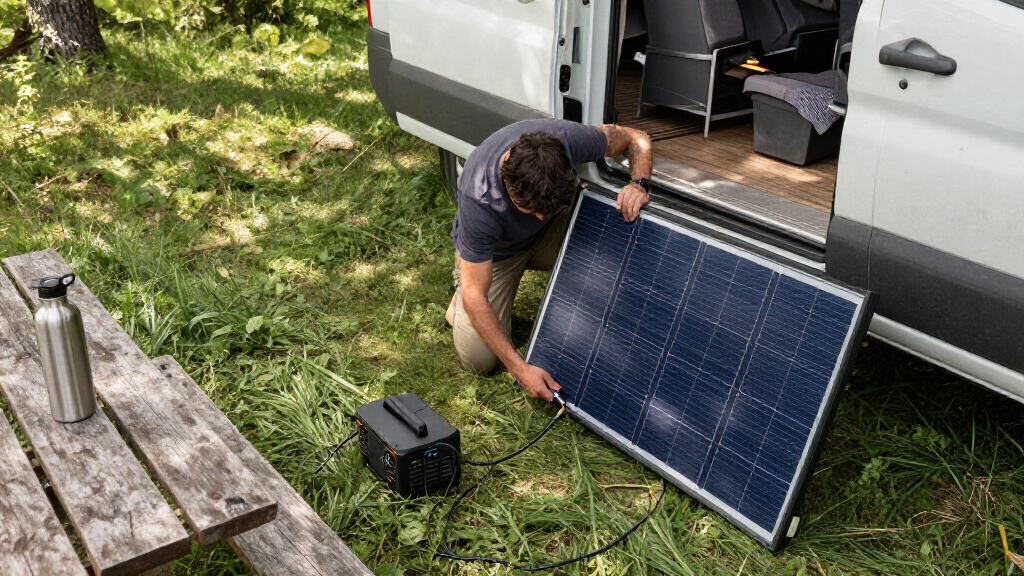
I compared these four panels as solar charging companions for portable power stations, rather than as standalone USB chargers or permanent rooftop modules. My ranking weighs rated power alongside the things that determine whether a panel is practical to bring out and use: carry weight, folded footprint, included cables, positioning options, and the clarity of the supplied specifications.
Compatibility is a major part of the ranking because an otherwise suitable panel can become a poor match if the cable is missing or the station accepts a different voltage or connector. I gave credit to products with adapters in the box, while noting when a separate adapter is needed. I also distinguish a panel’s own direct USB outputs from its ability to charge a power station; those are different charging paths.
I treat stated maximum wattage and efficiency as ratings, not a promise of real-world production. Sun angle, shade, temperature, weather, and the power station’s maximum solar input can all reduce the power that reaches the battery. None of the supplied information establishes identical test conditions across models, so I use the provided specs and stated features to explain fit and tradeoffs, not to claim a measured performance winner.
The order reflects usefulness for the widest range of power-station buyers first, then more specialized strengths. Renogy takes the lead for balancing 200W capacity with relatively low weight and versatile setup. SOKIOVOLA follows for its included cable and practical carrying features. GRECELL is the portability-focused 100W alternative, while EBL remains a plausible connector-rich choice for stationary or vehicle-based use despite its heavier carry weight.
| portable solar panels for power station | Stated conversion efficiency |
|---|---|
| Renogy 200W Portable Solar Pan | — |
| SOKIOVOLA 200W Foldable Portab | Up to 25% |
| GRECELL 100W Foldable Portable | — |
| EBL 200W Foldable Portable Sol | Up to 23.5% |
Factors to Consider When Choosing Portable Solar Panels For Power Stations
I’d choose a panel by working backward from the power station and the way I’ll carry it. Rated wattage, connector availability, and portability all matter, but none of them alone tells me whether a panel will be a good match. These checks help narrow the four picks to the one that fits the actual setup.
Check the power station before the panel
Start with the station’s manual or input label. Match the panel’s voltage range, current limits, and connector to the station’s permitted solar input. Renogy lists a maximum voltage of 21.6V, GRECELL lists 20V, SOKIOVOLA lists an 18V output, and EBL lists a maximum voltage of 35V DC. Those numbers make it especially important not to assume that a cable that plugs in will make the electrical pairing safe or supported. If the station has a maximum solar input below the panel’s rating, the station may limit the accepted power.
Treat rated watts as a ceiling, not a schedule
A 200W label describes a maximum rating, not the amount of energy a panel will provide throughout a day. Sun angle, passing clouds, shade, dirt, heat, and panel orientation can all affect production. The station’s own input ceiling can cap what it accepts as well. I’d choose 200W over 100W when a station can accept the extra input and the bigger panel is practical to carry. If the station has a modest input limit, GRECELL’s lighter 100W panel may be a better-matched purchase than carrying unused capacity.
Weigh the panel in the context of your route
The difference between 10.3 pounds and 17.95 pounds affects more than the walk from a car to a table. It can change whether I’m willing to reposition the panel during the day, pack it for an overnight trip, or bring it along at all. GRECELL is the clear pick for lower weight and a narrow folded shape. Renogy is the more balanced 200W choice at 13.89 pounds. SOKIOVOLA and EBL make more sense when the panel will travel mostly by car or move only a short distance after arrival.
Count what is included in the connection kit
MC4 is listed on all four products, but power stations may use different input sockets or need a compatible adapter cable. SOKIOVOLA includes a 5-in-1 cable; EBL includes an MC4-to-4-in-1 cable; GRECELL includes multiple adapters; Renogy’s 4-in-1 adapter is sold separately. I’d verify the exact connector required by the station, then confirm the cable supports the needed electrical limits. Connector variety is helpful, but it is not a substitute for checking the station’s manual.
Compare direct device charging with station charging
Renogy is the only panel here with listed USB-C PD 45W and dual USB-A outputs. Those ports let it charge some devices directly, which can free power-station capacity for other equipment. The other models are presented around their solar-panel output and power-station compatibility. If direct phone or tablet charging is a priority, Renogy has a distinct advantage. If all solar power will go into a station, its USB ports may matter less than weight, included adapters, or the station’s input ceiling.
Use stands and mounting points to plan your setup
Kickstands help position panels without requiring a separate support, while mounting holes or grommets can offer added ways to secure a panel. Renogy and EBL list four kickstands; GRECELL adds kickstands and mounting grommets; SOKIOVOLA lists four mounting holes. These features matter on uneven ground or where wind could shift an unanchored panel. They do not make a panel weatherproof in every condition, so follow the product instructions and bring it in when the weather calls for it.
Plan expansion around the station’s limits
GRECELL states that two panels can be connected in series or parallel, but this should only be done when the station and connection hardware support the resulting voltage and current. Series connections can raise voltage; parallel connections can raise current. Either change may exceed the station’s permitted input if the setup is not checked first. A second panel is also an additional item to carry and position. I’d expand only after confirming the station’s limits and deciding that more panel area is worth the extra bulk.
Frequently Asked Questions
Will any of these panels work with every power station?
No. Compatibility depends on the power station’s allowed solar voltage and current, its maximum input wattage, and the connector it accepts. The supplied cables can help with plug types, but a physically compatible plug does not confirm the electrical match. Check the power station’s manual before connecting a panel, especially for EBL’s listed 35V DC maximum and any multi-panel setup.
Does a 200W panel charge a power station at 200W?
Not consistently. Two hundred watts is the panel’s rated maximum under suitable conditions, while real solar input can vary with sunlight, angle, shade, temperature, and other conditions. The power station may also accept less than the panel’s rating because of its own input limit. I’d treat the rating as a way to compare panel capacity, not a promised charging speed.
Which pick is easiest to carry?
GRECELL is the easiest listed option to carry by weight at 10.3 pounds, and its folded shape is notably narrower than the broader 200W panels. Renogy is the lighter choice among the three 200W-rated models at about 13.89 pounds. All four are foldable, but even the lighter options are better suited to car camping and short carries than long hikes with other gear.
Which panel includes the most useful adapters?
SOKIOVOLA includes a 5-in-1 cable with XT60, DC5521, DC7909, DC8020, and Anderson options. EBL also includes a multi-connector cable, and GRECELL is described as including multiple adapters. Renogy lists an MC4 output, but its 4-in-1 adapter is sold separately. I’d still match the exact connector and electrical requirements to the power station before buying based on the cable kit.
Can I connect two panels to charge faster?
Possibly, but only when the panels, connection method, and power station are compatible. GRECELL describes series or parallel expansion, yet either method changes the electrical input and may exceed the station’s voltage or current limits. A second panel also adds weight and setup space. Check the station’s solar input specifications and the panel instructions before connecting panels together.
Conclusion
For the broadest range of buyers, I’d start with Renogy: it pairs 200W-rated capacity with the lowest listed weight among the 200W options, four kickstands, and direct USB outputs. I’d pick SOKIOVOLA instead when having a multi-adapter cable and carrying bag in the package matters more than keeping weight down. If I’m carrying the panel farther or have a smaller power station, GRECELL is the portability-first choice, with the tradeoff of a 100W rating. For a vehicle-based setup where several connectors and an IP65 design are priorities, EBL remains worth considering, provided its 17.95-pound weight and 35V maximum voltage suit the plan. In every case, I’d confirm the station’s input limits and connection requirements before choosing on rated wattage alone.
Fall Picks

Philips Hue Essential Starter Kit with Bridge and 4 E26 Smart Bulbs
As an affiliate, we earn on qualifying purchases.