
TL;DR

Get backup power and energy gear delivered free with Prime
- Fast, free delivery on millions of items
- Prime Video, Amazon Music and more included
- Member-only deals all year
Sumitomo Corporation announced progress on two battery energy storage projects in Japan: a 62MW/291MWh facility selected for a government capacity auction and a 16MW/70MWh project in Kyushu. Greenvolt Power has also brought two smaller, merchant-operated systems in Kyushu online, illustrating the range of project sizes and revenue models emerging in Japan.
Sumitomo Corporation has advanced two battery energy storage projects in Japan, including a 62MW/291MWh facility selected for a government-backed capacity auction, while Greenvolt Power has begun operating two smaller merchant systems in Kyushu. The developments show how Japan’s battery market is forming across projects with contracted revenue and smaller systems exposed to electricity-market trading.
On Oct. 1, Sumitomo said its subsidiary BS Holdings had started construction on a battery facility in Namie, Fukushima Prefecture. The 62MW/291MWh project was selected in Japan’s Long Term Decarbonisation Power Source Auction (LTDA), and project financing has been arranged with MUFG Bank. BS Holdings expects commercial operation in 2029.
The LTDA provides selected low-carbon assets with a fixed annual payment for 20 years in return for keeping capacity available, rather than paying for electricity delivered. Sumitomo said the Namie project was developed with the local community and is intended to support the integration of renewable energy into the Tohoku region’s grid.
On Oct. 28, Sumitomo reported that preparatory work was underway on Battery Station Ishiya, a 16MW/70MWh project in Nagasaki Prefecture. The project is being developed by Denki no Eki, a joint venture between Sumitomo and Kyushu Railway Company, at a former railway substation site and nearby land. Commercial operation is planned for December 2028. Sumitomo did not disclose financing details.
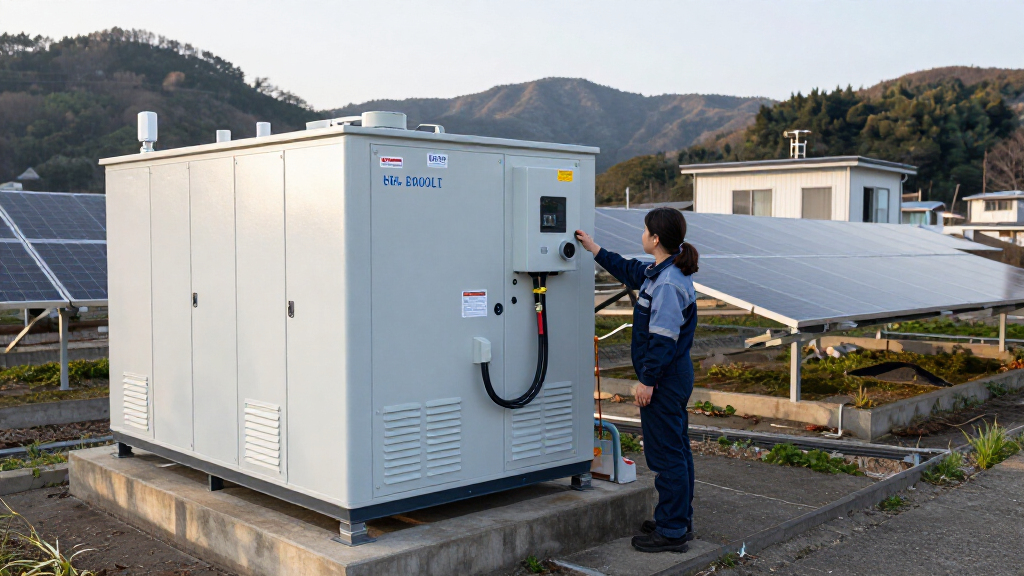
Separately, Greenvolt Power, the utility-scale renewable energy business of Portugal-based Greenvolt Group, has brought its first two Japanese battery projects into operation. The standalone systems are in Kyushu and have a combined output of 4MW and storage capacity of 8MWh, equivalent to two hours at full output. They operate on a merchant basis, earning revenue through participation in electricity markets. The supplied report does not identify the projects’ individual locations or commissioning dates.
Two Routes to Battery Revenue
The projects illustrate a market in which contracted and merchant revenue support different investment approaches. The Namie facility’s LTDA selection gives it a long-term capacity payment, a structure that can make financing easier to arrange. Greenvolt’s smaller systems instead depend on market participation, exposing owners to prices and trading opportunities without the same stated government contract.
That distinction matters for investors and grid planners. Larger projects can add substantial storage capacity, while smaller systems may provide a way to enter the market with less capital at risk. BloombergNEF Japan analyst Umer Sadiq told Energy-Storage.News that smaller projects can also face shorter grid-interconnection waits and give owners experience before they pursue larger investments.
The facilities are also relevant to renewable integration. Sumitomo says Namie will support the Tohoku grid, while the Kyushu projects add storage in a region where other large battery projects are being developed. The projects’ actual operating performance and market revenues have not yet been reported.
Products Worth Considering

Philips Hue Festavia 65-Foot Smart LED String Lights, 250 Color-Changing Mini LEDs

Arlo Essential Wireless Security Camera 2K (3rd Gen) – 3-Cam Kit with Yard Sign

Dyson Airwrap i.d. Multi-Styler for Straight and Wavy Hair
As an affiliate, we earn on qualifying purchases.
Japan’s Layered Storage Market
Japan’s emerging grid-scale battery market includes three broad categories, according to Sadiq: projects with revenue supported by the LTDA, subsidised merchant projects and unsubsidised merchant projects. LTDA projects tend to be larger, with output starting at about 30MW. At the smaller end, developers are deploying systems around 2MW/8MWh, often using corporate financing and merchant-market revenues.
The auction has already awarded substantial battery capacity. Its first round, run by grid coordinator OCCTO, awarded 1.1GW across 32 projects in April 2024. In the third round, held in May 2026 according to the source report, OCCTO selected 1,251MW across 19 projects, with eligibility restricted to projects with at least six hours of duration. The report also says that round introduced cybersecurity certification and a cap on the share of awarded capacity using cells from any single foreign country.
Sadiq said BloombergNEF forecast about 1.3GW of storage deployment in Japan in 2026, including both front-of-the-meter and behind-the-meter systems, with development concentrated in Kyushu and Hokkaido. The forecast is an estimate, not a confirmed deployment total.
“The Namie project will aid the grid integration of renewable energy in the Tohoku region.”
— Sumitomo Corporation
Financing and Operating Details
Several project details remain undisclosed. Sumitomo did not provide financing information for Battery Station Ishiya, and the source report does not state the individual locations, financing arrangements or commissioning dates for Greenvolt’s two operating systems. It also gives no reported revenue or performance data for the Greenvolt projects.
The planned commercial-operation dates for Namie and Ishiya are company expectations, not evidence that the projects are already operating. The source material also does not establish how either Sumitomo project will perform in electricity or balancing markets once commissioned.
Milestones Through 2029
The next milestones are construction and commissioning. Sumitomo expects Battery Station Ishiya to begin commercial operations in December 2028 and the Namie facility in 2029. Further company updates could clarify project financing, construction progress and operating arrangements.
For Greenvolt, the two Kyushu systems are already operating, but additional information about their market participation and performance would help show how the small-scale merchant model is working in practice. Across Japan, the timing and results of future auction rounds, grid connections and project completions will shape how quickly storage capacity is added.
Key Questions
What battery projects has Sumitomo announced?
Sumitomo has reported construction on a 62MW/291MWh project in Namie, Fukushima Prefecture, and preparatory work on a 16MW/70MWh project in Nagasaki Prefecture.
When are Sumitomo’s projects expected to operate?
Sumitomo expects Battery Station Ishiya to start commercial operations in December 2028 and the Namie project in 2029.
How are Greenvolt’s Japanese batteries earning revenue?
The two systems operate on a merchant basis, participating in electricity markets rather than relying on a disclosed long-term capacity contract.
What does the LTDA provide to selected projects?
The Long Term Decarbonisation Power Source Auction provides selected low-carbon assets with a fixed annual payment for 20 years to keep capacity available. It pays for capacity availability rather than energy delivered.
What remains unknown about the projects?
Sumitomo has not disclosed financing details for Ishiya. The source report also does not give Greenvolt’s individual project locations, financing arrangements, commissioning dates or operating results.
Source: energy-storage.news