
When comparing 120 V and 240 V generator outlets, the key difference lies in current draw for the same power. At 120 V, devices often draw more amperes, increasing the load on wiring and circuit breakers, while at 240 V, the same power requires less current, making it safer and more efficient for high-power tools. Understanding how these voltages impact amperage helps you select the right outlet and stay safe — learn more to make informed choices.

Get backup power and energy gear delivered free — and shop member deals
- Fast, free delivery on millions of items
- Access to Prime Big Deal Days deals on October 6–7
- Prime Video, Amazon Music and more included
Key Takeaways
- At the same power level, 240 V outlets draw half the current of 120 V outlets.
- Increasing voltage reduces the amperage required for the same wattage, improving electrical efficiency.
- 120 V outlets often supply higher amperage, suitable for lower-voltage, high-current devices.
- 240 V outlets provide lower amperage for high-power equipment, reducing wiring and circuit load.
- Proper outlet voltage and amperage ratings ensure safe operation and prevent overloads.
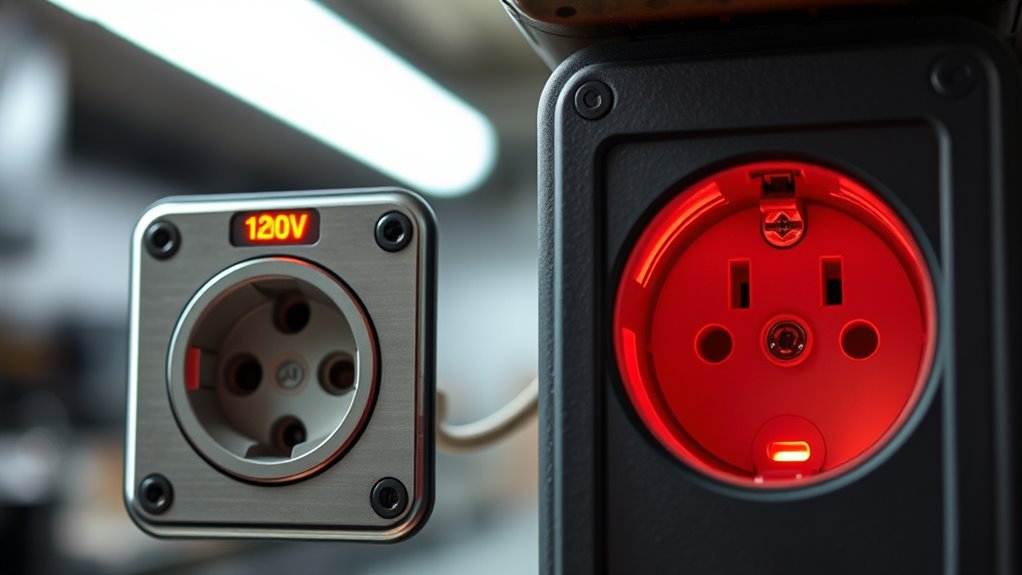
Understanding how amperage varies with voltage is essential when working with electrical systems. When you’re dealing with different generator outlets, especially 120 V and 240 V, knowing how amperage impacts power consumption and safety can help you make smarter choices. The relationship between voltage, current, and power isn’t just theoretical; it’s practical and vital for both efficiency and safety. If you overestimate or underestimate the amperage needed, you could risk equipment damage, electrical fires, or personal injury.
At a basic level, power consumption relates directly to both voltage and current. When using a 120 V outlet, your devices draw a certain amount of amperes to deliver the required power. Switch to a 240 V outlet, and the same device typically draws less current because the higher voltage delivers the same power more efficiently. For example, a device rated at 1200 watts will draw 10 amps at 120 V, but only about 5 amps at 240 V. This difference is significant because it influences how much current your wiring and circuit breakers need to handle. Lower current flow at higher voltage means you can potentially use thinner wiring, but it also demands attention to proper grounding and correct outlet connections to prevent safety hazards.
Knowing how amperage varies with voltage also helps you evaluate your power consumption. When you run high-powered tools or appliances, understanding these relationships ensures you don’t overload circuits, which could trip breakers or cause overheating. It’s also essential for choosing the right generator outlets; a 120 V outlet might be sufficient for small tools, but larger equipment often requires a 240 V supply to operate safely and efficiently. If you try to power a high-demand device on too low a voltage or current, you risk damaging the equipment or creating unsafe conditions. Conversely, using a higher voltage outlet for lower-demand devices might be unnecessary and could lead to wasteful power consumption.
Safety considerations are paramount. Higher amperage means more heat and a greater chance of electrical faults if wiring isn’t rated properly. When working with different voltages, always confirm your connections and circuit protections match the amperage requirements. Overloading an outlet or using incompatible plugs and cords can lead to sparks, shorts, or fires. Properly understanding how voltage affects amperage helps you avoid these hazards. Keep in mind that even if a device seems compatible with a certain outlet, it’s your responsibility to verify that your wiring and circuit breakers can handle the current draw safely. Additionally, awareness of amperage ratings ensures compliance with electrical standards and prevents potential hazards.
120V vs 240V generator outlet adapter
As an affiliate, we earn on qualifying purchases.
As an affiliate, we earn on qualifying purchases.
Frequently Asked Questions
How Does Amperage Affect Generator Efficiency at Different Voltages?
You’ll find that higher amperage at lower voltages can limit your generator’s efficiency because it strains the power transfer process and reduces load capacity. At 240 V, the same power requires less current, making the transfer smoother and more efficient. This means your generator handles larger loads better at higher voltages, with less stress on components, ultimately improving overall efficiency and extending its lifespan.
Are There Safety Concerns Switching Between 120 V and 240 V Outlets?
Switching between 120 V and 240 V outlets can pose safety risks if you don’t check circuit compatibility and grounding safety. Guarantee your generator and appliances are rated for the voltage you’re using. Proper grounding prevents electric shocks, and verifying circuit compatibility avoids overloads or damage. Always follow manufacturer instructions and use appropriate adapters or switches to maintain safety when switching voltages.
Can I Use the Same Appliances on Both 120 V and 240 V Outlets?
Did you know that most small appliances are designed for either 120 V or 240 V? You can’t just use the same appliance on both outlets without checking compatibility. Some appliances handle voltage conversion, but others may get damaged or pose safety risks. Always verify appliance compatibility prior to switching between 120 V and 240 V outlets to prevent hazards and ensure proper operation.
What Factors Determine the Maximum Amperage a Generator Can Handle?
Your generator’s capacity and power ratings determine the maximum amperage it can handle. These ratings specify how much current the generator can safely provide without overload. Factors like the generator’s wattage, its design, and the quality of components influence this limit. Always check the manufacturer’s specifications to guarantee your load stays within safe amperage levels, preventing damage or hazards while using your generator.
How Does Wiring Differ for 120 V Versus 240 V Outlets?
Think of wiring as the backbone of your setup—it’s the bridge connecting power to devices. For 120V outlets, you use a single hot wire, a neutral, and a ground, with standard circuit breakers. For 240V, you combine two hot wires and a ground, often requiring different breaker types. Grounding varies too, as 240V systems may need additional grounding measures to ensure safety.
high power generator outlets 240V
As an affiliate, we earn on qualifying purchases.
As an affiliate, we earn on qualifying purchases.
Conclusion
Understanding amperage at different voltages is like matching the right key to open your power needs. Whether you’re using a 120V or 240V outlet, knowing how amperage flows helps you avoid overloads and keep your devices safe. Think of voltage as the highway and amperage as the cars traveling on it—too many cars can cause traffic jams. Stay informed, stay safe, and let your power journey run smoothly like a well-oiled engine.
electrical safety circuit breaker
As an affiliate, we earn on qualifying purchases.
As an affiliate, we earn on qualifying purchases.
As an affiliate, we earn on qualifying purchases.
Fall Picks
fall essentials
As an affiliate, we earn on qualifying purchases.