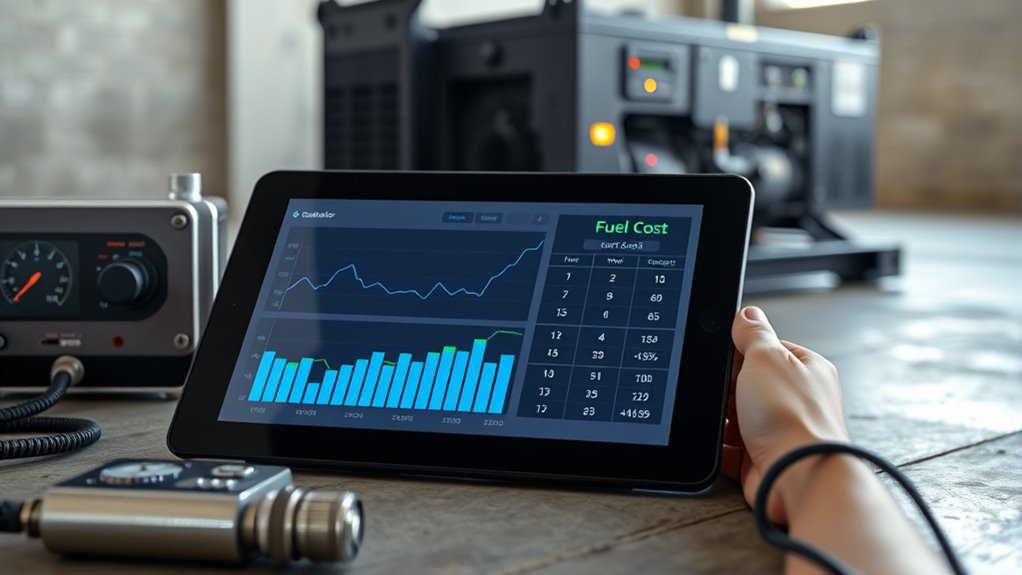

To calculate your generator’s fuel cost per kilowatt-hour, measure how much fuel it consumes during normal operation while recording the power output. Divide the total fuel used by the total kWh generated to find the efficiency in liters or gallons per kWh. Then, multiply this value by your current fuel price to get the cost per kWh. Continuing will help you understand how to keep these calculations accurate and help manage costs effectively.
Key Takeaways
- Measure fuel consumption during normal operation and record total fuel used over a specific period or load.
- Simultaneously record the total electrical energy (kWh) generated during the fuel consumption measurement.
- Divide the total fuel used by the total kWh produced to determine fuel efficiency in liters per kWh or gallons per kWh.
- Multiply the fuel efficiency (liters or gallons per kWh) by the current fuel price to calculate the cost per kWh.
- Update fuel prices regularly and consider emission data to maintain accurate and cost-effective generator operation.
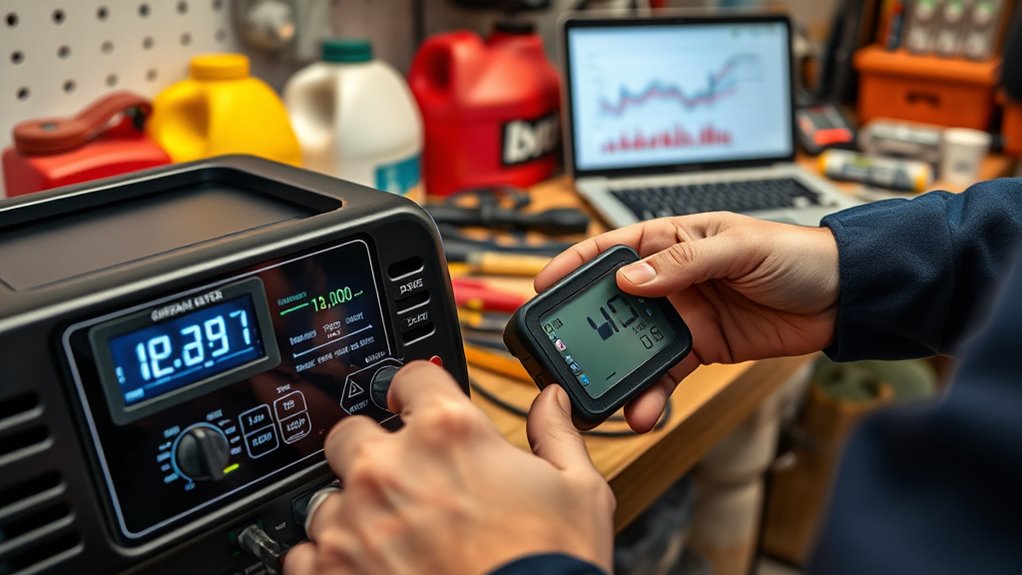
Have you ever wondered how to accurately determine the fuel cost for your generator? Understanding this process starts with evaluating your generator’s fuel efficiency, which is essential for calculating costs accurately. Fuel efficiency refers to how well your generator converts fuel into electricity, typically measured in liters or gallons per kilowatt-hour (kWh). To get a precise figure, you need to monitor how much fuel your generator consumes over a specific period or load condition. This involves running the generator under typical operating conditions and recording fuel consumption and power output. Once you have this data, you can determine the fuel efficiency by dividing the total fuel used by the total kilowatt-hours produced. For instance, if your generator consumes 10 liters of fuel to produce 50 kWh, then its fuel efficiency is 0.2 liters per kWh. Additionally, understanding your generator’s engine performance can help identify inefficiencies that affect fuel consumption.
Calculating the actual fuel cost involves multiplying the fuel consumption per kWh by the current fuel price. For example, if fuel costs $1.50 per liter and your generator’s fuel efficiency is 0.2 liters per kWh, then the cost per kWh is $0.30. This straightforward calculation helps you understand the direct relationship between fuel prices and operating costs, allowing for better budget planning. Keep in mind that fuel prices fluctuate and can vary based on location and supplier, so it’s wise to update your calculations regularly.
Emission analysis also plays an important role in understanding the overall impact and efficiency of your generator. While primarily focused on environmental impact, emission analysis can reveal how efficiently your generator runs. Higher emissions often indicate poorer fuel efficiency and more wasted fuel, leading to higher operational costs. By analyzing emissions, you can identify if your generator is running effectively or if it requires maintenance or adjustments to improve performance. Reducing emissions not only benefits the environment but can also lower fuel consumption, further decreasing your costs. Incorporating emission analysis into your routine helps you optimize your generator’s performance, ensuring you’re not only cost-effective but also environmentally responsible.

YGQ Generator Fuel Meter Level Gauge 0H9005 for Generac GP5500 6000 6500 7500 RS5500 RS7000E XT8000 5500w 6500w Portable Generator Fuel Tank
- Part Number Replacement: Compatible with multiple part numbers
- Compatible Models: Fits Generac 5-8kW generators
- Model Compatibility: Suitable for RS5500, RS7000E, XT8000E
As an affiliate, we earn on qualifying purchases.
As an affiliate, we earn on qualifying purchases.
Frequently Asked Questions
How Often Should Generator Fuel Efficiency Be Re-Evaluated?
You should re-evaluate your generator’s fuel efficiency at least every six months or when fuel pricing and emission standards change markedly. Regular assessments help guarantee ideal performance, account for fuel cost fluctuations, and maintain compliance with emission standards. If you notice a drop in efficiency or increased fuel costs, re-evaluate sooner. Staying proactive helps you manage expenses and environmental impact effectively.
What Factors Influence Variations in Fuel Cost Calculations?
Fuel cost fluctuations can dramatically skyrocket or plummet, making your calculations feel like riding a roller coaster. Factors like volatile fuel prices, fuel quality, engine efficiency, and load variations all influence these changes. Accurate fuel price forecasting helps you stay ahead of the game, but unexpected shifts can still throw you off. Keep monitoring these factors regularly to avoid surprises and guarantee your cost calculations stay reliable and precise.
How Do Maintenance Practices Impact Fuel Consumption Rates?
Your maintenance practices directly impact fuel consumption rates by ensuring ideal engine tuning and maintaining fuel quality. Regularly checking and adjusting engine components keeps the generator running efficiently, reducing fuel wastage. Using high-quality fuel minimizes deposits and improves combustion. Neglecting maintenance leads to engine inefficiencies, increased fuel use, and higher costs. Consistent upkeep helps sustain excellent fuel efficiency and lowers overall operational expenses.
Can Alternative Fuels Reduce Overall Generator Operation Costs?
Switching to alternative fuels can dramatically cut your generator costs; it’s like turning a mountain into a molehill. Renewable options and fuel diversification help lower fuel expenses and reduce environmental impact. By exploring these options, you not only save money but also increase energy resilience. Embracing alternative fuels makes your operations more sustainable, efficient, and less vulnerable to fluctuating fossil fuel prices, offering long-term savings and a greener footprint.
What Tools Are Best for Monitoring Real-Time Fuel Efficiency?
You should use digital monitoring tools like fuel flow meters and SCADA systems to track real-time fuel efficiency. These tools provide accurate data on fuel consumption and efficiency metrics, helping you identify inefficiencies quickly. By continuously monitoring these metrics, you can optimize generator performance, reduce costs, and make certain you’re getting the most out of your fuel use. Regular analysis of this data keeps your operations efficient and cost-effective.

WEN 4,750-Watt 120V/240V Dual Fuel Portable Generator with Wheel Kit and Electric Start (DF475T)
- Fuel Type: Switch between gasoline and propane
- Power Output: 4750 surge / 3800 running watts
- Voltage Options: 120V and 240V transfer switch compatible
As an affiliate, we earn on qualifying purchases.
As an affiliate, we earn on qualifying purchases.
Conclusion
Knowing how to calculate your generator’s fuel cost per kilowatt-hour helps you manage expenses effectively. Did you know that on average, diesel generators cost about $0.10 to $0.20 per kWh? This means small changes in fuel efficiency can markedly impact your budget. By understanding these costs, you can make smarter choices about generator use and optimize your energy expenses, ensuring you get the most value and reliability from your power source.

Generac 7009 LTE Propane Tank Fuel Level Monitor
- Real-time Fuel Monitoring: Monitor LP fuel levels instantly
- Alert Notifications: Get text and email alerts
- Easy Installation: Quick setup on remote-ready tanks
As an affiliate, we earn on qualifying purchases.
As an affiliate, we earn on qualifying purchases.

SURAIELEC Outlet Watt Meter, 90-250V Wide Range Power Meter Cost Calculator
- Electric Usage Monitoring: Measures power, voltage, current, and more
- Wide Voltage Range: Supports 90-250V and 0-16A
- Accurate Readings: Class 1.0 accuracy with high resolution
As an affiliate, we earn on qualifying purchases.
As an affiliate, we earn on qualifying purchases.