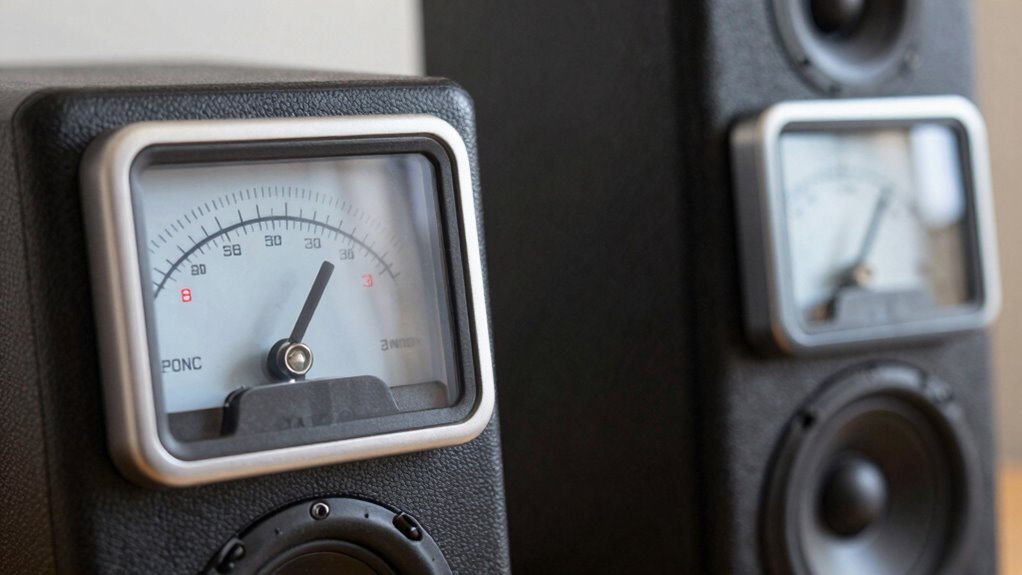
To compare sound ratings measured at different distances, first guarantee your equipment is properly calibrated for accuracy. Normalize the measurements using a distance correction formula, such as adding 20 dB when scaling from 10 meters to 1 meter under free-field conditions. Keep environmental variables like background noise and reflections consistent or accounted for, as they can affect the readings. mastering these steps will help you get reliable, comparable sound levels—if you keep exploring, you’ll discover even more precise techniques.
Key Takeaways
- Use the distance correction formula to normalize sound levels to a common reference distance.
- Ensure measurements are taken under similar environmental conditions to allow valid comparison.
- Calibrate sound measurement equipment regularly to maintain measurement consistency.
- Account for environmental variables like reflections, obstacles, and wind that can influence sound readings.
- Recognize that sound diminishes by approximately 6 dB when the distance doubles under ideal free-field conditions.
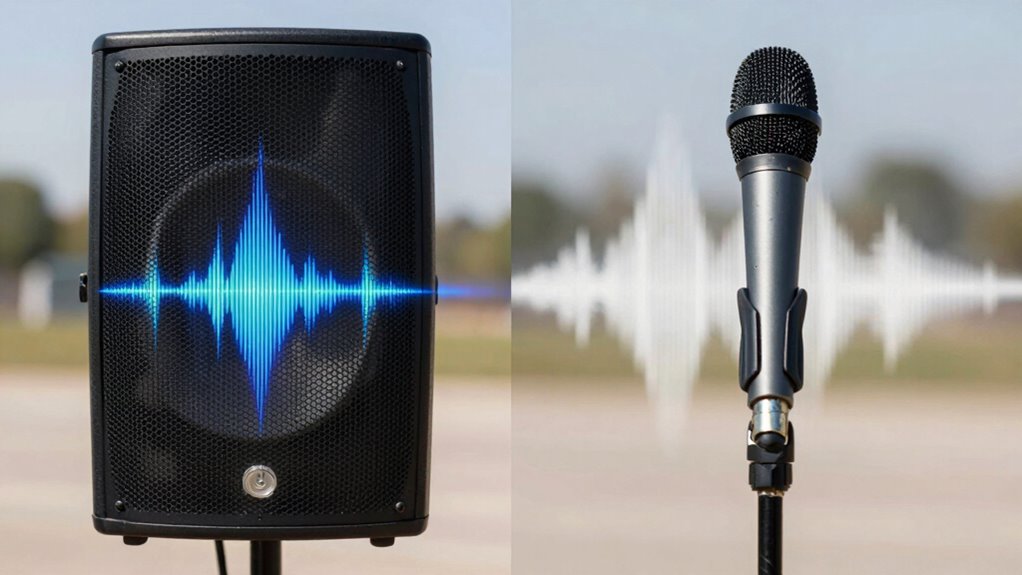
Ever wondered how sound diminishes as you move farther from its source? When comparing sound ratings measured at different distances, understanding the principles behind sound level calibration is essential. You need to ensure the measurements are accurate and consistent, so any differences you observe aren’t due to equipment errors or inconsistent procedures. Measurement consistency is the foundation for making reliable comparisons across various distances.
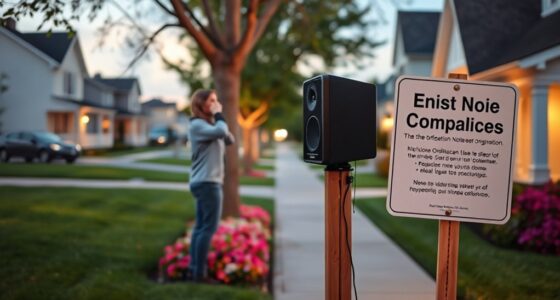
First, recognize that sound intensity decreases with distance due to the spreading of sound waves, often following the inverse square law in ideal conditions. This means that if you double the distance from the source, the sound level drops by approximately 6 decibels. To compare ratings accurately, you must normalize measurements to a common reference point or distance. This process involves adjusting the recorded sound levels based on the distance at which each measurement was taken, which relies heavily on proper sound level calibration. Proper sound level calibration ensures measurement accuracy and comparability across different distances.
Measurement consistency also requires controlling environmental variables. Factors such as background noise, reflections, and obstacles can influence sound readings. To compare sound ratings effectively, you should conduct measurements under similar conditions or record environmental factors to account for them during analysis. This way, differences in sound levels are more likely to reflect actual variations in the source rather than external influences. Additionally, understanding sound propagation helps in predicting how sound behaves under different conditions and improves measurement accuracy. Considering environmental factors such as wind or surface reflections further enhances the reliability of your comparisons.
When comparing measurements, use the formula for distance correction to normalize sound levels to a common distance. For example, if you know the sound level at 10 meters, you can estimate the level at 1 meter by adding 20 decibels, assuming free-field conditions. Applying these corrections consistently ensures that your comparisons are valid and reflect true differences in sound ratings rather than measurement artifacts.
As an affiliate, we earn on qualifying purchases.
Frequently Asked Questions
How Do Environmental Factors Affect Sound Measurements at Different Distances?
Environmental factors greatly influence sound measurements at different distances. You’ll notice sound attenuation caused by obstacles, humidity, and temperature, which can distort readings. To guarantee accuracy, you need measurement calibration to account for these variables. Adjusting for environmental influences helps compare sound ratings more reliably, as external conditions can either amplify or diminish sound levels, making it vital to take these factors into account when interpreting measurements taken across varying distances.
What Tools Are Best for Measuring Sound at Various Distances?
Imagine a trusty Sound Level Meter as your modern-day sound detective, capturing precise measurement accuracy across various distances. For best results, use digital sound level meters with wide frequency ranges and data logging features. For larger areas, consider using remote or wireless microphones. These tools help you accurately assess sound levels at different distances, ensuring your measurements are reliable and consistent, much like a seasoned Sherlock piecing together clues.
How Does the Type of Sound Source Influence Distance-Based Ratings?
The type of sound source considerably influences distance-based ratings because consistent sound sources guarantee accurate comparisons. If your sound source varies or isn’t steady, measurement calibration becomes challenging, leading to unreliable data. For example, a steady, continuous source like a speaker provides more dependable readings than a fluctuating one. Always check for sound source consistency and calibrate your measurement tools properly to accurately compare sound levels across different distances.
Can Sound Ratings Be Directly Compared Across Different Environments?
Did you know sound ratings can vary by up to 20 decibels across different environments? You can’t directly compare these ratings without considering factors like frequency response and acoustic calibration. Different spaces influence how sound travels, so calibration ensures measurements are consistent. When comparing ratings, always account for environment-specific variables, as acoustic conditions greatly impact sound levels, making direct comparisons less reliable without proper calibration and understanding of the frequency response.
How Do You Account for Obstacles Blocking Sound Paths?
Obstacles block sound paths by causing signal attenuation, which decreases sound intensity. To account for this, you should identify the type and size of obstructions, then use models or measurements to estimate their impact. You can adjust sound ratings by applying correction factors for obstruction impact, ensuring more accurate comparisons. Remember, larger or denser objects cause greater signal attenuation, so consider these factors when evaluating sound performance in obstructed environments.
professional sound calibration equipment
As an affiliate, we earn on qualifying purchases.
As an affiliate, we earn on qualifying purchases.
Conclusion
As you stand in the quiet park, imagine the distant hum of a city fading into a gentle whisper. Comparing sound ratings at different distances is like tuning into a melody from afar and then drawing closer to hear every note clearly. By understanding how sound diminishes over space, you can better gauge its true intensity. So, next time you listen, picture that sound’s journey from the source to your ears, revealing its real character along your path.
As an affiliate, we earn on qualifying purchases.
As an affiliate, we earn on qualifying purchases.