TL;DR

Get backup power and energy gear delivered free with Prime
- Fast, free delivery on millions of items
- Prime Video, Amazon Music and more included
- Member-only deals all year
Silicon Ranch has introduced a 15-cow herd at its 3.25-megawatt solar project in Christiana, Tennessee, using elevated, adjustable panels designed for grazing. The company describes the site as the first commercially viable utility-scale U.S. project combining solar generation and cattle farming; the approach’s long-term costs and performance remain unproven.
Silicon Ranch has brought 15 cattle onto its 3.25-megawatt solar project in Christiana, Tennessee, pairing utility-scale power generation with grazing. The company says the project is the first commercially viable U.S. utility-scale installation to combine solar and cattle farming, an approach that could let developers and farmers use the same land for energy and livestock.
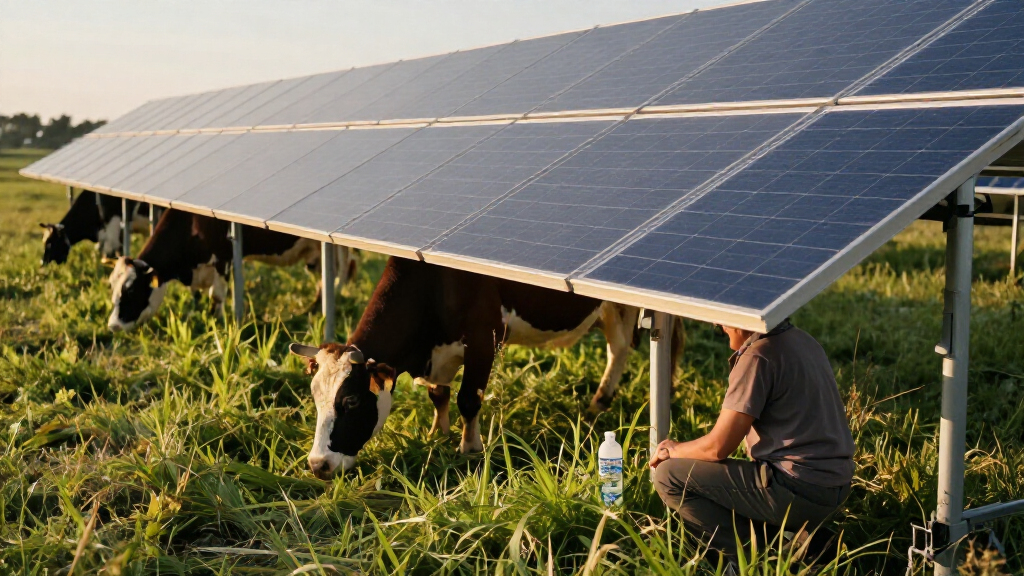
The herd rotates through 15 paddocks delineated with electric wire, grazing Bermuda grass beneath solar panels mounted higher than standard arrays. The cattle had been at the site for about six months when the report described the project. Silicon Ranch says the animals’ presence has worked better than its team initially expected, though the project is still an early test of the arrangement.
To accommodate the animals, the company developed a system called CattleTracker, using moderately elevated steel supports and adjustments to the solar trackers. In paddocks where cattle are grazing, the panels enter a “graze mode” that limits their tilt to about 20 to 30 degrees, rather than the maximum 60 degrees, keeping the lower panel edges above the animals.
Silicon Ranch executive Loran Shallenberger said the company kept the cost of reinforcing the solar equipment to about 3 percent above a standard design. He also said the project’s electricity was sold to local utility Middle Tennessee Electric for less than the wholesale rates the utility paid to the Tennessee Valley Authority. Those cost and price figures are the company’s account; the report does not provide independent project financial records.
Combining grazing and power generation could help answer a land-use concern as solar development expands: some communities object to large installations replacing familiar rural landscapes or agricultural land. If livestock can continue using a solar site, developers may be able to produce electricity without removing all agricultural activity from the property.
The idea also has a potential economic appeal for landowners. Solar revenue and cattle production could take place on the same acreage, rather than competing for it. But this project does not establish how much additional income ranchers could earn, whether the setup will work at other sites, or whether its costs will remain manageable at a larger scale.
There is a clear limit to the climate case: putting panels over cattle pasture does not address emissions from cattle themselves. The reported benefit is additional carbon-free electricity from land that remains in agricultural use, not a reduction in livestock’s greenhouse gas emissions.
Products Worth Considering

Roborock RockNeo Q110H Wire-Free Robot Lawn Mower

Philips Hue Play Gradient 65-Inch Smart TV Light Strip

Blueair Blue Pure 211i Max Air Purifier for Large Rooms
As an affiliate, we earn on qualifying purchases.
Why Cattle Need Special Panels
Solar developers already use sheep to manage vegetation at some sites, but cattle pose different engineering challenges. Their size and behavior can put equipment at risk, and conventional trackers move panels through the day to capture more sunlight. Designs made to withstand cattle may require extra steel and project-specific adjustments, adding costs for developers focused on generating as much electricity as possible per acre.
Silicon Ranch developed its approach with support from a Department of Energy grant, according to the report. The company opted for moderately raised supports rather than very tall structures, which would require additional steel underground for stability. It also selected Murray Grey cattle, a breed described in the report as known for calm dispositions.
The project follows earlier experiments in agrivoltaics, the practice of combining solar installations with agriculture. The report notes that an earlier 2-megawatt AES project in Massachusetts explored solar and sheep grazing in a community-solar setting. Silicon Ranch’s Christiana site is presented as a distinct test involving cattle at utility scale.
“I thought it would work — I just didn’t think it would work this well.”
— Loran Shallenberger, who leads Silicon Ranch’s Regenerative Energy and Agrivoltaics division
Costs and Long-Term Performance
The project’s initial results do not show whether the system will perform reliably over many years or across different farms, cattle breeds, climates and solar designs. The 3 percent cost premium and electricity-price comparison come from Silicon Ranch; independently verified cost data and a detailed comparison with conventional solar projects are not included in the report.
It is also not clear how much grazing affects panel output, maintenance needs, the condition of the pasture or the health and productivity of the cattle over time. Jennings of the Electric Power Research Institute said the research is still relatively new and that cattle’s interactions with panels remain uncertain.
Testing Whether the Model Scales
The next test is whether Silicon Ranch can repeat the approach at other projects while keeping equipment costs and electricity production competitive. The company’s Christiana installation offers a working example, but the report does not identify a published long-term evaluation, a timetable for wider deployment or additional projects already planned.
For now, developers, utilities and researchers will need more operating data to judge whether cattle-friendly solar can be used broadly. Relevant measures include maintenance costs, energy output, grazing outcomes and livestock safety. Until those results are available, the Tennessee project is evidence that the combination can be attempted, not proof that it will suit every solar site.
Key Questions
Where is the cattle-and-solar project?
It is at a 3.25-megawatt Silicon Ranch solar project in Christiana, Tennessee, southeast of Nashville.
How many cattle are grazing at the site?
The report describes a 15-member herd rotating among 15 fenced paddocks beneath the panels.
How are the panels adjusted for cattle?
Silicon Ranch’s CattleTracker system raises the panels on moderately elevated supports. When cattle are in a paddock, the trackers enter “graze mode,” limiting panel tilt to about 20 to 30 degrees.
Does the project reduce emissions from cattle?
No such reduction is reported. The project’s stated climate rationale is that it adds solar electricity while allowing livestock to graze on the same land; it does not address cattle emissions.
Has cattle-friendly solar been proven to work at scale?
Not yet. Silicon Ranch describes this as the first commercially viable U.S. utility-scale project combining solar and cattle, but its long-term costs and performance remain uncertain.
Source: canarymedia.com