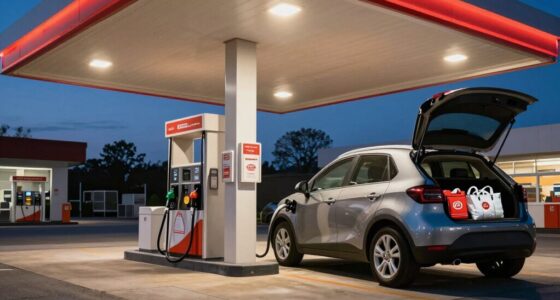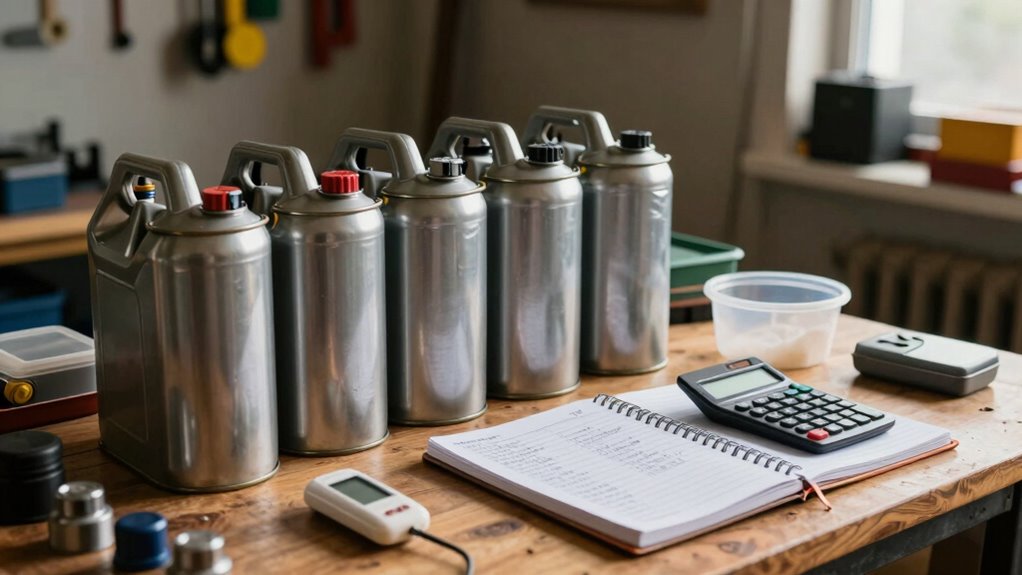

To estimate fuel needs for a 24-hour outage, start by listing your essential appliances and noting their wattages. Then, calculate the total power demand and determine how long each device runs daily. Check your generator’s fuel consumption rate at different loads and plan for running it at an efficient level with a safety buffer of 10-20%. Properly storing enough fuel and maintaining your equipment helps prevent shortages; continue to explore for detailed steps and tips.

Get backup power and energy gear delivered free — and shop member deals
- Fast, free delivery on millions of items
- Access to Prime Big Deal Days deals on October 6–7
- Prime Video, Amazon Music and more included
Key Takeaways
- Determine total wattage of essential appliances and their estimated operation durations.
- Check the generator’s fuel consumption rate at different load levels from the manual.
- Calculate baseline fuel needs by multiplying hourly consumption by 24 hours.
- Add a 10-20% buffer to account for inefficiencies and unexpected demands.
- Ensure fuel storage capacity can accommodate the total estimated fuel requirement comfortably.
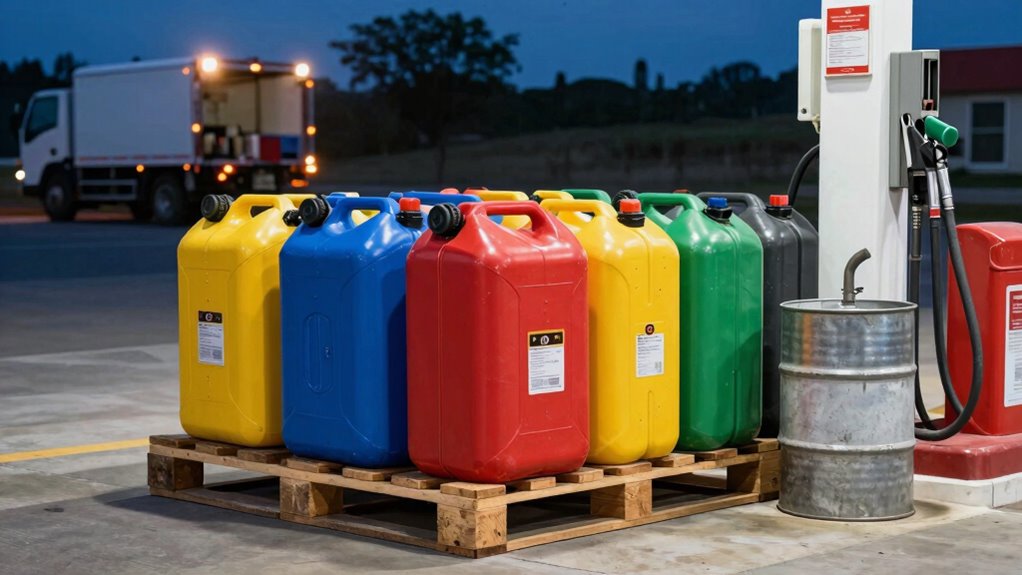
Planning for a 24-hour power outage means knowing exactly how much fuel you’ll need to keep essential appliances running. To do this effectively, you need to assess your power requirements, the efficiency of your generator, and how long each appliance will need to operate. Start by listing out the devices you deem essential—refrigerators, heating units, lights, medical devices, or communication tools—and determine their wattage. This helps you estimate the total power demand, which is fundamental for calculating the amount of fuel you’ll need to keep everything running smoothly.
Next, understand your generator’s fuel consumption rate. Most generators specify how many gallons or liters they consume per hour at a certain load. If you don’t have this info, check your generator’s manual or look for manufacturer specifications online. Keep in mind that running a generator at full capacity consumes more fuel, but operating it at lower loads is more efficient. To be safe, plan for the generator to run at a level that covers your essential power needs while factoring in some buffer for unexpected needs.
Check your generator’s manual for fuel consumption details at different loads to plan efficiently.
Generator maintenance plays a key role here. Ensuring your generator is well-maintained before an outage means it will operate reliably when you need it most. Regularly check oil levels, spark plugs, filters, and fuel quality. Proper maintenance reduces the risk of breakdowns, saving fuel and preventing stress during a crisis. Also, keep spare fuel on hand, stored safely and in accordance with local regulations, so you don’t run out unexpectedly. Having enough fuel stored in advance is a critical part of emergency preparedness, allowing you to avoid scrambling for resources when the power goes out.
To estimate your fuel needs for a 24-hour period, multiply your generator’s hourly consumption rate by 24 hours. Add a buffer—say 10-20%—to account for inefficiencies or unexpected power demands. For example, if your generator consumes 0.5 gallons per hour, you’ll need about 12 gallons for the day, plus extra. Don’t forget that the duration your appliances operate will influence your total fuel requirements; if some devices only need intermittent power, adjust your calculations accordingly. Additionally, understanding the importance of generator efficiency can help optimize your fuel usage during emergencies. Properly assessing your fuel storage capacity is also essential to ensure you have enough resources during an outage, especially considering appliance energy consumption patterns during prolonged outages.
A thorough understanding of fuel consumption rates helps you plan more accurately and avoid shortages.
portable generator fuel consumption meter
As an affiliate, we earn on qualifying purchases.
As an affiliate, we earn on qualifying purchases.
Frequently Asked Questions
What Types of Fuel Are Suitable for Backup Power During Outages?
You should consider diesel, gasoline, or propane as suitable fuels for backup power during outages. For safe fuel storage, keep containers tightly sealed and away from heat sources, following safety precautions. Regularly inspect and maintain your storage tanks to prevent leaks or accidents. Using these fuels properly guarantees reliable power during emergencies while minimizing risks, so always prioritize safety and proper handling to keep your backup system effective and secure.
How Accurate Are Online Fuel Consumption Calculators?
A stitch in time saves nine, and online fuel consumption calculators can be quite helpful, but they’re not perfectly accurate. Your fuel efficiency varies based on equipment, load, and conditions. These tools give a good starting point for estimation, but you should always add a buffer. For a 24-hour outage, rely on actual fuel usage data when possible, and use calculators as a guide rather than gospel.
Can Renewable Energy Sources Reduce Fuel Needs?
Renewable energy sources can greatly reduce your fuel needs, especially when combined with renewable integration and energy storage. By integrating solar or wind power, you decrease reliance on fossil fuels, and energy storage ensures a steady supply during low-generation periods. This approach helps cut fuel consumption, lowers costs, and enhances energy resilience during outages. You’ll find that renewables make your energy system more sustainable and less dependent on traditional fuel sources.
What Safety Precautions Should Be Taken When Storing Fuel?
You should prioritize fuel container safety by storing fuel in approved, tightly sealed containers away from heat sources. Always heed storage temperature considerations—keep fuel in a cool, well-ventilated area to prevent pressure buildup and degradation. Regularly inspect containers for leaks or damage, and guarantee they’re stored upright. Keep flames, sparks, and open flames away, and follow local regulations to minimize fire hazards and ensure safe fuel storage during outages.
How Often Should Fuel Supplies Be Rotated or Replenished?
Think of your fuel supplies as a delicate garden needing regular tending. You should rotate or replenish your fuel every 6 to 12 months to maintain fuel stability, preventing it from turning sour. Use proper, sealed storage containers to protect against moisture and degradation. Regularly check for signs of spoilage or leaks, and replenish to guarantee your emergency stash stays fresh and ready, like a well-watered plant in times of drought.
gasoline storage containers for emergency
As an affiliate, we earn on qualifying purchases.
As an affiliate, we earn on qualifying purchases.
Conclusion
Planning ahead guarantees you’re well-prepared for any unexpected quiet moments. By carefully estimating your fuel needs, you’ll avoid running low when it counts most. A little foresight goes a long way in keeping your operations smooth and stress-free. Remember, the goal isn’t just to survive the downtime, but to glide through it gracefully. With these tips, you’ll turn a potential challenge into a well-managed pause, leaving you confident and ready for what’s next.
As an affiliate, we earn on qualifying purchases.
essential appliance power consumption monitor
As an affiliate, we earn on qualifying purchases.
As an affiliate, we earn on qualifying purchases.
Fall Picks
fall essentials
As an affiliate, we earn on qualifying purchases.