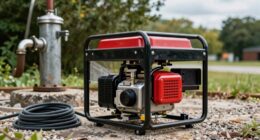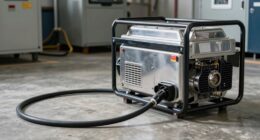

To reduce generator noise effectively, position it at least 20 to 30 feet away from your living or working areas. Distance helps lower the perceived sound levels and minimizes disturbance. Keep in mind that terrain, structures, and natural features can influence sound dissipation, so additional methods like barriers or noise cancellation might be helpful. If you want to learn more about optimizing placement and noise control strategies, there’s helpful information ahead.
Key Takeaways
- Place the generator 20-30 feet away from living or quiet areas for effective noise reduction.
- Use soundproof barriers around the generator to block and absorb sound waves.
- Natural features like foliage or sheds can help dissipate noise alongside distance.
- Larger, louder generators may require greater distances and additional soundproofing measures.
- Combining increased distance with barriers and noise-canceling techniques provides optimal noise control.

Have you ever wondered how far you should position a generator to keep noise levels down? The distance really depends on a few factors, but generally, the farther away you situate your generator, the quieter it will seem. However, simply moving it farther isn’t always enough, especially if you’re in a space where noise could disturb neighbors or disrupt your peace. To maximize noise reduction, consider using soundproof barriers around your generator. These barriers act as physical shields, absorbing and blocking sound waves before they reach your ears or neighboring properties. Materials like dense foam, mass-loaded vinyl, or specially designed soundproof panels can dramatically cut down the noise escaping from your generator.
Position your generator far away and add soundproof barriers for effective noise reduction.
In addition to soundproof barriers, employing noise cancellation techniques can make a big difference. These methods involve creating interference with the sound waves emitted by the generator, effectively canceling them out. You might use white noise generators or sound masking systems nearby to drown out the engine noise. Combining these techniques with proper placement can lead to significant noise reduction, especially in urban or noise-sensitive environments.
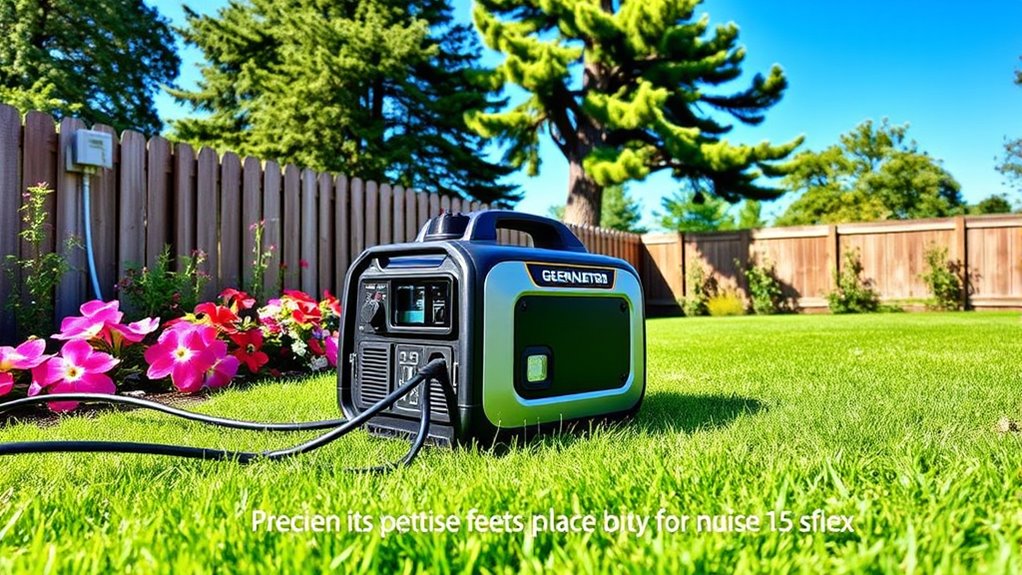
When deciding how far to place your generator, keep in mind that sound dissipates with distance. Typically, placing the generator at least 20 to 30 feet away from living or workspaces can reduce noise to acceptable levels. If you’re in a densely populated area, you might need to extend that distance further or add additional barriers. Remember that terrain and structures matter too; placing it behind a shed or behind thick foliage can help block direct sound paths. Yet, don’t rely solely on natural features—integrating soundproof barriers will give you better control over noise levels.
Another key consideration is the generator’s design and size. Larger, louder units naturally require greater distances and more extensive soundproofing measures. If noise is a major concern, investing in quieter models or inverter generators can lessen the need for extreme distancing. Still, combining these quieter units with strategic placement and soundproof barriers offers the best results.
Ultimately, the ideal placement balances safety, accessibility, and noise control. Keep your generator as far away as practical, reinforce it with soundproof barriers, and employ noise cancellation techniques when possible. Doing so ensures you keep noise levels down while maintaining the convenience of having power on demand. Remember, thoughtful placement is your first line of defense against disruptive noise, so take your time to plan it carefully. Considering soundproof barriers and their effectiveness can greatly enhance your noise mitigation strategy.

TroyStudio Portable Sound Proof Box, 16" x 12" x 16.2" Noise Reduction Enclosure, Light Blocking Quiet Cover, Soundproof Barrier for Ultrasonic Cleaner, Air Pump, Rock Tumbler & Generator
【DIMENSIONS & COMPONENTS】: Exterior dimensions: 16"L x 12"W x 16.2"H; Interior space: 12"L x 8"W x 14.2"H; Foldable…
As an affiliate, we earn on qualifying purchases.
As an affiliate, we earn on qualifying purchases.
Frequently Asked Questions
Can Placing the Generator Farther Away Impact Its Cooling Efficiency?
Placing your generator farther away can impact its cooling efficiency if airflow isn’t maintained. When you position it too far, the hot air exhaust might not dissipate effectively, causing the generator to overheat. To optimize cooling efficiency, guarantee proper ventilation and avoid obstructions, even if you decide to increase the distance. Proper generator placement balances noise reduction with adequate airflow, keeping your unit running smoothly and safely.
Does Terrain or Landscaping Affect Noise Reduction When Placing a Generator?
Terrain and landscaping considerably influence noise reduction for your generator. You can improve outdoor acoustics by using sound barriers like fences, shrubs, or walls that absorb or deflect sound. Elevating the generator on a platform minimizes ground vibrations, while natural features such as trees or hills act as sound dampers. By combining strategic placement with landscape elements, you enhance noise control, making your outdoor space quieter and more comfortable.
Are There Legal Distance Requirements for Placing Generators in Residential Areas?
You should verify your local zoning codes and legal regulations before placing your generator. Many residential areas have specific distance requirements to ensure noise doesn’t disturb neighbors, often recommending at least 10 to 20 feet from structures or property lines. Ignoring these rules can lead to fines or complaints. Always verify your city or neighborhood’s rules, and position your generator accordingly to stay compliant and minimize noise issues.
How Does the Type of Generator Influence Optimal Placement Distance?
If you have a large, high-noise generator, you should place it farther away from your home, perhaps 20-30 feet, to minimize disruption. For example, a commercial-grade generator with a high noise level requires more distance than a small, inverter-type generator. Your generator size and noise level directly influence the most suitable placement distance, ensuring safety and comfort while complying with local regulations.
What Additional Noise Mitigation Methods Can Complement Increased Distance?
You can further reduce noise by adding soundproof barriers around your generator, which absorb or block sound waves. Vibration dampening mats placed beneath the generator also help minimize noise caused by vibrations. Combining these methods with increased distance creates a quieter environment. Keep in mind, sealing gaps and maintaining the generator can also improve noise reduction, ensuring you stay within safe and comfortable noise levels.

LUNTHINK Generator Box, Generator Quiet Box Interior Space: 39.4" x 35" x 35.5", Ventilation, Heat Dissipation and Impact Resistance
High quality: Made of high-temperature galvanized steel plates, both the inner and outer surfaces are treated with high-temperature…
As an affiliate, we earn on qualifying purchases.
As an affiliate, we earn on qualifying purchases.
Conclusion
Think of your generator as a loud neighbor’s music. The farther you place it, the quieter the noise reaches you. Just like choosing a cozy spot away from that booming sound, find the right distance to keep your peace. Moving it a little farther isn’t just about noise—it’s about creating your own peaceful oasis. So, measure wisely and give yourself the gift of tranquility, even when the power’s out.

WEN Quiet and Lightweight 4800-Watt RV-Ready Portable Inverter Generator with Fuel Shut Off (56477i)
224cc engine generates up to 4800 surge watts and 4000 rated watts
As an affiliate, we earn on qualifying purchases.
As an affiliate, we earn on qualifying purchases.

Pure Resonance Audio SMG1 Sound Masking Generator – Adjustable White, Brown & Pink Noise for Speech Privacy & Productivity, Commercial-Grade, Mounting Bracket Included
Protect Privacy & Reduce Distractions – Effectively masks speech and background noise, ensuring confidential conversations remain private in…
As an affiliate, we earn on qualifying purchases.
As an affiliate, we earn on qualifying purchases.