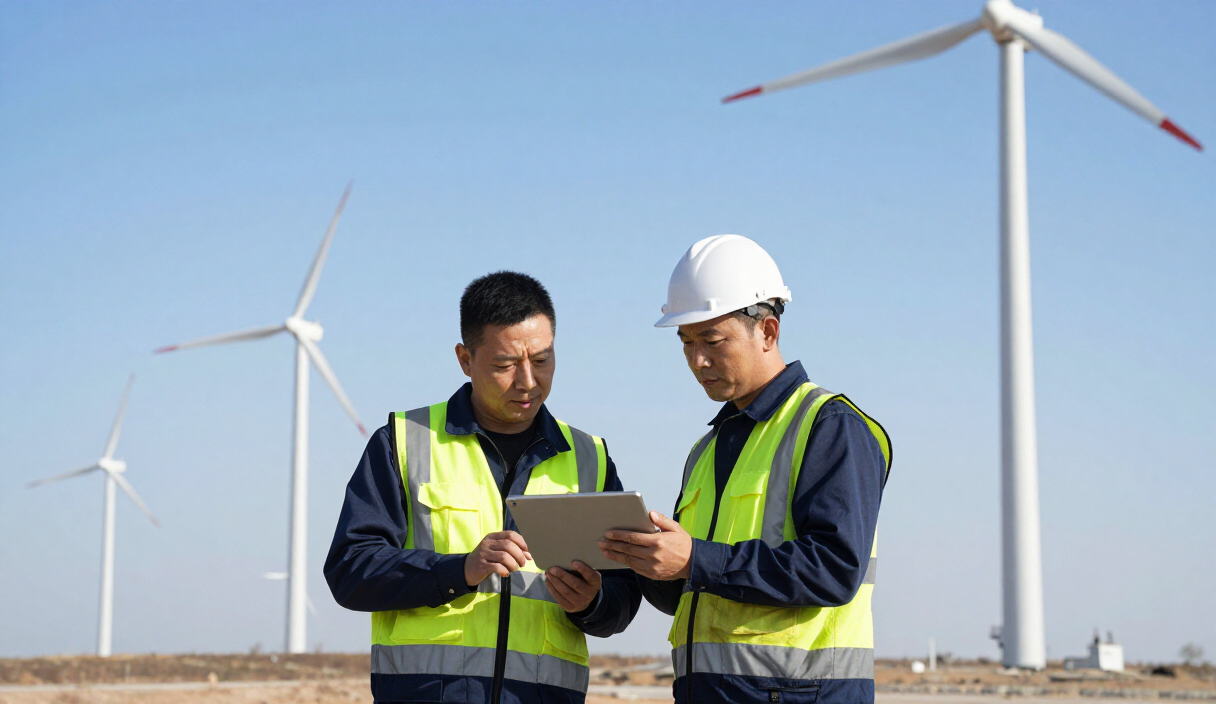
Wind farms are built across distance. Turbine positions are spread over large sites, crews rotate, acceptance walks happen in the field, and mobile coverage cannot be assumed. Yet the documentation still has to be completed. Meetings, evidence, defects, deadlines and reports cannot become less precise simply because the work is distributed or a crew has entered a dead zone.
Energie & Öko · Field documentation
A wind farm’s records must travel farther than its crews.
Across dispersed turbine positions, rotating teams and dead zones, every observation still has to stay connected to the correct place, task and trade.
Acceptance is distributed across the site. Position-specific defects, recurring issues and meeting decisions cannot drift into the wrong record.
Crews can continue documenting without a connection and sync later, so signal availability does not decide whether an observation is recorded.
The platform separates field capture, browser-based planning and operational coordination.
Cross-border teams in the EU, US and APAC can work in their own language while the evidence original remains unambiguous.
Projects can use an EU cloud or the customer’s own infrastructure, with regional AI-provider selection across the EU, US and Asia, including mainland China.
That makes wind farms and renewable-energy projects natural territory for Gewerkton, a voice-first construction documentation and defect management platform for global markets. Its central premise is captured by the line: “On site, what counts is what’s proven.” For renewables, that is less a slogan than a description of the work. A project may span dozens of turbine positions, but its decisions and records still need to remain connected to the right place, task and trade.
The product is in beta now, with a public beta planned for fall 2026. That status matters for anyone evaluating it: Gewerkton is not being presented as a finished, generally available platform. It is a developing system with three product lines—Field, Studio and Cloud—built around the documentation demands of construction teams working on site, in the browser and across project data.
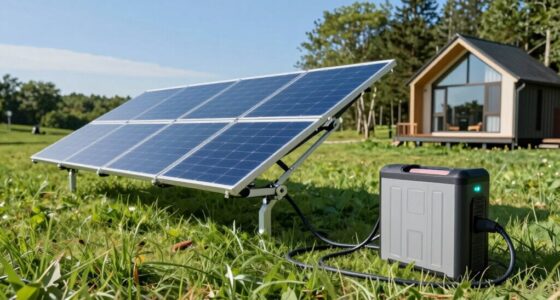
field documentation tablet for wind farm construction
As an affiliate, we earn on qualifying purchases.
As an affiliate, we earn on qualifying purchases.
Why renewables put documentation under pressure
A conventional site already produces a steady stream of observations, instructions, defects, reports and acceptance records. A wind farm adds geography to that burden. The work is not concentrated around one building or a compact group of trades. Teams move between turbine positions, responsibilities pass between rotating crews, and field acceptance must take place where the physical work is located.
That distribution changes the practical challenge. A note about one turbine position cannot drift into the records for another. A meeting decision must survive beyond the group that heard it. A defect recorded during an acceptance walk needs to remain documented when the next crew takes over. Information has to travel even when the people who created it do not remain on site.
Connectivity creates another constraint. Dead zones are not an exceptional edge case for distributed renewable sites. They are part of the working environment. Gewerkton Field supports offline capture so documentation can continue without a connection and be synced later. The essential point is continuity: the absence of a signal does not remove the need to record what happened.
This is the setting for Gewerkton Field, the product line that carries the renewable-energy story. Field is the voice-first construction site app, covering dictation to evidence, defects, daywork reports, takt and a portal. It is designed around the reality that site documentation is created while people are moving through the work, not while they are sitting at a desk.
offline data capture device for construction sites
As an affiliate, we earn on qualifying purchases.
As an affiliate, we earn on qualifying purchases.
Voice-first capture fits work that happens on the move
Acceptance walks are observational by nature. Site teams inspect, speak, point, photograph and move on. A voice-first workflow treats dictation as the beginning of a record rather than an informal note that must be rewritten later. In Field, dictation can become evidence, defects and daywork reports within the site workflow.
For wind projects, that matters because the unit of attention changes continually. A crew can be discussing one position, moving toward another and working through a series of acceptance items. The documentation has to keep pace with the walk. If capture is delayed until the team returns to an office, the record becomes separated from the moment and location in which it was created.
Offline capture addresses the same problem from another direction. Documentation continues in a dead zone and syncs later. This does not make connectivity irrelevant; it prevents connectivity from deciding whether a field observation can be captured at all. On a distributed site, that distinction is fundamental.
Meetings create a parallel trail of information. Decisions made by the people present need to remain documented across the project, including across dozens of turbine positions. The value lies in preserving the working record as crews rotate and the site advances, rather than allowing decisions to remain attached only to a particular meeting or individual.
cloud-based project management software for wind farms
As an affiliate, we earn on qualifying purchases.
As an affiliate, we earn on qualifying purchases.
Defects cannot disappear between turbine positions
Wind-farm acceptance is not one walk through one finished structure. It involves field activity distributed across multiple positions. The documentation therefore has to distinguish between recurring issues, position-specific defects and the decisions made during each part of the process.
Field brings defects into the same voice-first site environment as evidence and reports. That gives crews a consistent place to record what they encounter during field acceptance. The purpose is not to make the site appear simpler than it is. It is to keep the complexity visible and documented as work moves between positions and teams.
Housing and building construction illustrates another part of the same Field capability: defects can be recorded with a photo and deadline, while daywork reports can be dictated and a signature can be captured on the device during handover. The deployment setting is different, but the underlying discipline is recognisable. A finding is more useful when it remains tied to its evidence and expected follow-up.
On renewable sites, disciplined capture also supports the larger sustainability argument. Sustainable building claims become verifiable when the work behind them is documented consistently. The environmental purpose of a project does not replace the need for evidence. If anything, it raises the importance of being able to show what was built, what was observed and how site issues were recorded.

VOICEGIFT Play, 10 Hour Capacity Screen-Free Voice Recorder, Playback Tool, Portable Electronic Story Player with Speaker, Clip & Strap, Add Voice to Journals, Albums and Keepsakes
- Screen-Free Audio Player: Plays stories without screens or Wi-Fi
- Custom Voice Recordings: Records up to 2.5 hours of audio
- Child-Friendly Design: Includes stickers and simple controls
As an affiliate, we earn on qualifying purchases.
As an affiliate, we earn on qualifying purchases.
The same field logic applies to charging infrastructure
EV-adjacent construction brings a similar pattern. Charging-infrastructure sites are distributed, field crews move between locations, and documentation must follow the work. The physical assets differ from turbines, but the operational question remains: can a team create a usable record at the point of work, including when the connection is unavailable?
For both wind farms and charging infrastructure, the site is not a single stable office environment. Capture has to work in the field, and later coordination has to preserve the relationship between the record and the relevant site position. Voice-first input and offline capture are therefore not decorative additions. They respond directly to the conditions under which renewable and EV-adjacent construction is documented.
Gewerkton’s wider structure is built around this division between field capture, browser-based planning and operational coordination. The three lines share one brand, but each has a distinct role. That separation matters when assessing the platform because it shows where the field workflow ends and where broader project coordination begins.
Field, Studio and Cloud
Gewerkton Field
Field is the construction site app. It takes voice-first input into evidence, defects, daywork reports and takt, with a portal included in the product line. For distributed renewable projects, it is the direct interface with site activity: the place where crews document during walks, acceptance and day-to-day work.
Gewerkton Studio
Gewerkton Studio is the browser workspace for plans and models. Where no model exists, the site team can create one in the browser. That is relevant to projects where the documentation structure cannot depend on a model already being available. Studio provides the browser side of the branded product house without turning the field app into a catch-all.
Gewerkton Cloud
Gewerkton Cloud handles operations and model or data coordination between Field, Studio and third parties. In a distributed project, coordination is the link between records created on site and the wider project environment. Cloud occupies that link across the three-part system.
Data residency is a choice: an EU cloud or the customer’s own infrastructure. Gewerkton also offers regional AI-provider selection across the EU, the US and Asia, including mainland China. These options address projects whose teams, data and operating requirements cross regional boundaries.
One project, many languages and regions
Renewable-energy construction can bring together teams from different countries and regions. Gewerkton supports 27 content languages and is designed for cross-border teams in the EU, US and APAC working on the same project, each in their own language while the evidence original remains unambiguous.
Projects in Asia are an explicit deployment field. Chinese, Korean and Vietnamese crews can work in multilingual flows from capture through to report, with data residency selected by the project. Gewerkton was born in the German market and has its deepest German commercial integration through GAEB, REB, XRechnung and DATEV, but its stated scope is global.
The AI architecture follows the same regional approach. Gewerkton’s BYO-AI model covers 13 AI providers, allows organisations to bring their own keys and makes the region selectable across EU, US and Asian providers, including providers in mainland China. The aim is to avoid vendor lock-in while allowing a project to choose the provider and region appropriate to its operating environment.
These choices are particularly relevant when a renewable project involves cross-border participants. Multilingual capture is only part of the problem. Teams must also consider where the supporting services are provided and where project data resides. Gewerkton presents both as selectable parts of the platform rather than assuming one universal arrangement.

Six deployment fields, one documentation discipline
Wind farms and renewables are one of six stated deployment fields. The others show how the same documentation principles are applied under different pressures:
- Data centres and industrial plants, where many trades work in parallel under tight deadlines and meeting decisions become trade-sorted task lists.
- Housing and building construction, where defects are recorded with a photo and deadline, daywork reports are dictated, and handover signatures are captured on the device.
- Infrastructure and tunnels, where projects run for long periods, change orders are numerous and instructions are backed by the original audio.
- Cross-border teams, where participants in the EU, US and APAC work on the same project in their own languages while the evidence original remains unambiguous.
- Projects in Asia, including Chinese, Korean and Vietnamese crews, with multilingual working from capture to report and data residency by choice.
The conditions vary, but the common theme is continuity. Information has to remain usable as trades, crews, languages, project phases and physical locations change. For wind farms, that continuity is tested by distance and connectivity. For industrial plants, it is tested by parallel work and deadlines. For tunnels, it is tested by project duration, change orders and the need to preserve instructions with original audio.
A technically unusual build
Gewerkton is being built by a solo founder directing a fleet of coding agents using Codex and Claude. In one night, that fleet shipped 21 software packages, verified with negative controls and mutation tests. That development model is part of the product’s background, alongside its beta status.
The public-facing operation has also been built with specific constraints. The Gewerkton marketing site is available in 27 languages, uses zero trackers, has no cookie banner and runs on a fully egress-free architecture. A media bank contains more than 51 self-produced clips and posters.
None of those details changes the practical test on a renewable site. The platform still has to fit distributed work, rotating crews, field acceptance and offline capture. The technical architecture and multilingual presentation provide context, but the field workflow remains the decisive part of the proposition.
Documentation is part of sustainable construction
Renewable infrastructure is judged by what it is intended to deliver, but construction quality still depends on ordinary disciplines: accurate capture, clear evidence, recorded decisions and visible defects. A green purpose does not make those requirements disappear. Sustainable building claims are verifiable only when the underlying work is documented.
That is why Gewerkton Field is the most relevant entry point for wind farms and EV-adjacent sites. It concentrates on the moment documentation is created: during the walk, beside the work, across distributed positions and sometimes without a connection. Studio and Cloud then provide the browser and coordination layers around that field record.
The limitations should be stated as clearly as the intended use. Gewerkton is in beta, and its public beta is planned for fall 2026. Teams considering it are evaluating a platform still under development, not a mature product being presented as complete.
Even at this stage, the problem it addresses is easy to recognise. Wind farms cannot bring every turbine position into one room. They cannot keep every crew together for the life of the project, and they cannot guarantee a signal at every point where documentation matters. What they can do is treat capture, evidence and follow-up as part of the construction work itself.
For distributed renewable projects, that is the standard worth keeping in view: documentation should continue where the work happens, remain connected when crews rotate and survive the dead zones between one position and the next. On site, what counts is what’s proven.