
TL;DR

Get backup power and energy gear delivered free with Prime
- Fast, free delivery on millions of items
- Prime Video, Amazon Music and more included
- Member-only deals all year
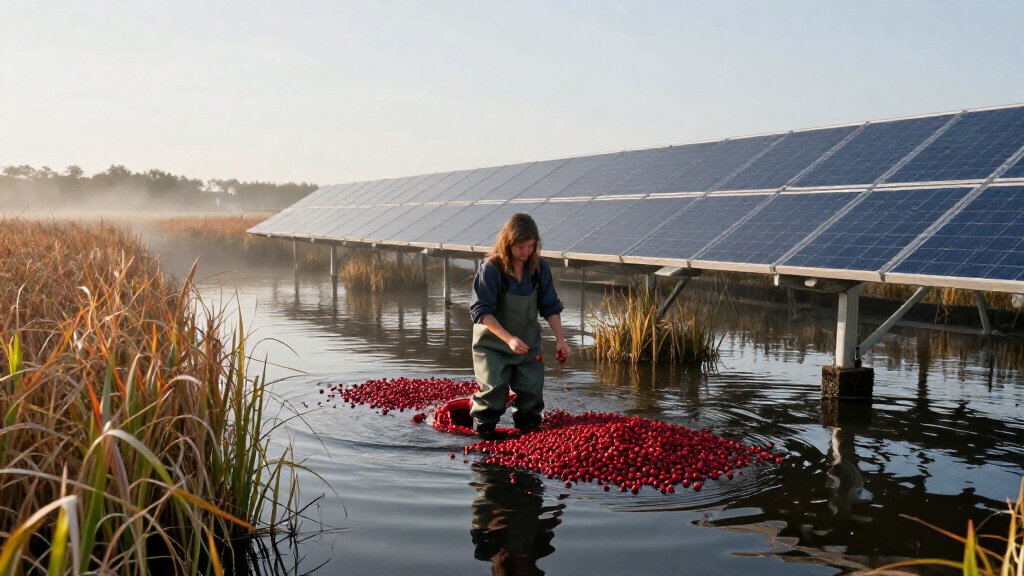
Two cranberry bogs in Kingston and Plymouth, Massachusetts, have completed a second harvest beneath operating solar arrays. The projects pair cranberry production with community solar, showing one way to keep protected agricultural land in use while generating electricity; the long-term effects on yields and farm finances remain unclear.
Two cranberry bogs in Kingston and Plymouth, Massachusetts, have completed a second harvest beneath operating solar panels, a pairing reported as the first of its kind in the country. The projects combine cranberry growing with community solar generation, offering a potential way to keep bogs in agricultural use while producing electricity.
The Kingston site has a 4.4-megawatt solar array paired with a 13.5-megawatt-hour battery. The Plymouth installation has a 1-megawatt array. Clean-energy developer Greenbacker Renewables bought the properties from farmers who were ready to leave the cranberry business, then worked with Distributed Energy Infrastructure to build the projects. Solar consultant and longtime cranberry farmer Iain Ward manages the growing operations.
Both sites use a community solar model, selling electricity to customers. Their panels sit about 10 feet above the ground and can tilt to track the sun. The structures were designed with wider spacing between support pilings so harvesting equipment can pass through. Because the bog soil could not support ordinary foundations, developers had to drive pilings deeper to reach stable ground; wiring runs overhead rather than being buried.
“We are literally proving it can be done,” said Prateek Tare, Distributed Energy Infrastructure’s co-founder and executive vice president, according to Canary Media. Ward described the arrangement as “a farm viability opportunity.” Those comments express the project team’s view; the report does not provide measured results comparing crop yields or farm income with and without the panels.
Solar Power Without Leaving Bog Production
The projects address a siting challenge facing Massachusetts solar development: open land can attract opposition over landscape changes, habitat impacts or the loss of agricultural use, while rooftops and parking areas can be more expensive to develop and offer limited capacity. Agrivoltaics places panels above active farming rather than requiring agriculture to stop.
Cranberry bogs have a particular economic and land-use profile. Massachusetts is the nation’s second-largest cranberry-producing state, after Wisconsin, according to the report. Bogs are protected wetlands and cannot be converted to housing or commercial development even when cranberry production ends. For sites that can connect to the electricity grid, solar may offer another source of revenue while farming continues. Whether these specific projects deliver durable benefits for growers, crop production and local power customers is not established by the reported harvests alone.
Products Worth Considering

Bose SoundLink Plus Portable Bluetooth Speaker, Wireless Outdoor Speaker, Up to 20 Hours Battery Life, Waterproof and Dustproof, Black

Bose SoundLink Flex Bluetooth Speaker (2nd Gen) – Portable Outdoor Speaker with Hi‑Fi Audio, Waterproof and Dustproof, USB‑C, Up to 12 Hours

Philips Hue Secure Starter Kit with Contact Sensors, Motion Sensor, Bridge, and Color Smart Bulbs
As an affiliate, we earn on qualifying purchases.
Massachusetts Incentives and Bog Design
Massachusetts has encouraged dual-use solar, also called agrivoltaics, through its solar incentive program. Canary Media reported that the state began offering a financial boost for such projects in 2018. At the time covered by the report, qualifying arrays between 1 and 5 megawatts had a base rate of 23.17 cents per kilowatt-hour, with an additional 9 cents per kilowatt-hour for agrivoltaic projects. These are program figures reported by the outlet and may depend on eligibility and applicable rules.
The design had to accommodate the waterlogged conditions and day-to-day work of a cranberry farm. Tare said standard solar foundations often extend 8 to 10 feet underground, but the bog installations needed pilings driven farther to find stable ground. Developers also had to keep cables above the bog and leave enough room for harvesting machinery. The resulting setup is distinct from conventional ground-mounted solar and may not transfer directly to every site.
““We are literally proving it can be done.””
— Prateek Tare, co-founder and executive vice president of Distributed Energy Infrastructure
Crop Yields and Project Economics
The report does not provide harvest totals, yield comparisons or long-term financial results for the Kingston and Plymouth bogs. It is not clear how panel shade, equipment access and maintenance affect cranberry production over time, or how electricity revenue and project costs are divided among the landowner, developer, farm manager and community solar customers.
The report describes these sites as the first operating cranberry agrivoltaic projects in the country, and says they may be the first in the world; the broader global claim is not established with a full survey. Grid access is another limitation: not every bog is positioned to connect economically to the electricity system. The report also does not specify when the preliminary work at another bog will lead to construction.
More Bogs and a Carver Restart
Distributed Energy Infrastructure is pursuing additional agrivoltaic projects, including work involving apple orchards, cattle pasture and a Christmas tree farm. Preliminary work is also underway at another cranberry bog, though the report gives no construction or operating timetable.
A separate pair of arrays in nearby Carver could also resume development. They were built at cranberry bogs, and crops are growing beneath them, but the company responsible went bankrupt before the project began operating. Ward said the new bog owner has “every intention to finish them.” The timing, financing and steps required to bring those sites online remain unreported.
Key Questions
Where are the operating cranberry-and-solar projects?
They are in Kingston and Plymouth, southeastern Massachusetts. The Kingston site has a 4.4-megawatt array and battery; the Plymouth site has a 1-megawatt array.
Are cranberries still being grown beneath the panels?
Yes. Canary Media reported that both farms completed a second harvest from beneath operating solar installations.
How do the panels accommodate harvesting?
The panels are mounted about 10 feet above the ground, and their support pilings are spaced to allow harvesting equipment to move through the bog. Wiring is suspended overhead because it cannot be buried in the boggy ground.
Does the report show that solar improved cranberry yields or farm income?
No. It describes the projects and their second harvest, but does not provide yield comparisons or measured financial results that establish an effect on crop production or farm income.
What is happening with the Carver bog projects?
Arrays were built and crops are growing at two Carver bogs, but the projects did not begin operating before the company behind them went bankrupt. Ward said the new owner intends to finish them; a schedule has not been reported.
Source: canarymedia.com