TL;DR

Get backup power and energy gear delivered free with Prime
- Fast, free delivery on millions of items
- Prime Video, Amazon Music and more included
- Member-only deals all year
Germany added around 8.2 GWh of battery storage in the first nine months of 2026, a 91% increase from the same period in 2025, according to BSW-Solar’s analysis of regulator data. Utility-scale installations rose particularly quickly, and the association is urging 15 regulatory reforms as it forecasts full-year additions above 10 GWh.
Germany added about 8.2 GWh of battery storage in the first nine months of 2026, a 91% increase on the same period a year earlier, according to an analysis by the German Solar Association, BSW-Solar. The figures, drawn from the Federal Network Agency’s energy market register, show utility-scale batteries accounting for nearly half of new capacity as the association presses for regulatory changes to support further deployment.
More than 500,000 storage systems were commissioned between January and September, BSW-Solar said. Its analysis of the Bundesnetzagentur’s core energy market data register uses records available as of October 12, 2026. The association cautioned that totals can rise as late installation registrations are added to the database, which is permitted in Germany.
Utility-scale additions reached about 3.8 GWh, roughly 350% above the same nine-month period in 2025. That segment represented just under 46% of newly installed capacity. Residential systems added 3.2 GWh, up 20%; commercial and industrial installations added about 0.7 GWh, up 67%; and micro-storage, often paired with plug-in balcony solar systems, reached approximately 0.5 GWh, up 33%.
BSW-Solar expects Germany’s new storage additions for the full year to exceed 10 GWh. That is an association forecast, not a completed-year figure. The group says deployment needs to grow faster to help integrate the country’s expanding solar and wind generation into the electricity system.
The increase marks a change in the mix of new installations: utility-scale projects contributed nearly 46% of added capacity, while residential systems remained a substantial part of the market at 3.2 GWh. The breakdown matters because batteries can store electricity for later use and may help manage periods when renewable generation and grid capacity do not align.
BSW-Solar argues that more storage could reduce system costs, but the installation figures alone do not establish the savings achieved so far. A study presented in July by Fraunhofer IEE modelled around €3.9 billion in annual savings for consumers and the federal budget in a scenario with 20 GW of additional battery power capacity and four-hour duration. That is a modelled result tied to a specific scenario, not a measured outcome or a forecast that the savings will necessarily occur.
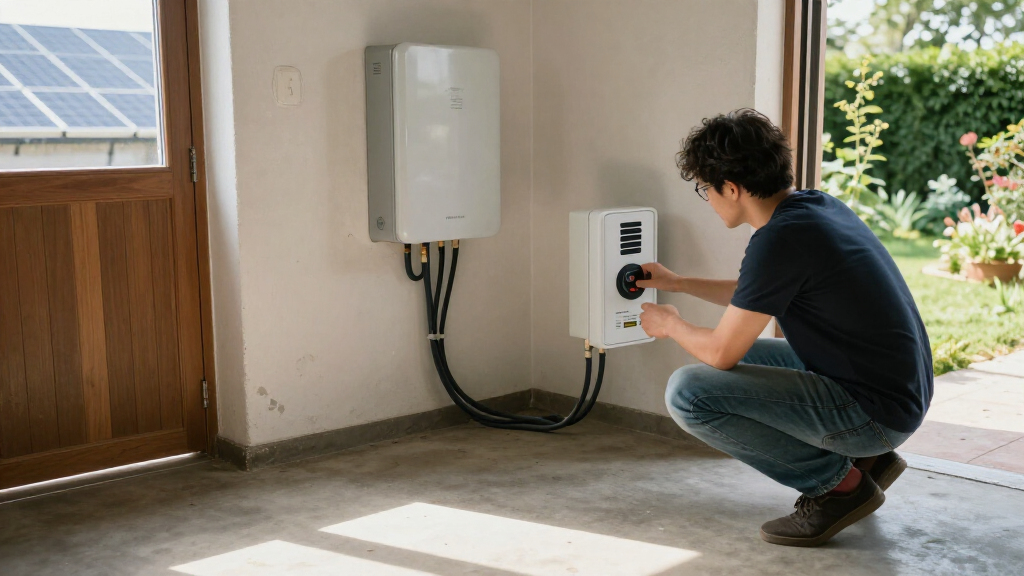
home battery energy storage system
As an affiliate, we earn on qualifying purchases.
As an affiliate, we earn on qualifying purchases.
The Rules Behind Grid Connections
Alongside its market figures, BSW-Solar has published a position paper with 15 proposed reforms. A central issue is access to the grid: the association wants a legally binding right to fair and flexible connection agreements. Grid connection terms are a particular concern for large battery projects, which need to connect to the electricity network and operate within its technical limits.
The group also proposes that distribution system operators run targeted tenders for batteries that can support the grid at substations. On congestion management, it wants the connection point—not each individual generation asset—to determine how restrictions are applied. BSW-Solar says that approach could allow a battery co-located with a solar plant to absorb excess power during a temporary bottleneck instead of requiring the solar plant to curtail generation. These are policy proposals; the source does not report that they have been adopted.
“The association expects full-year additions to easily clear the 10 GWh mark.”
— German Solar Association (BSW-Solar)
As an affiliate, we earn on qualifying purchases.
Late Registrations Could Raise Totals
The 8.2 GWh figure reflects register data available on October 12, rather than a final audited count for the full nine-month period. BSW-Solar says late registrations typically increase installation totals, but the report does not quantify how much the January-September figure may change.
The report also does not give a final full-year 2026 total, individual project details, or evidence that the association’s 15 reform proposals will be enacted. The impact of the proposed grid and congestion rules, and whether the modelled savings would materialize under real-world conditions, remain unsettled.
As an affiliate, we earn on qualifying purchases.
Year-End Data and Policy Decisions
The next market checkpoint will be updated installation data as further registrations enter the Federal Network Agency’s register, followed by a full-year total. BSW-Solar’s expectation of more than 10 GWh in 2026 can be assessed once those figures are available.
On policy, the association is calling for action on its 15 proposals, including grid connection rights, tenders for grid-supportive batteries and changes to congestion management. The supplied report does not identify a government response or a decision timetable, so the proposals’ prospects and timing remain unknown.
utility scale battery storage system
As an affiliate, we earn on qualifying purchases.
As an affiliate, we earn on qualifying purchases.
Key Questions
How much battery storage did Germany add in the first nine months of 2026?
About 8.2 GWh, according to BSW-Solar’s analysis of energy market register data recorded as of October 12, 2026.
Which segment grew fastest?
Utility-scale storage grew fastest among the listed segments, reaching roughly 3.8 GWh, around 350% above the same period in 2025.
How much storage does BSW-Solar expect Germany to add in 2026?
The association expects full-year additions to exceed 10 GWh. That is a forecast, not a final year-end measurement.
What reforms is the association proposing?
BSW-Solar has put forward 15 measures, including fair and flexible grid connection agreements, targeted tenders for batteries at substations, and changes to how grid congestion is managed.
Could the 8.2 GWh figure change?
Yes. The total is based on records available on October 12, and BSW-Solar says late registrations typically increase installation counts. The report does not estimate the size of any revision.
Source: rss
Fall Picks
fall essentials
As an affiliate, we earn on qualifying purchases.