
TL;DR

Get backup power and energy gear delivered free with Prime
- Fast, free delivery on millions of items
- Prime Video, Amazon Music and more included
- Member-only deals all year
ON.Energy says its centralized battery system passed multi-megawatt testing at the National Laboratory of the Rockies. The company has a 5-gigawatt order from data center developer Crusoe and is preparing to test the system at commercial scale. The technology is designed to protect computing equipment while reducing abrupt changes in data center demand seen by the grid.
ON.Energy says its centralized battery system, designed to protect data centers from power disturbances while limiting their impact on the grid, completed multi-megawatt trials at the National Laboratory of the Rockies. The startup is now preparing to put the system to a commercial-scale test under a 5-gigawatt order from data center developer Crusoe, though the source report does not specify a delivery schedule or how much of the order will be installed initially.
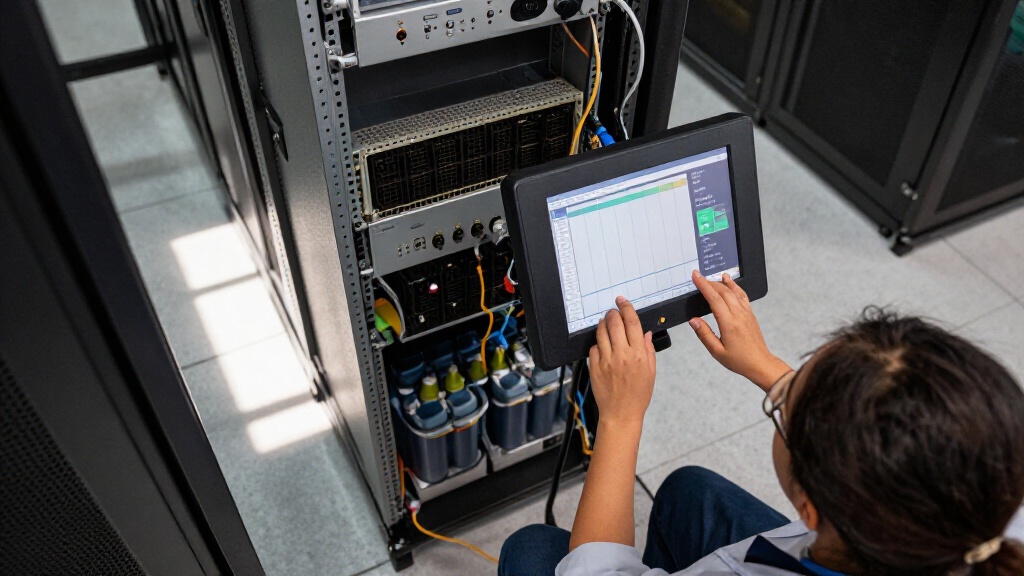
The system, called AI UPS, combines functions of a data center’s uninterruptible power supply (UPS) with those of a grid-scale battery. A conventional UPS keeps servers operating when utility power flickers or fails, but such systems—often using lead-acid batteries—typically sit idle until an emergency. ON.Energy says its lithium-ion system can continuously stand between the grid and the data center, with the aim of supplying stable power to computing equipment and presenting a more manageable load to the grid.
ON.Energy CEO and co-founder Alan Cooper told Canary Media that the system’s development took roughly five years. The company says it uses patented “double-conversion” technology to electrically separate a data center’s equipment from fluctuations in its power source. The National Laboratory of the Rockies, formerly the National Renewable Energy Laboratory, tested the system using a grid simulator at multi-megawatt configurations, according to chief engineer Shahil Shah. The source report says testing concluded earlier this year, but does not publish detailed performance results.
The proposed grid benefit is that a battery could buffer fast changes in data center demand and reduce the risk of a sudden disconnection. Shah said some data center loads can change from 5% to 100% in milliseconds. ON.Energy’s system is also intended to keep a facility from disconnecting in response to power-quality disturbances, which can abruptly remove a large amount of demand from the grid. The company says its approach would make the load appear more predictable to utilities and grid operators.
Buffering Data Centers for the Grid
The development addresses a growing operational challenge as large data centers draw substantial power and their demand can change quickly. Grid operators must keep electricity supply and demand balanced; sudden shifts in load can contribute to voltage or frequency problems. A battery that both supports computing equipment and smooths the facility’s interaction with the grid could offer a way to manage those changes without relying only on backup generators or conventional UPS equipment.
The concept is not yet proof that data centers can routinely act as flexible grid assets. Its importance will depend on performance at commercial scale, reliability, cost and whether operators can make the system worthwhile beyond emergency backup. ON.Energy’s order gives the technology a route toward a larger deployment, but the size of the order alone does not establish how many facilities will use the system or what grid benefits will result.
industrial lithium-ion UPS battery
As an affiliate, we earn on qualifying purchases.
As an affiliate, we earn on qualifying purchases.
Why Data Center Loads Matter
Data centers have long used UPS batteries to keep computing equipment running through brief power interruptions, alongside backup generators for longer outages. Developers have often favored fossil-fuel generation for dependable around-the-clock supply, while batteries can be difficult to justify if they are used only during emergencies. A centralized system that can serve additional purposes may improve the case for investment, but its economics depend on how it is designed and operated.
Grid operators are increasingly focused on large loads that can alter demand rapidly or disconnect unexpectedly. Canary Media reported that PJM Interconnection has recorded several multi-gigawatt data center load drop-offs in recent years, including an incident in July when nearly 4 gigawatts of data center load in Virginia disconnected. That figure describes the reported event; the source does not provide a year or a comparison baseline for it. Shah said operators are developing requirements intended to prevent large loads from harming grid reliability.
ON.Energy is not the only company working on battery systems for this role. Shah said the laboratory is also testing a similar system from Prevalon Energy and other systems whose developers he could not name. The technology is therefore part of a broader effort to adapt grid-scale batteries for the needs of power-intensive computing sites.
“The grid sees a battery that’s always charging, and the load sees a battery that’s always outputting perfect quality power.”
— Alan Cooper, ON.Energy CEO and co-founder
grid-scale battery energy storage system
As an affiliate, we earn on qualifying purchases.
As an affiliate, we earn on qualifying purchases.
Commercial Performance Still Unproven
The laboratory trials are reported as successful, but detailed test results, operating data and independent performance measures are not included in the source material. It is not clear when the Crusoe deployment will begin, how the 5-gigawatt order is structured, or how much battery capacity will be installed at each site. The order should not be read as confirmation that the system is already operating at that scale.
Costs, expected savings and any revenues from grid services are also not specified. The source report says data centers must be designed in advance to use ON.Energy’s centralized system, which may limit retrofits. It remains to be seen whether the technology can meet data center reliability needs while delivering measurable benefits to grid operators under real-world conditions.
data center uninterruptible power supply
As an affiliate, we earn on qualifying purchases.
As an affiliate, we earn on qualifying purchases.
Crusoe Deployment Will Test Scale
The next reported milestone is a commercial-scale test tied to Crusoe’s 5-gigawatt order. ON.Energy says the data center must be planned to accommodate the centralized batteries; the source report describes a Crusoe campus under construction where a newer building has reserved space for the system. No commissioning date, site capacity or installation schedule is given.
Evidence from deployment will help establish whether the system can maintain power quality for computing equipment, respond reliably to grid events and justify its cost. Further details from ON.Energy, Crusoe or the laboratory about installation timing and measured results would clarify how the technology performs beyond controlled testing.
multi-megawatt battery backup system
As an affiliate, we earn on qualifying purchases.
As an affiliate, we earn on qualifying purchases.
Key Questions
What is ON.Energy’s AI UPS?
It is a proposed centralized lithium-ion battery system that combines data center UPS functions with grid-scale battery storage. ON.Energy says it is designed to supply stable power to computing equipment while smoothing the facility’s interaction with the grid.
Did the system complete testing?
According to the source report, ON.Energy concluded multi-megawatt trials at the National Laboratory of the Rockies earlier this year. Detailed performance results are not provided in the report.
What does the 5-gigawatt Crusoe order mean?
ON.Energy is preparing to test the technology at commercial scale under an order from data center developer Crusoe. The source does not explain the order’s structure, deployment schedule or how much capacity will be installed first.
How could batteries help grid reliability?
The system is intended to buffer rapid changes in a data center’s electricity use and reduce abrupt disconnections that can shift demand suddenly. Whether it delivers that benefit reliably at operating sites remains to be demonstrated.
Source: rss
Halloween Picks
halloween
As an affiliate, we earn on qualifying purchases.