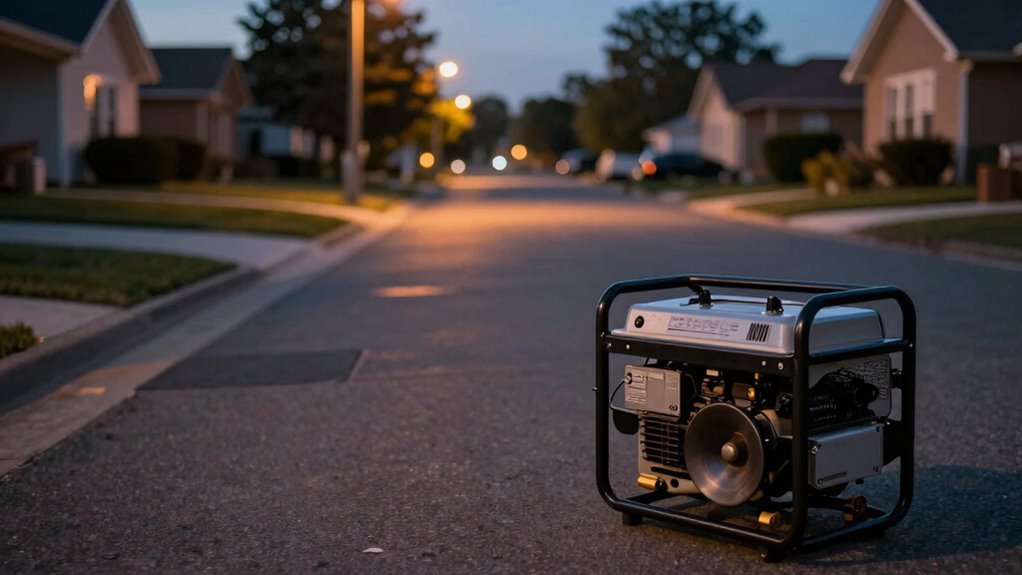

As you move away from a generator, its perceived loudness decreases because sound waves spread out and lose energy. Typically, noise drops by about 6 dB with each doubling of distance in open air, so at 4 meters, the loudness can be half of what it is at 1 meter. Environment and obstacles also affect how sound diminishes. Keep exploring to understand how different factors influence noise levels and improve your setup.
Play games included with Prime
Start a Prime free trial and play with Amazon Luna on your devices.
As an affiliate, we earn on qualifying purchases.
Key Takeaways
- Noise levels typically decrease by about 6 dB with each doubling of distance in open environments.
- Moving the generator farther away reduces perceived loudness due to sound wave dispersion.
- Environmental factors like walls and reflective surfaces can influence how loudness diminishes over distance.
- Open spaces promote faster noise attenuation compared to enclosed or reflective environments.
- Perceived loudness diminishes significantly as the distance from the source increases.
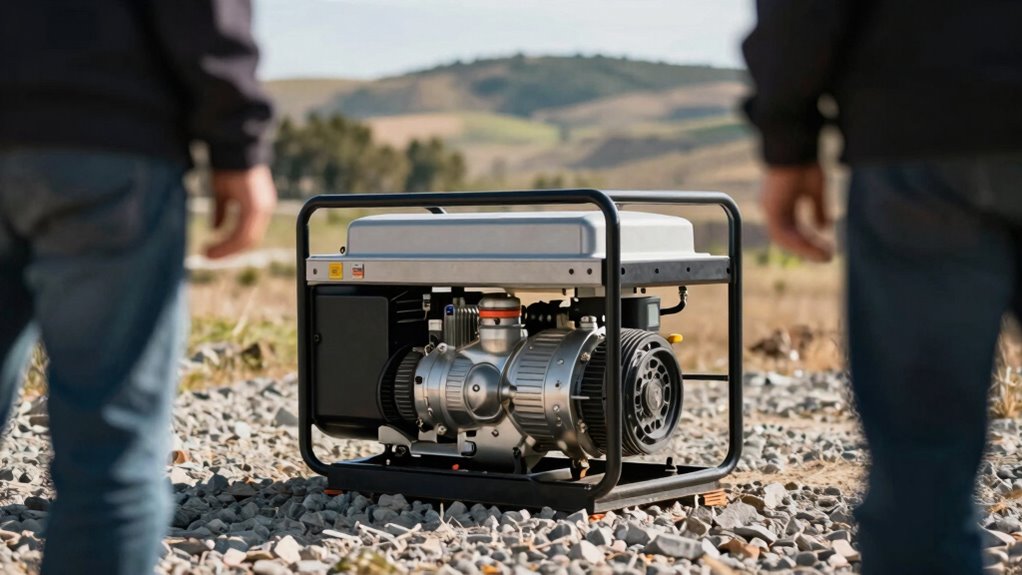
When evaluating the noise level of a generator, it’s important to understand how its perceived loudness changes with distance. As you move farther away, the sound waves produced by the generator undergo noise attenuation, which reduces the overall loudness you perceive. This phenomenon occurs because sound waves spread out and lose energy as they travel through the air, making the generator seem quieter the further you stand from it. Recognizing this relationship helps you gauge how loud a generator truly is in different settings, especially when considering noise ordinances or comfort levels.
Your sound perception is directly influenced by the distance from the source, but it’s not just a simple matter of “further equals quieter.” The rate at which noise attenuation occurs depends on several factors, including the environment and the frequency of the sound. Open spaces, like fields or yards, typically allow sound to disperse more freely, resulting in faster noise attenuation. Conversely, enclosed or reflective environments, such as inside buildings or near walls, can reflect sound waves, causing echoes that may make the generator seem louder even at greater distances. Hence, the environment plays a vital role in how you perceive noise levels over distance. Additionally, understanding how sound frequency affects noise attenuation can provide more precise estimates of perceived loudness at various distances. It’s also helpful to consider sound absorption, which can significantly influence how sound travels in different environments. Factors like air temperature and humidity can also impact sound propagation, further complicating the perception of noise levels. Knowing about acoustical properties can help you better predict how sound behaves in specific settings.
Environment and sound frequency significantly influence how noise diminishes over distance.
Understanding how noise attenuation works can help you better estimate at what point the generator’s noise becomes acceptable or negligible. For example, if a generator produces 70 decibels at 1 meter, moving just a few meters away can noticeably decrease the perceived loudness—often by about 6 decibels per doubling of distance in open air. This means that at 4 meters, the noise might be perceived as roughly half as loud. However, this rule of thumb can vary based on environmental factors, emphasizing the importance of considering surroundings when assessing perceived generator loudness. Planning your setup with these acoustical principles in mind can greatly improve your comfort and compliance with local noise standards.
generator noise reduction muffler
As an affiliate, we earn on qualifying purchases.
As an affiliate, we earn on qualifying purchases.
Frequently Asked Questions
How Does Ambient Noise Affect Perceived Generator Loudness?
Ambient noise can considerably reduce how loud a generator seems, thanks to sound masking from surrounding sounds. When there’s steady background noise, your ears interpret the generator as quieter. Acoustic barriers also help by blocking sound waves, further decreasing perceived loudness. You should consider both sound masking and acoustic barriers to effectively minimize generator noise, especially in residential or sensitive areas, making the noise less noticeable and more tolerable.
Does Generator Size Influence Perceived Loudness at Various Distances?
Generator size does influence perceived loudness at various distances, especially when considering placement and sound insulation. Larger generators tend to produce more noise, but proper placement away from your living area can reduce perceived loudness. Using sound insulation around the generator further dampens noise. By strategically positioning your generator and adding insulation, you can minimize loudness perception, even with a bigger model, ensuring quieter operation at different distances.
How Do Different Terrain Types Impact Sound Perception?
Different terrain types markedly impact sound perception through terrain acoustics and sound attenuation. Open fields allow sound to travel farther with minimal attenuation, making generators seem louder at a distance. Conversely, dense forests or hilly areas cause more sound absorption and scattering, reducing perceived loudness. You’ll notice that rugged or uneven terrain diminishes sound more quickly, while flat, open areas amplify how far generator noise travels.
Can Weather Conditions Alter Perceived Generator Noise Levels?
Weather conditions can definitely change how loud a generator sounds. Wind, humidity, and rain can carry noise further or muffle it, making it seem louder or quieter. You should consider generator placement and noise mitigation strategies, especially in windy or damp conditions. When the weather shifts, it’s like trying to hear a whisper in a storm—adjusting your setup helps keep noise levels manageable and predictable.
What Role Does Sound Frequency Play in Loudness Perception?
Sound frequency markedly influences loudness perception because of how your ears process different pitches. Higher frequencies, or pitch perception, often seem louder at the same volume due to frequency modulation effects, especially in certain environments. When you encounter a generator, its sound’s frequency range can make it feel louder or softer, regardless of actual decibel levels. Understanding this helps explain why some noises seem more intrusive than others, even if they’re technically quieter.
portable sound barrier for generators
As an affiliate, we earn on qualifying purchases.
As an affiliate, we earn on qualifying purchases.
Conclusion
As you step back from the generator, its roar becomes a distant thunder, fading into a whisper of power. Distance acts like an artist’s brush, softening the raw intensity into a gentle hum that’s easier on your ears. Just like a lighthouse’s beam dims as you drift away, the closer you stand, the louder it screams—reminding you that perception is a dance between sound and space. So, keep your distance and enjoy the quiet symphony of safety.
outdoor generator soundproof enclosure
As an affiliate, we earn on qualifying purchases.
As an affiliate, we earn on qualifying purchases.
As an affiliate, we earn on qualifying purchases.
Fall Picks
fall essentials
As an affiliate, we earn on qualifying purchases.