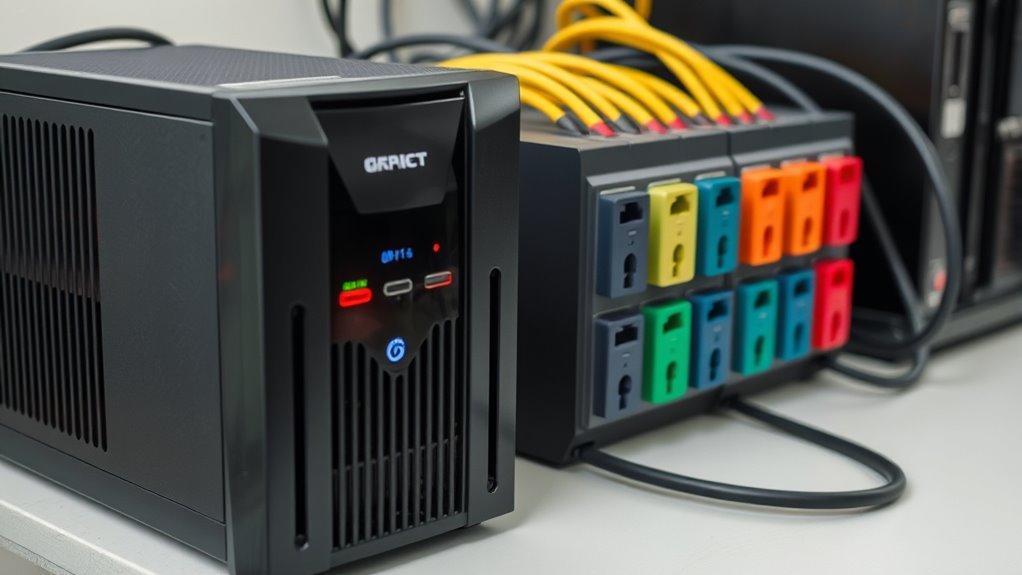

When choosing UPS and surge protectors based on your generator’s output, actively match their watt ratings to prevent overload or insufficient backup. Confirm your surge protectors have high joule ratings to handle voltage spikes during generator startup, and select a UPS that can support your critical devices for the needed backup time. Proper matching maintains system stability and safeguards your electronics. Keep going to discover more tips on optimizing your power setup effectively.

Get backup power and energy gear delivered free — and shop member deals
- Fast, free delivery on millions of items
- Access to Prime Big Deal Days deals on October 6–7
- Prime Video, Amazon Music and more included
Key Takeaways
- Match UPS wattage closely with generator output to prevent overload or insufficient backup during power outages.
- Choose surge protectors with high joule ratings that can handle voltage spikes during generator startup.
- Ensure UPS battery capacity supports critical devices for the required backup duration aligned with generator capacity.
- Verify surge protector compatibility with generator’s waveform and voltage fluctuations to maintain system stability.
- Balance generator output, UPS capacity, and surge protection to optimize overall system safety and power quality.

Are you wondering how to choose the right UPS and surge protectors to keep your electronics safe? If you’re relying on a generator as your backup power source, understanding how your generator’s output interacts with your surge protection mechanisms and battery backup is essential. The key is to match your UPS and surge protectors to your generator’s capacity, making sure your devices stay protected without overloading the system.
First, consider the power output of your generator. Generators are rated in watts, which indicates the maximum load they can sustain. When selecting a UPS, you need to confirm its power capacity aligns with your generator’s output. If the UPS’s wattage exceeds what your generator can provide, you risk overloading the system, leading to potential failures or damage. Conversely, choosing a UPS with too low a capacity can cause it to trip or fail during a power outage. Check the surge protection mechanisms of your UPS and surge protectors, making sure they are rated to handle the kind of surges your equipment might face, especially during generator startup, which can produce power spikes. High-quality surge protection mechanisms can absorb or divert sudden voltage spikes, shielding your electronics from damage.
Ensure your UPS wattage matches your generator’s output to prevent overloads and protect your electronics.
Your battery backup plays an important role when you’re using a generator. During a power outage, the battery backup kicks in to provide immediate power, giving you time to save work or shut down devices safely. When pairing your UPS with a generator, ensure the battery backup has enough capacity to handle your critical devices for the duration you need. Keep in mind that some surge protectors are built into UPS units, offering combined protection. These integrated systems are advantageous because they provide both surge protection mechanisms and battery backup in one unit, simplifying your setup. However, verify that their surge protection ratings are suitable for your environment; cheap or outdated surge protectors may not withstand voltage spikes caused by generator startup, risking damage to your equipment.
Finally, consider the quality and compatibility of your surge protectors. Not all surge protection mechanisms are created equal—look for units with a high joule rating, indicating better protection capacity. When your generator is running, transient surges can occur, and a reliable surge protector will prevent these spikes from reaching your sensitive electronics. Be sure that your surge protectors and UPS units are compatible with generator power, especially in terms of wave form and voltage regulation. Proper matching ensures your setup remains stable, and your electronics stay protected, even during fluctuations caused by generator startup or shutdown. Additionally, understanding the power quality of your electrical system can help you select the most appropriate surge protection and UPS options for optimal safety and performance. By paying close attention to generator output, surge protection mechanisms, and battery backup capacity, you can create a resilient system that safeguards your electronics effectively during power disruptions.
UPS with 1000W capacity for generator backup
As an affiliate, we earn on qualifying purchases.
As an affiliate, we earn on qualifying purchases.
Frequently Asked Questions
How Do Generator Surges Affect Sensitive Electronic Equipment?
Generator surges can considerably impact your sensitive electronic equipment by causing power quality issues. These sudden voltage spikes can damage components, lead to data loss, or shorten equipment lifespan. To guarantee proper equipment protection, you should use surge protectors designed for generator use. This helps filter out surges, maintains stable power delivery, and keeps your electronics safe from unexpected voltage fluctuations. Proper protection is key to avoiding costly repairs and data errors.
Can a UPS Protect Against Power Fluctuations During Generator Startup?
Imagine your data center experiences a sudden voltage spike during generator startup. A UPS can protect against power fluctuations by providing clean, stable power, guaranteeing your equipment remains safe. It improves power quality and helps prevent damage. Just make certain your UPS is compatible with your generator’s power profile; otherwise, it might not respond effectively. So, yes, a UPS can safeguard your equipment during startup if chosen correctly for compatibility.
What Is the Ideal UPS Capacity for a Generator-Based System?
You should choose an UPS with at least 20-30% more capacity than your total load to handle generator startup surges. Make certain it has compatible batteries and outlet configurations that match your equipment. This way, you prevent overloads, maintain power stability, and protect your devices during generator operation. Always verify that the UPS’s battery compatibility aligns with your system, and that outlet arrangements support your setup for seamless backup performance.
Are Surge Protectors Necessary if I Have a Generator?
Did you know 60% of power surges happen indoors? Surge protectors are still essential, even if you have a generator. Many believe surge protector myths, like thinking generators prevent surges, but they don’t. Proper generator maintenance helps, but surge protectors shield your devices from unexpected power spikes. Protect your electronics reliably by using surge protectors, regardless of your generator, ensuring your equipment stays safe from damaging surges.
How Does Generator Size Influence UPS Selection?
Your generator size directly impacts your UPS choice by affecting power compatibility and efficiency. If your generator has higher capacity, it can support a more powerful UPS that handles larger loads smoothly. Conversely, a smaller generator might require a lower-capacity UPS to prevent overloads. Ensuring your generator’s efficiency aligns with the UPS’s power requirements is key to maintaining reliable backup power during outages and avoiding system failures.
high joule surge protector for generator startup
As an affiliate, we earn on qualifying purchases.
As an affiliate, we earn on qualifying purchases.
Conclusion
Now that you know how to match your UPS and surge protectors to your generator’s output, you’re like a captain steering a sturdy ship through stormy seas. With the right gear, your devices stay safe and powered, riding out any electrical turbulence. Think of it as planting a strong anchor—keeping everything grounded and secure. So, set sail with confidence, knowing your setup is ready to weather any power surge or outage that comes your way.
battery backup UPS for critical electronics
As an affiliate, we earn on qualifying purchases.
As an affiliate, we earn on qualifying purchases.
surge protector compatible with generator waveform
As an affiliate, we earn on qualifying purchases.
As an affiliate, we earn on qualifying purchases.
Fall Picks
fall essentials
As an affiliate, we earn on qualifying purchases.