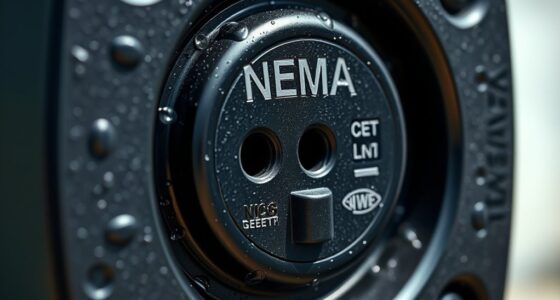
NEMA outlets are designed to guarantee safe and proper connections for various devices. The NEMA 5-15R is the most common household outlet, with two vertical slots and a grounding hole, suitable for everyday appliances. The NEMA 5-20R looks similar but handles higher current loads up to 20 amps, while the Tt-30R is used mainly for RVs and rated for 30 amps, featuring a different configuration. Understanding these differences helps you choose the right outlet—keep going to learn more about their features and uses.

Get backup power and energy gear delivered free with Prime
- Fast, free delivery on millions of items
- Prime Video, Amazon Music and more included
- Member-only deals all year
Key Takeaways
- NEMA 5-15R outlets are standard household sockets rated for 15 amps, with two vertical slots and a grounding hole.
- NEMA 5-20R outlets are similar but designed to handle higher loads up to 20 amps, with a different neutral slot shape.
- NEMA TT-30R outlets are specialized for recreational vehicles, rated for 30 amps, and have a unique configuration for heavy-duty use.
- Proper grounding and matching device ratings are essential for safety and compatibility across all NEMA outlet types.
- Understanding outlet differences ensures correct installation, prevents hazards, and supports proper appliance functioning.

Have you ever wondered what the different NEMA outlet types mean and how they impact your electrical connections? Understanding these outlets is essential for guaranteeing safety, functionality, and proper compatibility in your home or workspace. NEMA outlets are standardized connectors designed to meet specific electrical needs, and each type has unique features related to grounding requirements and compatibility considerations. Recognizing these differences helps you select the right outlet for your equipment and avoid potential hazards.
Understanding NEMA outlet types ensures safety, compatibility, and proper electrical connections in your home or workspace.
Take the NEMA 5-15R, for example. This is the most common household outlet in North America. It features two vertical slots and a round grounding hole, making it straightforward to connect standard appliances and electronics. The grounding pin is a critical safety feature, providing a path to ground in case of a fault. When installing or replacing a 5-15R, you need to guarantee that your wiring system includes proper grounding to meet electrical codes and safety standards. Compatibility considerations are simple here—most standard three-prong plugs will fit, but you should always verify that your device’s plug matches the outlet’s configuration to prevent loose connections or incompatible fittings.
Moving up, the NEMA 5-20R looks similar but has a slight difference in the shape of the neutral slot. It’s designed to handle higher current loads—up to 20 amps—compared to the 15-amp capacity of the 5-15R. When considering grounding requirements, the 5-20R still maintains the grounding pin, guaranteeing safety isn’t compromised. However, compatibility considerations become more critical: you’ll need to guarantee your appliances or equipment are rated for the higher current and that your wiring system can support it. Using a 5-20R with a device only rated for 15 amps can be dangerous, so always check your device specifications and consult an electrician if unsure.
Then there’s the NEMA TT-30R, used mainly for recreational vehicles and certain appliances. This outlet also includes a grounding pin and is designed for 30-amp connections. Its configuration differs significantly from the standard household outlets, so compatibility considerations are crucial. You can’t just plug a standard device into it; instead, you’ll need compatible plugs and cords rated for 30 amps. Proper grounding is equally vital here—an inadequate grounding setup could lead to electrical shocks or equipment damage. Before installing or using a TT-30R outlet, verify that your wiring can handle the current load and that your devices are compatible to prevent overloads or safety hazards.
As an affiliate, we earn on qualifying purchases.
Frequently Asked Questions
Can NEMA Outlets Be Used Internationally?
NEMA outlets aren’t typically compatible internationally because they’re designed for specific voltage standards and plug types used mainly in North America. If you want to use them abroad, you’ll need an appropriate adapter and possibly a voltage converter to match the local standards. Always check the electrical requirements and compatibility to avoid damage or safety issues when using NEMA outlets outside their intended region.
Are NEMA 5‑20r Outlets Compatible With 15‑Amp Plugs?
This is as simple as a breeze—you can’t plug a 15-amp plug into a NEMA 5-20r outlet without risking damage. NEMA 5‑20r outlets are specifically designed for 20-amp plugs, with different outlet specifications that prevent compatibility with standard 15-amp plugs. Always check plug compatibility to guarantee safety and proper functioning, because forcing a plug can cause electrical hazards and damage your equipment.
How Do I Identify the Correct NEMA Outlet for My Appliance?
To identify the correct NEMA outlet for your appliance, start by checking the plug’s configuration and amperage rating. Look at the shape, slot arrangement, and if it’s a 15 or 20-amp plug, as this determines outlet compatibility. Match the plug with outlets like NEMA 5‑15r for 15 amps or NEMA 5‑20r for 20 amps. Always verify the outlet fits your plug for safe, proper operation.
Are NEMA Outlets Weatherproof for Outdoor Use?
Did you know that only about 30% of NEMA outlets are designed for outdoor use? Weatherproof design is essential for outdoor suitability, ensuring safety and durability. Most standard NEMA outlets aren’t weatherproof and need special covers or enclosures. When choosing an outlet for outdoor use, verify it’s rated for weatherproof application to prevent moisture damage, electrical shorts, or hazards. Always select outlets specifically labeled for outdoor, weatherproof use for safety and longevity.
What Safety Features Are Integrated Into NEMA 5‑20r Outlets?
NEMA 5-20R outlets include safety features like grounding safety, which prevents electrical shocks by safely directing stray current to the ground. They also have overload protection, ensuring the outlet can handle only a specific current limit, reducing the risk of overheating or fires. These features help protect both your equipment and yourself during use, making the outlet safer for various electrical needs.
As an affiliate, we earn on qualifying purchases.
Conclusion
Now that you know the differences between NEMA 5-15R, 5-20R, and TT-30R outlets, you’re better equipped to choose the right one for your needs. Think of these outlets like tools in your toolbox—each has a specific job to do. By understanding their features, you can guarantee safety and compatibility. With this knowledge, you’ll handle electrical setups confidently, like a pro steering a familiar path.
As an affiliate, we earn on qualifying purchases.
As an affiliate, we earn on qualifying purchases.
Halloween Picks
halloween
As an affiliate, we earn on qualifying purchases.