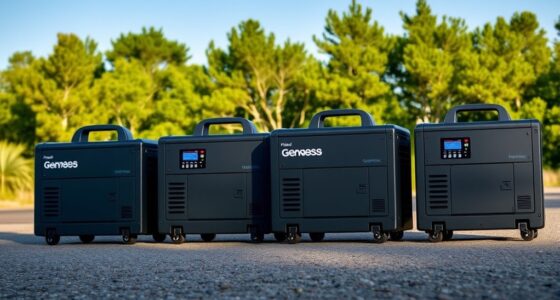
This checklist is for homeowners planning a home battery system for solar use, backup power, or both. It covers the major components to evaluate, while noting where a product’s name alone does not establish whether it will work with your existing equipment.

Get backup power and energy gear delivered free with Prime
- Fast, free delivery on millions of items
- Prime Video, Amazon Music and more included
- Member-only deals all year
The sections follow the path from storage and power conversion to transfer, cabling, mounting, and monitoring. Each pick is considered for its intended role; the product name is not a substitute for checking its specifications or installation requirements.
Before buying, record your inverter model, battery voltage and chemistry, expected loads, and installation location. Use that information to check compatibility and capacity with the product documentation, and consult a qualified installer for electrical design and code requirements.
Modular Home Battery
A battery module is the heart of a storage setup, so the key question is not simply whether a listing says “10kWh.” Confirm the unit’s usable capacity, nominal and operating voltage, chemistry, continuous and peak current limits, cycle information, and permitted charging conditions. The pick is named “51.2V 200Ah Battery Module Rack Mount Home Storage 10kWh”; those figures and terms should be verified in its documentation rather than treated as a complete specification.
A common mistake is buying a battery before confirming that the inverter supports its chemistry, voltage range, and communications method. Check whether the system requires a battery-management connection, specific firmware, or a particular number of modules, and verify how expansion is allowed. Also confirm the physical dimensions, weight, terminal layout, enclosure clearances, and any included mounting hardware. “Rack mount” does not by itself establish that a module fits a particular rack or can be safely stacked.
Plan capacity around the loads you actually need to support and the duration you want, then have an installer check the system’s current limits and protection requirements. Confirm the manufacturer’s installation instructions and warranty terms before purchase. Compatibility first is the practical rule: a battery that cannot safely communicate with or supply the chosen inverter is not a useful match, regardless of its stated capacity.
What to look for:
- Verified battery chemistry, nominal voltage, and operating voltage range
- Usable capacity and continuous and peak current limits
- Inverter compatibility, communications requirements, and expansion rules
- Dimensions, weight, terminal arrangement, and approved mounting method
- Installation instructions, required protection, and warranty terms
51.2V 200Ah Battery Module Rack Mount Home Storage 10kWh

This rack-mounted home energy storage system provides 10.24kWh of usable capacity with Grade-A cells and a lifespan exceeding 10 years. Its modular design allows capacity expansion up to over 150kWh, and it features an intelligent BMS for protection and seamless inverter integration, making it ideal for solar storage and backup power.
Pros:
- High-capacity, scalable energy storage solution
- Long lifespan with over 6000 cycles
- Supports easy expansion and quick installation
- Built-in protection and real-time monitoring
Cons:
- Requires compatible inverter for full functionality
- Heavy and may need professional installation
- Limited detailed user interface information
Best for: Homeowners comparing rack-mount battery storage for a planned system
Not ideal for: Buyers who cannot confirm inverter compatibility or installation requirements
Bottom line: Treat the stated capacity as a starting point and verify the full electrical and physical specifications before purchasing.
Battery Inverter
The pick listed for this section is “Battery Storage Organizer AA & AAA Combo (Black)”. Its name describes an organizer for AA and AAA batteries, not a battery inverter. An inverter is the component that converts battery power for compatible electrical loads, so do not assume this item can serve that role. The first buying step is to confirm that the product listing matches the component you need.
For an actual battery inverter, evaluate its supported battery voltage and chemistry, output type, continuous and surge capacity, charging functions, and compatibility with the battery’s management system. Check whether it is designed for grid interaction, backup operation, or off-grid use, as applicable to your project. Confirm that its output and connection requirements fit the loads and electrical design, and that its installation instructions align with your site and local requirements. Avoid selecting an inverter based only on a broad label such as “solar” or “battery.”
If you are considering the named AA/AAA organizer for household cells, check its dimensions, capacity, and whether it suits the batteries you intend to store. It should not be treated as a substitute for power-conversion equipment. Resolve the category mismatch before comparing technical details: source the correct inverter listing, then verify it against the battery, transfer equipment, and installer’s system design.
What to look for:
- Confirm the listing is for a battery inverter, not a household battery organizer
- Supported battery voltage and chemistry
- Continuous and surge output ratings suited to planned loads
- Charging, grid, and backup functions required for the system
- Battery-management, wiring, installation, and code compatibility
Battery Storage Organizer AA & AAA Combo (Black)

The NOTMBESTM battery storage organizer provides a first‑in‑first‑out solution for up to 10 AA and 10 AAA batteries, keeping them organized and ready to use. Its wall‑mountable design can be installed with screws or adhesive, and a side window lets you see how many batteries remain.
Pros:
- First‑in‑first‑out design prevents battery leakage and ensures fresh usage.
- Holds up to 10 AA and 10 AAA batteries in separate slots.
- Flexible wall‑mount installation with screws or adhesive.
- Side window shows remaining battery count.
Cons:
- Limited capacity may require multiple units for larger households.
- Plastic construction could be prone to scratching over time.
Best for: Shoppers who need to distinguish household battery storage from inverter equipment
Not ideal for: Anyone seeking an inverter based on this organizer’s product name
Bottom line: The listed AA/AAA organizer is not identified as an inverter, so find and verify the correct inverter before proceeding.
Smart Transfer Switch
A transfer switch manages how selected electrical loads receive power from different sources, making system coordination central to this purchase. The listed pick is the “Generac 400 Amp Automatic Transfer Switch.” Its name gives a brand, product type, and amp figure, but does not establish whether it is suitable for a particular home, service, generator, or battery-backed system. Verify the exact model documentation and intended application.
Common mistakes include treating the amp figure as proof of compatibility, overlooking the service configuration, or assuming any automatic transfer switch will work with any inverter or generator. Check the switch’s voltage, phase, number of poles, service rating, approved source combinations, and control or communication requirements. Confirm which loads it is intended to transfer and whether the proposed setup needs a separate load-management arrangement. Have a qualified electrician assess the panel, service, grounding, and local code requirements before purchase.
Also verify enclosure and mounting requirements, wiring specifications, and whether the product is listed for the intended installation. Make sure the switch’s operating sequence and controls match the rest of the system; a mismatch can prevent the intended backup arrangement from working. Professional confirmation is especially important for service equipment, where product naming alone cannot establish suitability for a specific installation.
What to look for:
- Exact model number and manufacturer documentation
- Voltage, phase, poles, and service rating suited to the installation
- Approved source combinations and control requirements
- Compatibility with the inverter, generator, and intended loads
- Mounting, wiring, listing, and local-code requirements reviewed by an electrician
Generac 400 Amp Automatic Transfer Switch

The Generac 400 Amp Automatic Transfer Switch provides full-load power transfer for large residential or light commercial standby systems. It features automatic operation, integrated load management for HVAC loads, and an expandable system for load prioritization, all housed in a durable NEMA 3R aluminum enclosure suitable for outdoor installation.
Pros:
- Automatic operation ensures seamless power transfer during outages
- Integrated load management for HVAC loads without additional accessories
- Expandable system allows for load prioritization and shedding
- Durable outdoor NEMA 3R aluminum enclosure
Cons:
- Requires professional installation due to complexity
- Limited to single-phase 120/240V systems
- No mention of smart home integration beyond Wi-Fi control
Best for: Projects that require an automatic source-transfer component
Not ideal for: Installations without an electrician’s review of service and system compatibility
Bottom line: Verify the exact switch specifications and have a qualified electrician confirm that it fits the home’s electrical design.
Battery Cable Set
Battery cables carry substantial current, so choosing by length and gauge alone can leave important questions unanswered. The listed pick is “4/0 Gauge 10 Feet Black + 10 Feet Red Combo Welding Cable – 100% Coppe”. Confirm the complete product description and specifications, including conductor material, insulation, temperature rating, flexibility, and whether the set includes properly sized and installed terminations. Do not infer those details from a truncated listing title.
A frequent mistake is assuming that a cable marketed for welding is automatically suitable for a stationary battery installation. Cable ampacity depends on the installation conditions, including current, run length, ambient temperature, bundling, and applicable electrical rules. The inverter or battery manufacturer may specify minimum cable size, terminal type, fuse placement, and maximum cable length. Check those instructions and have the final selection reviewed for the actual system rather than relying on a general gauge comparison.
Measure the route before ordering, allowing for safe routing and bend radius without leaving unnecessary excess. Confirm the red and black leads reach the correct terminals, and verify connector size and compatibility with the battery and inverter. Also plan appropriate overcurrent protection and secure cable support. Correct terminations and protection matter as much as conductor size; installation should follow the equipment manuals and be completed or reviewed by a qualified professional.
What to look for:
- Verified conductor material, insulation, and temperature rating
- Cable ampacity appropriate to current and installation conditions
- Exact route length, terminal sizes, and connector compatibility
- Manufacturer requirements for cable size, length, and overcurrent protection
- Complete listing details, including what terminations or hardware are included
4/0 Gauge 10 Feet Black + 10 Feet Red Combo Welding Cable – 100% Copper, Extra F

This EWCS combo pack includes two 10-foot lengths of 4/0 gauge welding cable, one black and one red, made from 100% copper for durability and flexibility. Rated for 600 volts and temperatures from -50°C to 105°C, it is suitable for various automotive and industrial applications.
Pros:
- High-quality 100% copper construction for durability
- Flexible and easy to handle
- UV, chemical, and oil resistant insulation
- Suitable for a wide range of automotive and industrial uses
Cons:
- Only includes two cables, limited length for large projects
- Requires proper handling due to high flexibility
Best for: Installers planning short, high-current battery connections
Not ideal for: Buyers relying on gauge and length alone to determine suitability
Bottom line: Confirm the full cable specifications and installation-specific ampacity before connecting a battery system.
Wall-Mounted Battery Rack
No product is listed for this slot, so treat it as installation advice rather than a product recommendation. A wall-mounted battery rack must be selected around the battery manufacturer’s approved mounting method, the battery’s size and weight, and the structure that will carry the load. A rack’s appearance or advertised fit does not prove it is suitable for a particular battery.
Check the battery documentation for permitted orientation, clearances, mounting points, and stacking or spacing limits. Measure the available wall area and confirm access for wiring, inspection, ventilation or other manufacturer-required conditions, and service. A common mistake is choosing a rack before knowing the battery dimensions and terminal location, which can make cable routing awkward or block access. The wall and fasteners must also be appropriate for the combined installed load, with the attachment method confirmed by a qualified installer.
Consider whether a floor-supported rack or another approved mounting arrangement is more appropriate for the battery and building. Do not modify an enclosure or rely on generic shelving unless the manufacturer and installer confirm that the arrangement is acceptable. Plan for cable strain relief, separation from hazards, and safe access to disconnects and protective equipment. Follow the battery manual and applicable local requirements; mounting advice cannot replace a site-specific structural and electrical assessment.
What to look for:
- Battery-manufacturer approval for the mounting method and orientation
- Rack dimensions, supported load, and compatibility with battery mounting points
- Wall construction, attachment method, and installer assessment of the load
- Required clearances and practical access for wiring and service
- Safe routing, cable support, and access to disconnects and protection
Battery Monitor
A battery monitor can help track system operation, but the right choice depends on what it measures and how it connects. The listed pick is “Victron Energy BMV-712 Smart Battery Monitor with Shunt 6.5-70 VDC.” Confirm the full manufacturer specifications, supported voltage range, shunt rating, display and communication features, and compatibility with the battery system. The product name provides a stated voltage span, but does not establish that the monitor supports every battery chemistry or system configuration.
One common mistake is assuming that adding a monitor automatically provides accurate battery state information. The shunt must be installed in the correct position so the relevant current passes through it, and its rating must suit the system. Check the monitor’s setup requirements, wiring instructions, supported communications, and any settings that must be configured for the battery. Confirm that the display or app features you need are available and that the installation does not conflict with battery-management equipment.
Think through who will install and configure the shunt, where the display or communications equipment will be located, and how the wiring will be routed and protected. Follow the battery and monitor manuals, and have a qualified installer review the setup if you are unsure. Measurement depends on installation: confirm shunt placement and configuration rather than treating the product name as a guarantee of accurate readings.
What to look for:
- Manufacturer-verified voltage range and shunt current rating
- Compatibility with the battery chemistry and system configuration
- Correct shunt placement and clear installation instructions
- Required setup, communications, and display or app functionality
- Wiring, protection, and access requirements for the planned location
Victron Energy BMV-712 Smart Battery Monitor with Shunt 6.5-70 VDC
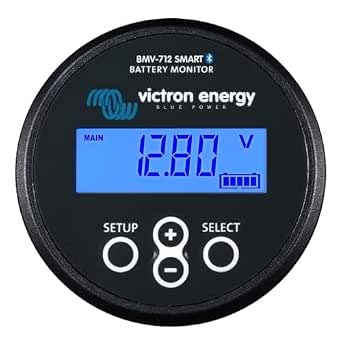
The Victron Energy BMV-712 is a comprehensive battery monitor designed for systems with voltages from 6.5 to 70 VDC. It features Bluetooth connectivity, an additional input for measuring temperature or voltage, and a display showing key parameters like State of Charge, Voltage, and Current.
Pros:
- Wireless Bluetooth monitoring via smartphones and tablets
- Displays comprehensive battery data including State of Charge and energy remaining
- Additional input options for versatile measurement
Cons:
- Requires professional installation due to high voltage and safety concerns
- Additional components like GX device and VE.Direct cable sold separately
Best for: Homeowners seeking battery-system monitoring with a shunt
Not ideal for: Systems whose voltage, current, or communications requirements are unverified
Bottom line: Confirm the monitor’s ratings and installation details, especially shunt sizing and placement, before integrating it.
For a budget-first buying order, start by documenting the loads and confirming the battery-inverter match before purchasing hardware. Next, verify the transfer equipment and required protection, then size cables and mounting around the approved system design. Add monitoring after confirming the shunt and configuration requirements. Buy in dependency order so each component is selected for the system it must work with.
Use product manuals and qualified professional advice to resolve specifications that a product name cannot answer. If a listing does not clearly identify the component or its compatibility, pause and clarify it before ordering. A careful checklist can make the project easier to plan and help keep safety and fit at the center of every decision.